
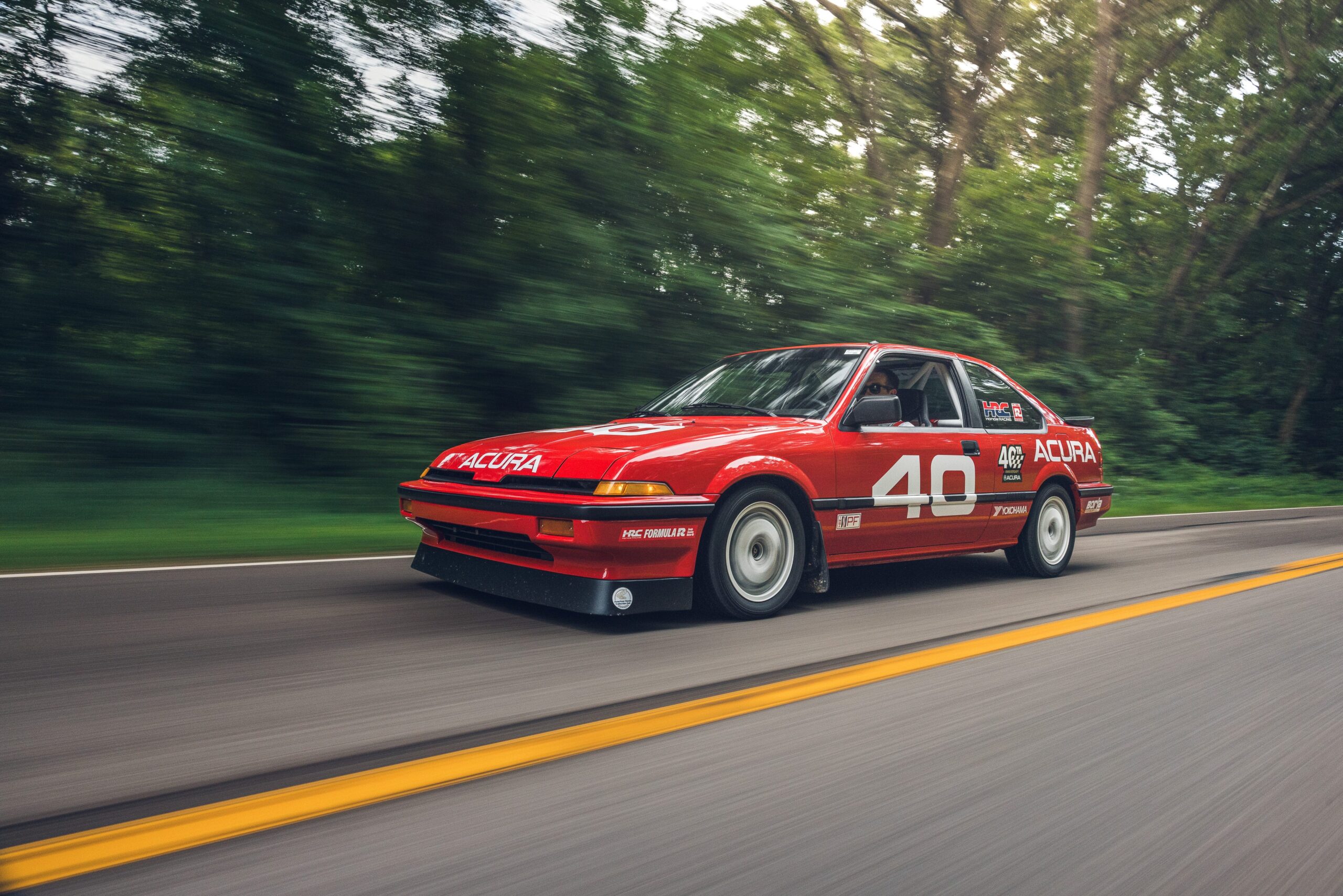


Two thousand one hundred fifty-two pounds. That’s what Acura’s Integra 40 Racer weighed when Car and Driver hoisted it onto their scales in Ann Arbor — roughly half a modern Integra Type S. In a single number, the entire arc of 40 years of automotive progress, and automotive bloat, snaps into focus.
Acura could have marked its 40th anniversary with a museum-piece Legend sedan or a corporate cocktail party. Instead, someone inside Honda’s luxury division made the rare and correct decision to build a stripped-down race car from a 1987 Integra RS. That’s the same platform that won back-to-back IMSA International Sedan Series championships in ’87 and ’88.
The result is a love letter written in cable-throttle linkages, manual steering racks, and a 1.6-liter dual-cam inline-four punching out 155 horsepower through a transmission smoothed by Synchrotech internals. No power steering, no brake booster, no ABS, and a physical ignition key. The only concession to the 21st century is a coil-on-plug ignition upgrade replacing the original distributor.
What makes this build interesting isn’t just what Acura left out — it’s what the company chose to put in. Rather than raiding its own OEM parts bins, Acura sourced components from aftermarket brands that import-scene enthusiasts actually use: TEIN suspension, a Torsen limited-slip differential, Yokohama ADVAN A050 tires on 14-inch Mugen wheels, a Honed Developments clutch and brake-booster delete kit, an OMP racing harness. This is a car built by people who know the culture, not by a marketing department reading a brief about it.
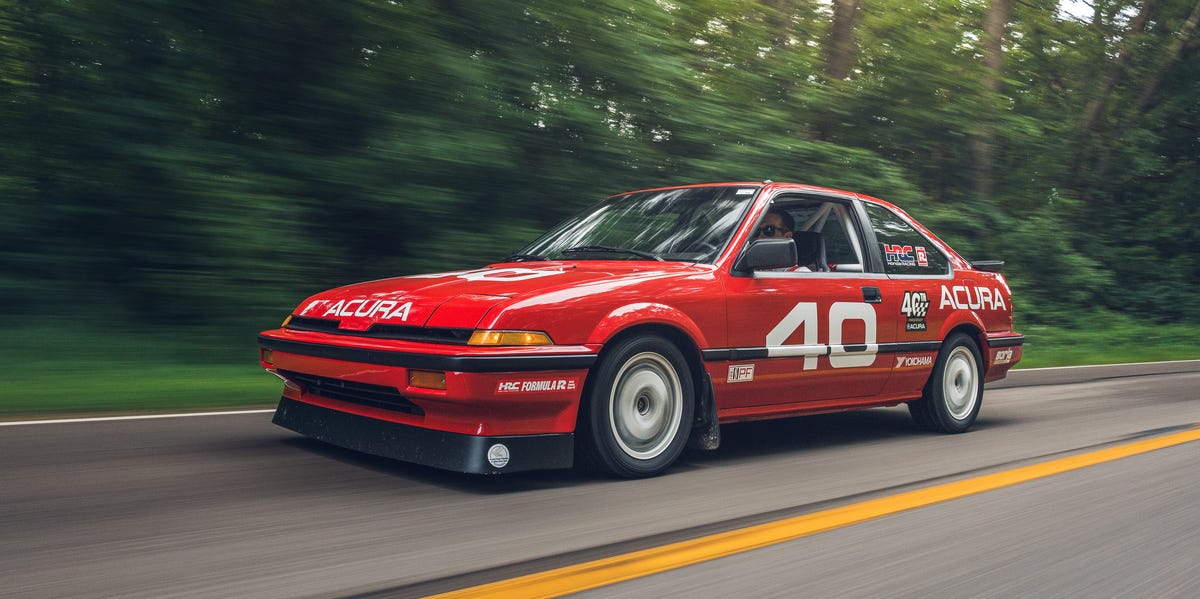
Car and Driver’s Michael Simari, who owns a 1998 Integra GS-R track car, drove the 40 Racer on the magazine’s 10Best evaluation loop. The same loop, coincidentally, where an Integra earned a 10Best trophy in 1987. His report reads like a man reconnecting with a first love who hasn’t aged: flat on the throttle through corners at speeds that felt ludicrous but barely registered on the speedometer, neutral handling from the TEIN setup, shifts that felt smoother and more direct than any 38-year-old transmission has a right to feel.
The timing of the car’s arrival carried its own poetry. It showed up at Car and Driver’s headquarters just as the magazine’s long-term 2024 Integra Type S crossed 40,000 miles. Parking the two side by side told a story no press release could.
The ’87 weighs 2152 pounds and makes 155 horsepower. The modern Type S tips 3217 pounds and produces 320 horsepower. One is raw, transparent, and analog. The other is fast, refined, and digitally managed to within an inch of its life.
The Integra nameplate has always punched above its weight — literally and figuratively. From those IMSA titles through six straight SCCA World Challenge Touring Car championships with RealTime Racing from 1997 to 2002, the car earned a credibility in motorsport that most compact-car nameplates never sniff. Acura eventually climbed all the way to Le Mans, but the Integra is where the belief started.
Building a race car out of a nearly four-decade-old chassis isn’t a business strategy. It doesn’t move metal off dealer lots or boost quarterly earnings calls. It does something harder to quantify and more valuable in the long run: it tells the people who loved your cars before they were cool, and who kept loving them after everyone else moved on, that you remember them.
The Integra 40 Racer weighs barely more than a ton and carries the full weight of a brand’s identity. For a company navigating an electrified future — where even the Corvette ZR1X has a front-mounted electric motor making more power than this entire car — that kind of anchor to the past isn’t nostalgia. It’s a compass.


Share this Story