
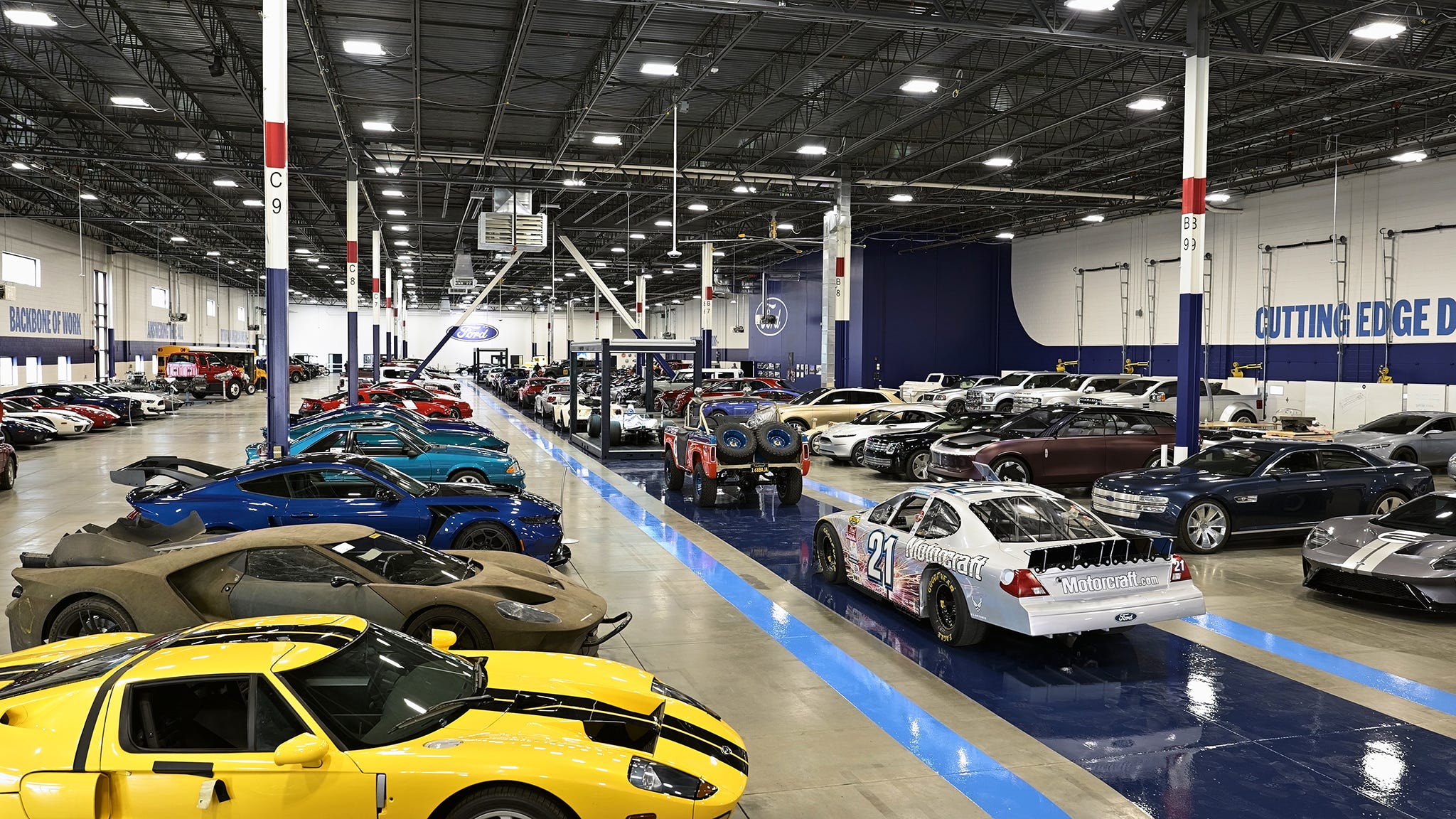


Ford’s corporate memory now lives in a former Amazon fulfillment center. The building that once moved packages by the hour now holds the company’s Heritage Fleet, and for now, almost nobody is allowed inside.
The collection first appeared in March 2025, crammed into a dingy parking garage beneath the old Glass House headquarters. It has since moved into a space Ford calls the Vault, which is finally big enough to show the cars properly.
Public visits are on hold while Ford works through permits and paperwork. No opening date has been given.
Ford says the fleet has a job. It helps the company’s brands tell their stories and gives development engineers historical context for the products on their desks. These are working reference cars, not trophies.
Some of them never worked at all.
Take the 1963 Cougar II. Early in Ford’s partnership with Carroll Shelby and AC Cars, Dearborn toyed with a Corvette-killer built on the AC Cobra platform.
Chassis CSX2008, with a 260 V-8 and a four-speed manual, got a fiberglass body and a name. The ambition was real. The stainless center roof section lifted off, and the body carried pressure-relief gates designed to open if cabin pressure climbed 15 psi above atmospheric.
Ford VP of styling Eugene Bordinat and designer McKinley Thompson Jr. drew the shape. It toured with Ford’s X-Car group at the New York World’s Fair and the Chicago Auto Show.
Then the accountants weighed in and ruled it too expensive to build. There was also a more basic problem.
The footbox sat too close to the engine, which left the Corvette-killer undrivable. Its most successful afterlife was as a 1:25-scale model kit. The car itself is on loan from the Detroit Historical Society.
Its convertible sibling did better on the road, if only on private pavement. The 1963 XD Cobra, known as the Bordinat Cobra, rode on chassis CSX3001. That chassis was designated a big-block car but shipped without an engine.
Ford’s Corporate Projects Design Office used it as a rolling showcase for Royalex, a lightweight thermoformed ABS plastic from Uniroyal. The planned 427 never stayed. A high-performance 289 and an automatic took its place early on.
It was never licensed for public roads. Bordinat drove it plenty anyway, inside the Dearborn Proving Grounds.
The details show how concept cars really get built. A three-piece zippered roof came off and stowed inside the rear deck. The taillamps were lifted from a Buick Riviera and mounted upside down, because that was quicker than designing new ones.
The newest oddity in the building was never meant to be a product. The Mustang Ute was a training exercise for apprentices in Ford’s Experimental Vehicle Building Metal Shop, a way to learn concept-car construction by doing it.
The bed floor is a Ranger part. The tailgate uses original Mustang decklid sheetmetal. Ford hasn’t named the donor car, but from the doors forward it looks like a sixth-generation Shelby GT350.
That pickup had never been shown in public before October 2026. It debuted in a warehouse the public still can’t enter.
The Cobra-based cars spent decades as footnotes, the road Ford didn’t take while Shelby took the other one. Now they share a roof with a pickup Ford never planned to sell, all of them waiting on a permit.
Share this Story