
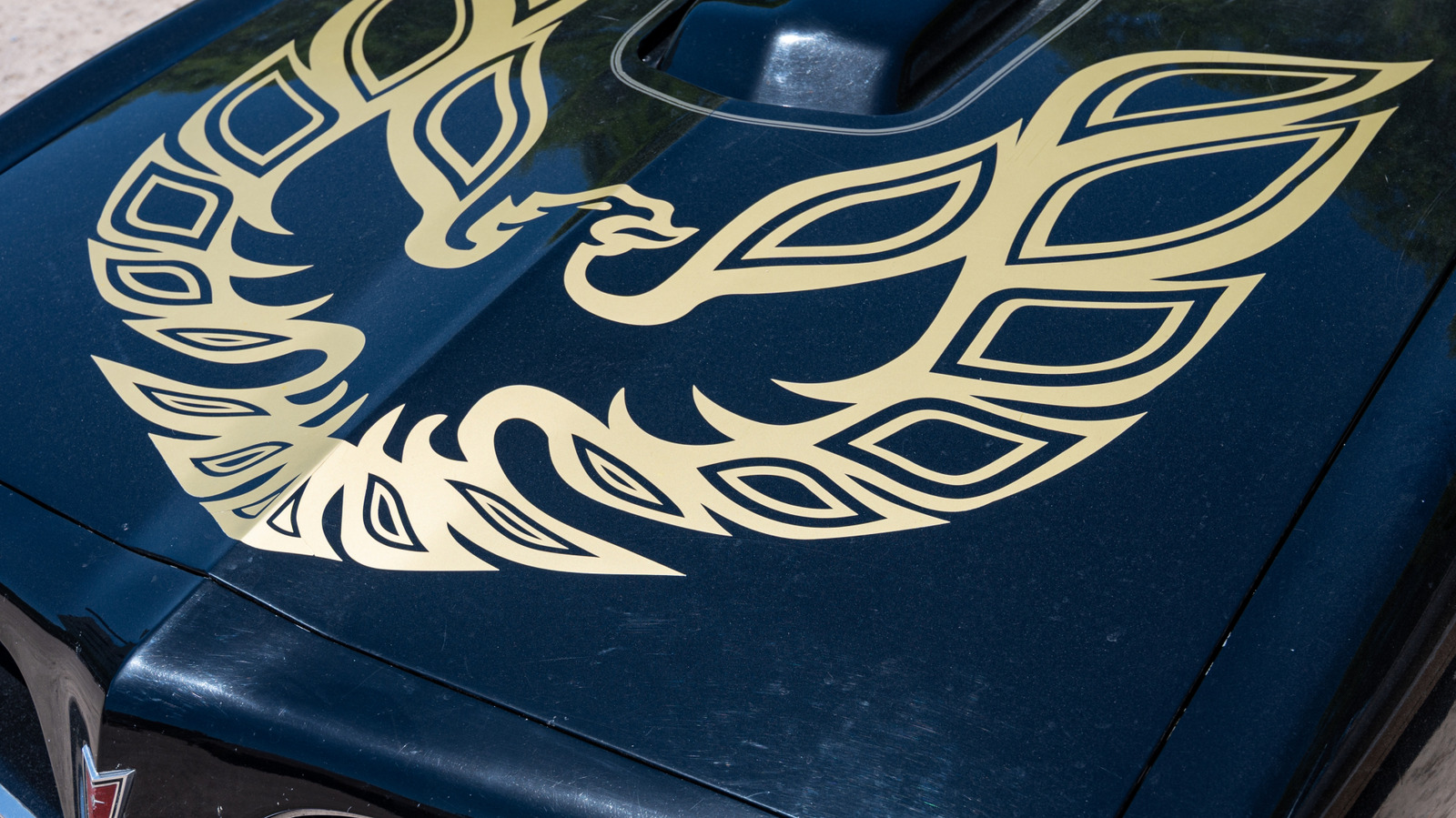


Pontiac’s most famous piece of artwork had an official name so dull it could have been stamped on a parts bin: the Trans Am Hood Decal. It cost $55 as an option in 1973. Enthusiasts have spent five decades calling it something louder.
Some say “rising phoenix.” Most say “screaming chicken.” Pontiac never said either.
The bird nearly never flew. It survived only because one designer refused to let it go, and another figured out which buttons to push on the man who killed it.
The story starts in 1967, when the first Firebird wore a restrained emblem. The bird’s wings were down and its beak closed, in a style resembling Hopi Native American jewelry. It was tidy and quiet, everything the later hood graphic would not be.
Bill Porter, Pontiac’s head of design, wanted more. He took that emblem and gave it dramatic wings and gold feathers, inspired by the colorful Tiffany vases he collected.
During development of the 1970 Firebird, Porter printed his design and stuck it onto a full-size clay model. He did not wait for permission.
GM design chief Bill Mitchell saw it and hated it, as Porter told Original MotorCar in 2024. At GM in that era, Mitchell’s verdict usually ended the conversation.
It ended this one for about two years.
Then GM designer John Schinella came across Porter’s shelved artwork. He refined it and decided to pitch it to Mitchell again, this time with a smarter plan.
Schinella had noticed that Mitchell owned a black motorcycle with gold graphics. So he put a gold bird on the hood of a black Trans Am and parked it in front of the boss.
Mitchell approved it.
The decal arrived on the 1973 Firebird Trans Am, and buyers loved it immediately. The original measured 45.5 inches wide and 44.5 inches long.
By 1978 it had grown to 47 inches wide and 55 inches tall. The head had turned, too. Instead of facing the driver, it now looked toward the passenger side.
For 1979, the enlarged bird became standard on every Trans Am except the 10th Anniversary model. The graphic Mitchell once rejected was no longer an extra on the order sheet but part of the car itself.
It grew slightly again for 1980, and Pontiac made a separate version for the turbocharged Trans Ams.
The bird was popular enough that Ford answered with a big gold snake on the hood of the Mustang King Cobra. When your chief rival starts copying your hood art, the argument over taste is settled.
The third-generation Firebird arrived in 1982 and still offered the graphic, though smaller than before. Demand faded through the decade, and Pontiac dropped the decal after the 1987 model year. The 1988 cars came without it.
The Firebird ran four generations across 35 years. Pontiac, founded a century ago, has been gone for 16 years.
The decal has outlived the brand in one place that counts. Black and gold Trans Ams with that oversized bird spread across the hood keep turning up as restomod projects, and the 1980 car is a particular favorite as a starting point.
Mitchell said no. Schinella found a better way to ask. Collectors are still making the same choice Mitchell eventually made.


Share this Story