
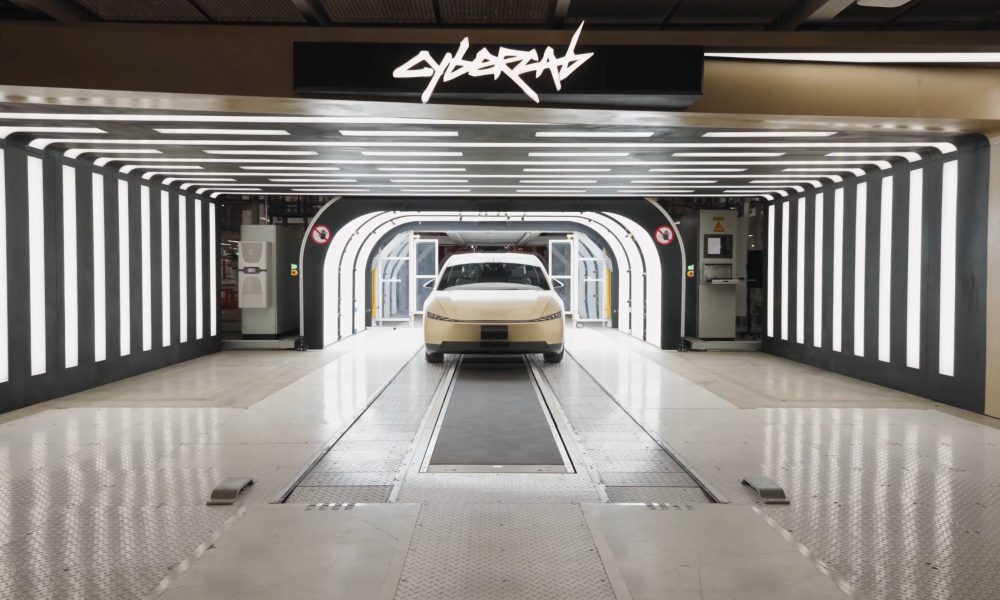


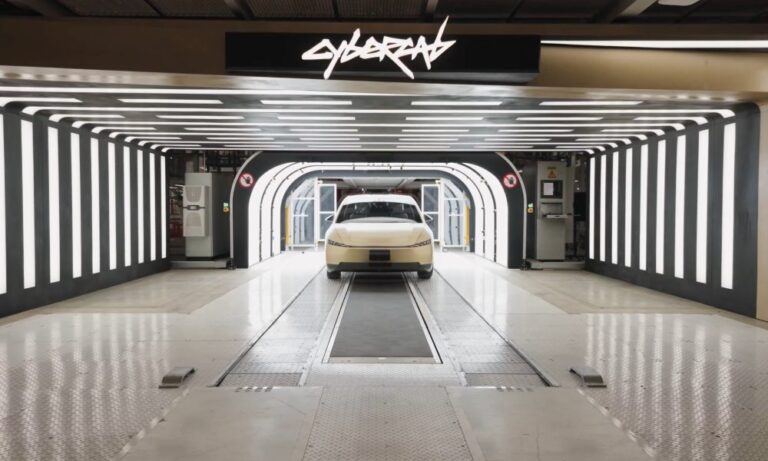
Tesla’s Cybercab factory in Austin can crank out robotaxis faster than the company can put them on the road. That admission from Lars Moravy, Tesla’s Vice President of Vehicle Engineering, is the kind of problem most automakers would kill to have. It also reveals where the real bottleneck in autonomous transportation actually sits.
“We don’t run every day because the line can run so fast. It’s currently outpacing our deployments,” Moravy told Munro Live during a factory walkthrough. “It’s a bit of a race right now. Who’s going to go faster? Right now the manufacturing line’s ahead.”
The listed capacity exceeds 125,000 units a year, and Moravy says even that number undersells reality. Yet only 463 Cybercabs appear in Texas registration records. Every unit built since volume production started in April has gone into Tesla’s own fleet.
The speed comes from a manufacturing approach that looks nothing like a conventional car plant. Tesla deleted the paint shop entirely. The Cybercab’s aluminum castings use alloys that don’t oxidize, so they skip coating altogether.
Only the side modules, built around boron-steel door rings, get an anti-corrosion dip. Exterior color comes from the plastics shop, where pigment is mixed into polyurethane resin and injected into molds. The panel comes out already colored with a finished surface. No spray booth, no volatile organic compounds, no hours-long curing cycle.
Moravy framed the decision the way Tesla frames most decisions. “Question the requirements: why do you need paint?”
The factory floor reflects that same logic. Tesla’s unboxed process splits each Cybercab into front, rear, side, and center modules, built and tested independently before converging on a final line with roughly 25 automated stations. That is perhaps a fifth to a tenth of what a Model Y requires.
The full line runs at about 78 percent automation, the framing line at 100 percent, and the whole layout uses roughly half the floor space per vehicle compared to a traditional plant. The stated target is one finished Cybercab every 10 seconds.
The battery architecture follows the same philosophy of radical simplification. An 88S6P pack of 4680 cells sits in a steel enclosure, a first for Tesla, with individually potted modules that allow single-module swaps instead of full pack replacements. Wireless battery management boards replace wiring harnesses. New contactors are fast enough to eliminate the pyro fuse.
Tesla’s battery director graded it an A minus. He gave the Model Y structural pack a D.
The drive unit runs an 11:1 gear ratio instead of the roughly 9:1 used on other Teslas because a robotaxi that never leaves city streets doesn’t need a high top speed. Engineers said the car is designed for at least 500,000 miles.
None of that matters if the vehicles sit in a parking lot. Tesla said on its Q3 earnings call that Cybercab service will launch in Dallas next month. Moravy said the company aims to get Cybercabs to customers by year end.
More than 50 units worked the Formula 1 weekend in Austin, which served as a high-visibility proof of concept but not exactly a mass deployment.
The manufacturing achievement is real. Stripping out the paint shop alone eliminates hundreds of millions in capital cost and a million man-hours of construction. Cutting floor space in half while pushing toward full automation is the kind of factory reinvention that made Tesla’s competitors nervous a decade ago with Model 3.
But a robotaxi is not a car you sell. It is a service you operate. Regulatory approvals, mapping, fleet management, insurance frameworks, and the messy reality of autonomous driving in uncontrolled environments all move on their own timelines.
The factory can be as fast as physics allows. The world outside the factory is slower.
Munro Live asked when it could get a Cybercab to tear down. Tesla’s answer was simple: “Not yet.”

Share this Story