
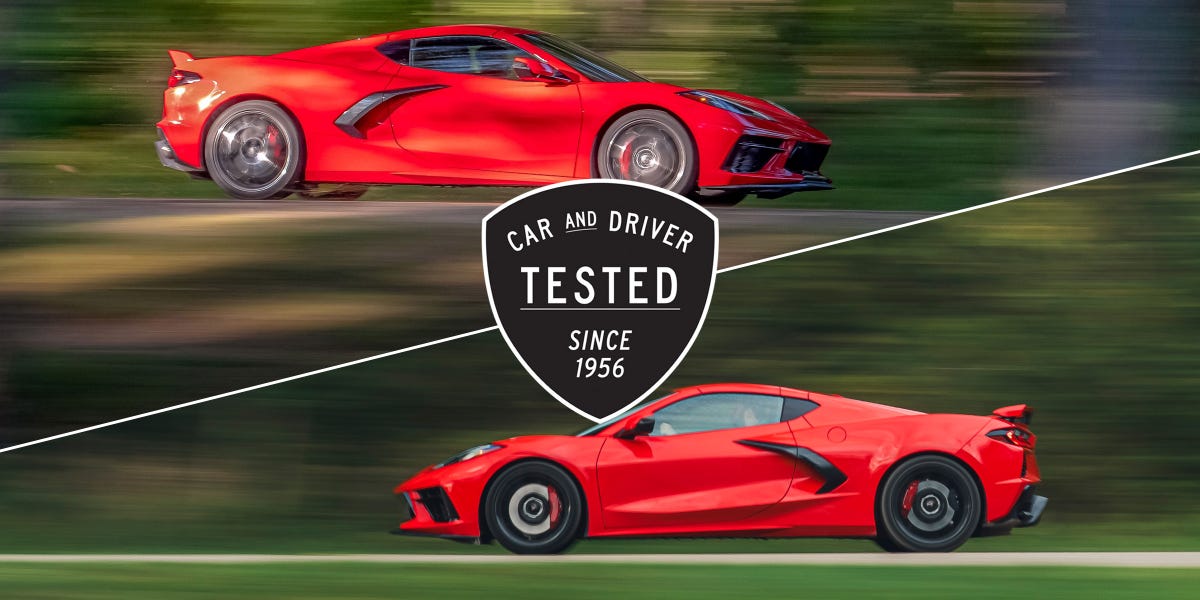


Chevrolet’s 2027 Corvette Stingray packs a new 6.7-liter LS6 V-8 making 535 horsepower and 520 pound-feet of torque. That’s 40 more horses and 50 more pound-feet than the outgoing LT2 6.2-liter. On paper, the refresh looks like a slam dunk, but on the test track, the story gets complicated.
Car and Driver ran the numbers, comparing a 2027 1LT Stingray with the Z51 package against a similarly equipped 2020 model. The headline result: 2.7 seconds to 60 mph versus 2.8. One tenth of a second, and that’s it.
Push deeper and the LS6 starts to flex a little more muscle. The new car hits 100 mph in 6.9 seconds compared to 7.2 for the old one. It clears the quarter mile in 11.0 seconds flat at 124 mph, while the 2020 car needed 11.2 seconds and only managed 122 mph through the traps.
At 150 mph, the gap stretches to eight tenths of a second. But here is where it gets strange.
The base 2027 Stingray without the Z51 package can hit 200 mph, making it a sub-$75,000 car that cracks a barrier once reserved for exotics. Bolt on the Z51, though, and top speed drops to 183 mph, one mile per hour slower than the 2020 Z51. Larger brake cooling ducts, the added drag from the front splitter and rear wing, and a shorter 5.56:1 final drive ratio borrowed from the Z06 all conspire to clip the car’s top end.
Braking is a wash. Both cars stop from 70 mph in 149 feet. From 100 mph, the new car needs 297 feet versus 301 for the old one, a four-foot improvement across five years of development.
Grip actually went backward. The 2027 Stingray pulled 1.02 g on the skidpad while the 2020 car managed 1.03 g. Part of that regression traces to weight, as the new car tips the scales at 3,702 pounds, 55 pounds heavier than the 2020 tester.
Both wore 245-series fronts and 305-series rears, though the newer car rolls on Michelin’s Pilot Sport S5 tires rather than the older 4S compound.
Fuel economy drops a tick across the board, one mpg in every EPA category, landing at 18 combined, 15 city, and 25 highway. You don’t add half a liter of displacement for free.
Where the LS6 earns its keep is through the speakers your ears provide. At idle, it registers 53 decibels, a full 6 dBA louder than the LT2. At redline, it screams to 96 dBA versus 92, yet at a 70-mph cruise the cabin is actually one decibel quieter than before.
Chevy managed to make the car louder when you want it and softer when you don’t.
The base price for the 2027 Stingray 1LT sits at $73,795, and the Z51 package adds $5,395. Car and Driver’s tester, loaded with the 3LT package and various options, stickered at $101,095.
So the 2027 Corvette Stingray is faster in a straight line, nearly identical in braking, marginally worse in cornering grip, heavier, thirstier, and louder. The performance gains are real but modest, concentrated mostly in mid-range acceleration where the extra displacement and torque have room to breathe. For buyers who already own a C8, the LS6 doesn’t rewrite the equation so much as nudge the decimal points.
For first-time buyers, the math still borders on absurd. A 535-horsepower, mid-engine, 200-mph American sports car for under $75,000 remains the kind of value proposition that makes European rivals look like they’re running a charity in reverse. Whether the LS6 represents a generational leap or a careful evolution depends entirely on which number you choose to stare at.


Share this Story