
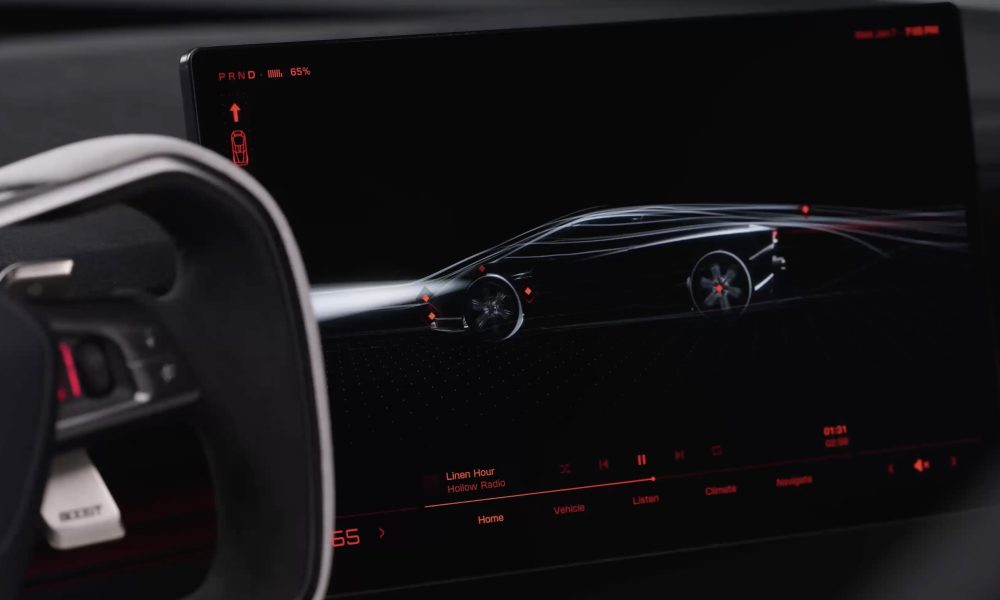


A 34-second video posted to X on Friday gave future Roadster owners their first real look at the car’s cockpit interface, and it has almost nothing in common with the rest of Tesla’s lineup. Where every other Tesla puts a map at the center of its screen, the Roadster plants a 3D wireframe of the car itself on the home page. The red-on-black graphics owe more to Lockheed Martin than Silicon Valley.
The clip walks through a touchscreen built around a squared-off yoke. Tapping sections of the wireframe pulls up controls for the active rear wing, toggling between low drag and high downforce positions. A row of tabs along the bottom reads Home, Vehicle, Listen, Climate and Navigate.
Standard enough. But the real substance lives in Track Mode.
That screen shows a live circuit map, session lap times, brake and motor temperatures, and individual tire pressure and temperature readouts. A setup page lets the driver choose between Auto, Low Drag, High Downforce, and Custom aero modes. Aero balance, brake balance, stability control, traction control, all adjustable. At the bottom of the display sits a status bar reading “Thruster · 5,500 PSI” next to a “Boost Ready” indicator.
That gauge is not decorative. It connects directly to the cold gas thruster hardware Tesla demonstrated near Waco, Texas, on October 15. The Thrust and Rocket variants use carbon overwrapped pressure vessels feeding cold gas thrusters, with Tesla claiming 0-60 times under 0.9 seconds and under 0.59 seconds respectively.
The base Performance model skips the rockets and relies on a fan-driven ground suction system for grip. Tesla’s Roadster page also lists two smaller forward displays flanking the main touchscreen. The company has said nothing about whether any of this Track Mode telemetry might filter down to the Model 3 Performance or other vehicles.
The interface design itself tells you who this car is for. Every screen prioritizes vehicle dynamics data over convenience features. The music player is tiny, the charging page is minimal, and Track Mode gets the majority of the video’s runtime along with the most detailed UI treatment.
Tesla built this dashboard for someone who wants to know their rear left tire is running three degrees hot, not someone who wants to browse Spotify.
Production remains a long way off. Elon Musk said at the October event that Roadster manufacturing will begin in 2028, and the flagship Rocket version is explicitly not approved for public road use. Reservations require a $50,000 deposit.
The Thrust variant is a limited release, and Rocket is invite only. For anyone who wants to see the car without putting down fifty grand, it goes on public display this weekend. The Roadster will sit in the lobby of the Petersen Automotive Museum in Los Angeles from October 24 through 27, marking the first time anyone outside Tesla’s events can walk up to it.
Two years is a long time between a UI video and actual deliveries. Tesla has a history of showing polished software concepts that change before reaching customers. The interface could look quite different by 2028.
But what it reveals about Tesla’s intent is harder to walk back. This is not a luxury grand tourer screen. It is a telemetry station with a music player bolted on as an afterthought.
The 5,500 PSI thruster gauge sitting casually at the bottom of a touchscreen, right next to the climate controls, is the kind of detail that only makes sense if you have already accepted the premise that a street-legal car needs rocket propulsion. Tesla is betting enough buyers have.
Share this Story