
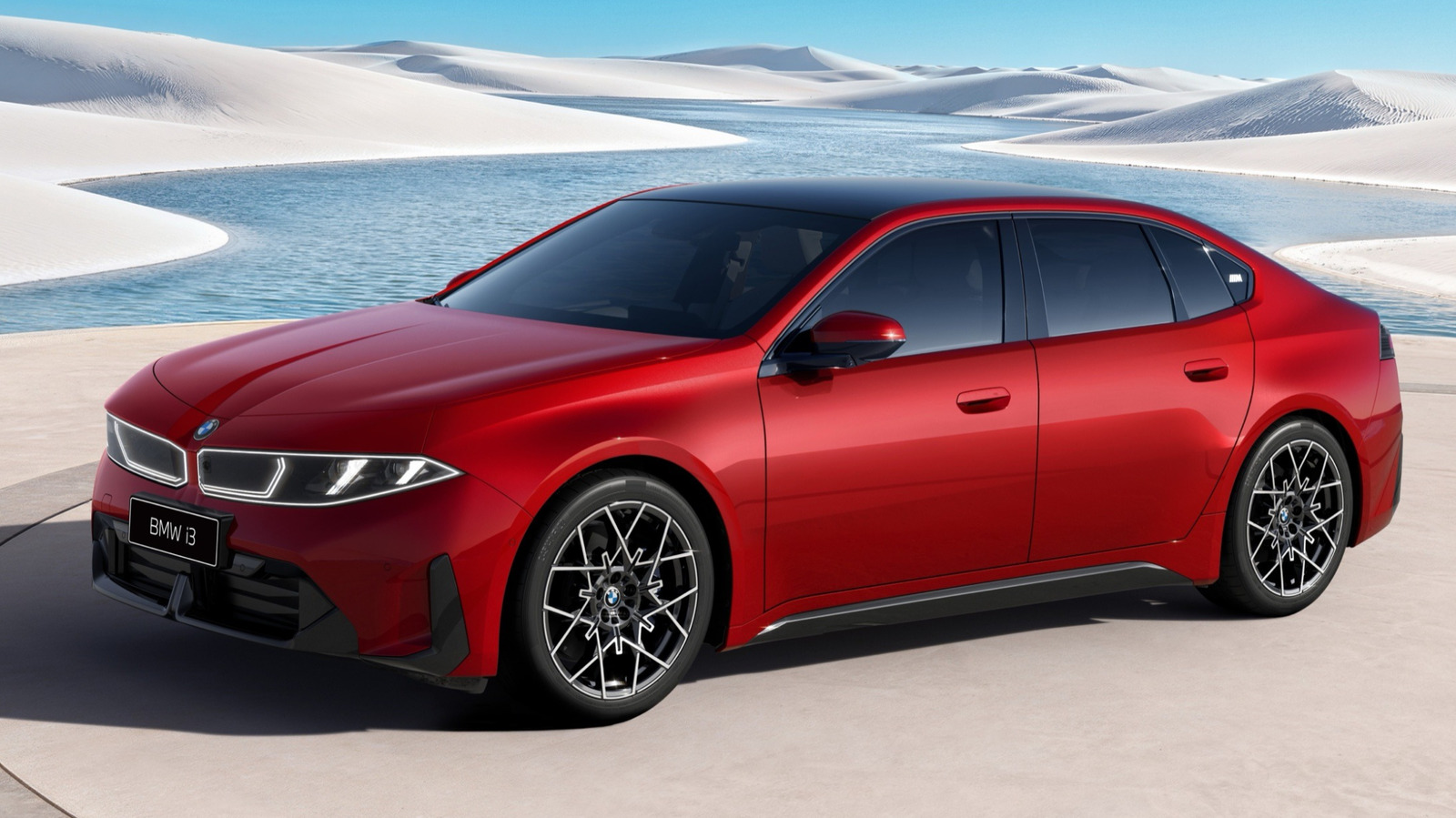


BMW’s Chinese-market i3 50L just covered 754 miles on a single charge during a long-distance endurance challenge, arriving at its destination with 1% battery remaining. The sedan averaged 7.06 miles per kWh, which translates to roughly 238 MPGe. Those are numbers that make every other production EV on sale look like it’s wasting electricity.
And you can’t buy one.
The i3 50L is a China-only variant of BMW’s Neue Klasse electric 3 Series, built on a longer wheelbase and packed with a 113.4 kWh battery that no Western dealer will ever stock. American and European buyers got their i3 this fall with either an 82.8 kWh or 108.7 kWh pack. Chinese customers walked into showrooms and ordered something bigger, longer, and more capable of going the distance.
The usual caveats apply. China’s CLTC testing cycle is famously generous, making even Europe’s WLTP figures look like hard science. And the 754-mile result came from a BMW-organized test, not an independent evaluation.
But even with those asterisks, the numbers are hard to dismiss. The car covered real roads over real distance and still had juice left in the tank.
BMW officially rates the i3 50L at more than 621 miles under CLTC testing. The endurance run blew past that figure by more than 130 miles. Hypermiling techniques and ideal conditions likely played a role, but beating your own rated range by 21% is not a parlor trick.
The Western i3 is no slouch. Europe’s top-spec i3 50 xDrive carries a 108.7 kWh battery, charges at up to 400 kW, and claims 567 miles of WLTP range. The entry-level i3 40 xDrive manages 441 WLTP miles from its smaller pack. Both come with dual-motor, all-wheel-drive powertrains, and neither comes with the option to go further.
China’s version takes a different approach entirely. The i3 50L runs a single rear motor, which helps efficiency. It rides on a wheelbase stretched 4.3 inches longer than the global car, a nod to the Chinese preference for generous rear-seat legroom.
That extra length also likely explains where BMW hides the larger battery. The shorter Western body may simply lack the floor space to accommodate 113.4 kWh worth of cells. The i3 50L also features different door handles to comply with China’s updated safety regulations, a small but telling detail about how deeply localized this variant really is.
BMW hasn’t publicly explained why the biggest battery stays in China. The wheelbase theory is plausible, but the silence speaks louder. China is where the EV competition is fiercest, where brands like BYD, NIO, and Xpeng have been pushing range figures past 600 miles for over a year. BMW needed a weapon for that specific battlefield, and the i3 50L is it.
For American buyers who just spent north of $50,000 on a new i3, learning that a version exists with 40% more range and a price tag tuned for the world’s largest EV market stings a little. The Neue Klasse platform is clearly capable of delivering extraordinary efficiency. BMW just chose where to deploy that capability.
Whether the long-wheelbase variant ever migrates westward remains an open question. BMW has confirmed the dual-motor xDrive powertrain will eventually reach China too, suggesting the platform’s modularity runs deep. A long-wheelbase option for Europe or the U.S. would be an obvious play.
For now, 754 miles belongs to China.
Share this Story