
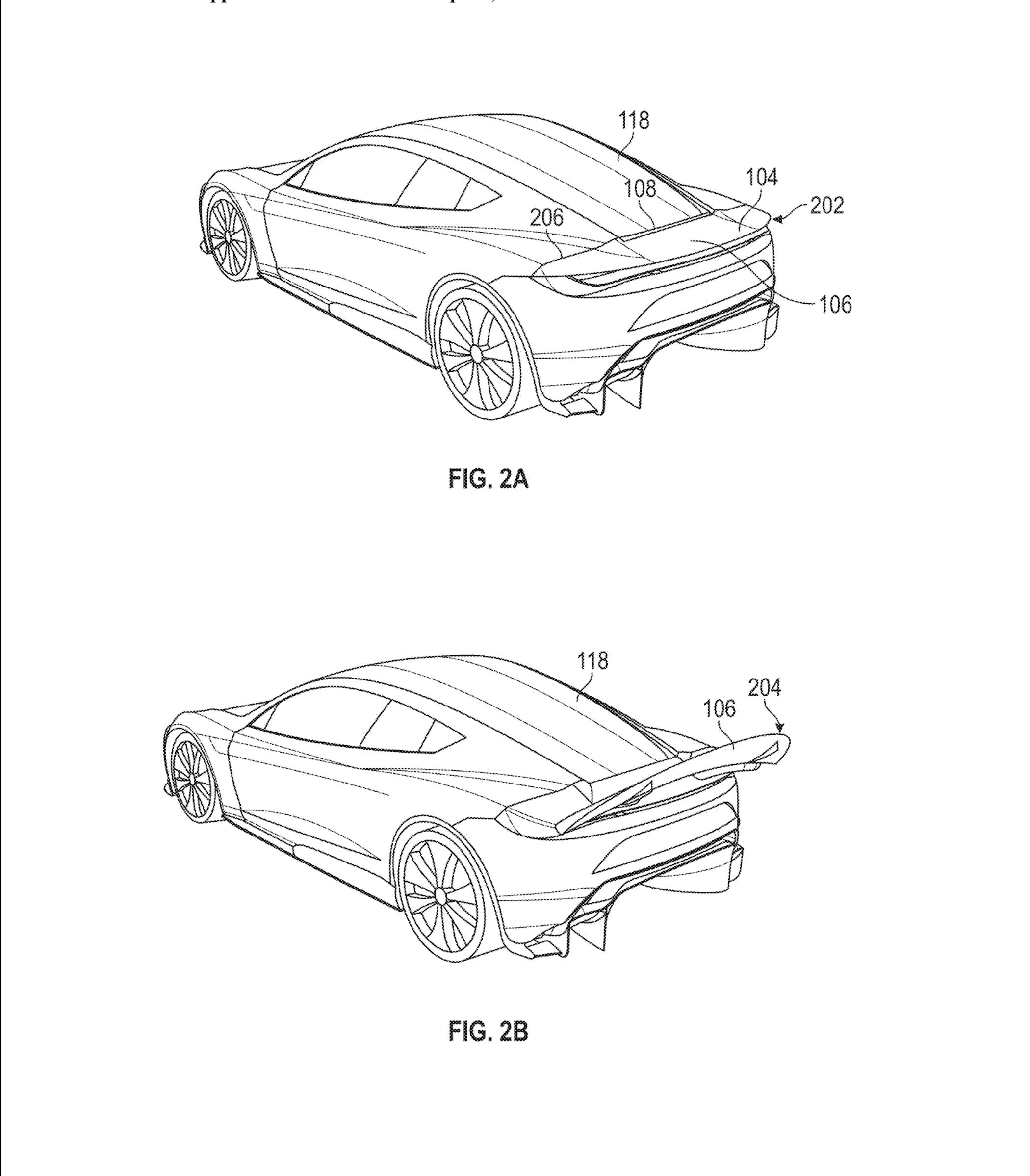


A freshly published patent with the U.S. Patent and Trademark Office shows a two-door Tesla equipped with a deployable rear wing capable of generating real downforce, reducing drag, or tucking itself flat against the body. The timing is no accident. Tesla’s second-generation Roadster is set for its big reveal on October 1 at SpaceX’s test site in Texas.
The wing described in the patent is not a passive pop-up spoiler like the one hiding in the tail of a Porsche 911. It is an active aerodynamic surface with multiple operating modes, controlled by the vehicle’s driver-assist software. At speed, it can extend to press the car into the pavement.
In straight-line situations, it pivots to cut drag. And if the system predicts an imminent collision, it retracts entirely.
That last detail is the most telling. Tying active aero to crash-avoidance logic means Tesla envisions a wing that responds not just to speed but to threat. It is less of an aerodynamic accessory and more of an integrated safety system, at least on paper.
The patent drawings depict a two-door coupe rather than the targa-top layout Tesla showed off when the Roadster prototype first surfaced nearly a decade ago. Whether the production car matches those drawings, or whether this tech even makes it to the October reveal, remains unconfirmed.
What is confirmed is that speculation around the Roadster has reached a fever pitch. The so-called SpaceX package has been the subject of wild conjecture for years, with Elon Musk hinting at compressed-gas thrusters fed by onboard cold gas systems. Musk has never been shy about overpromising on timelines or technology.
The thruster talk sounds absurd until you remember that Dreame, a Chinese EV startup, already bolted twin solid-fuel rocket boosters onto a production vehicle. It is a strange new world when a rear wing feels like the conservative option.
Tesla’s challenge with the Roadster has always been credibility. The car was first shown in 2017. Deliveries were originally promised for 2020. Every year since has brought fresh excuses and recycled hype.
At some point, the actual product has to justify nearly a decade of anticipation, and a clever wing is not going to do that alone.
But the patent does suggest Tesla is thinking seriously about how the car behaves at its limits. Active aerodynamics at this level of integration, where the software decides in real time whether the car needs grip, speed, or protection, goes beyond what most production sports cars offer. Porsche’s system is speed-triggered.
Ferrari and McLaren have adaptive aero tied to driving modes. Tying it directly into collision prediction is a step further.
The question is execution. Patents are aspirations, not promises. Tesla has filed hundreds that never reached production.
Even if this wing does appear on the Roadster, the software controlling it will need to be flawless. An active aero surface that misjudges the moment could make things worse, not better.
October 1 is now days away. The Roadster will either validate years of waiting or collapse under the weight of its own mythology. Either way, at least one piece of the puzzle appears to involve actual aerodynamic engineering rather than rocket fuel.
Share this Story