
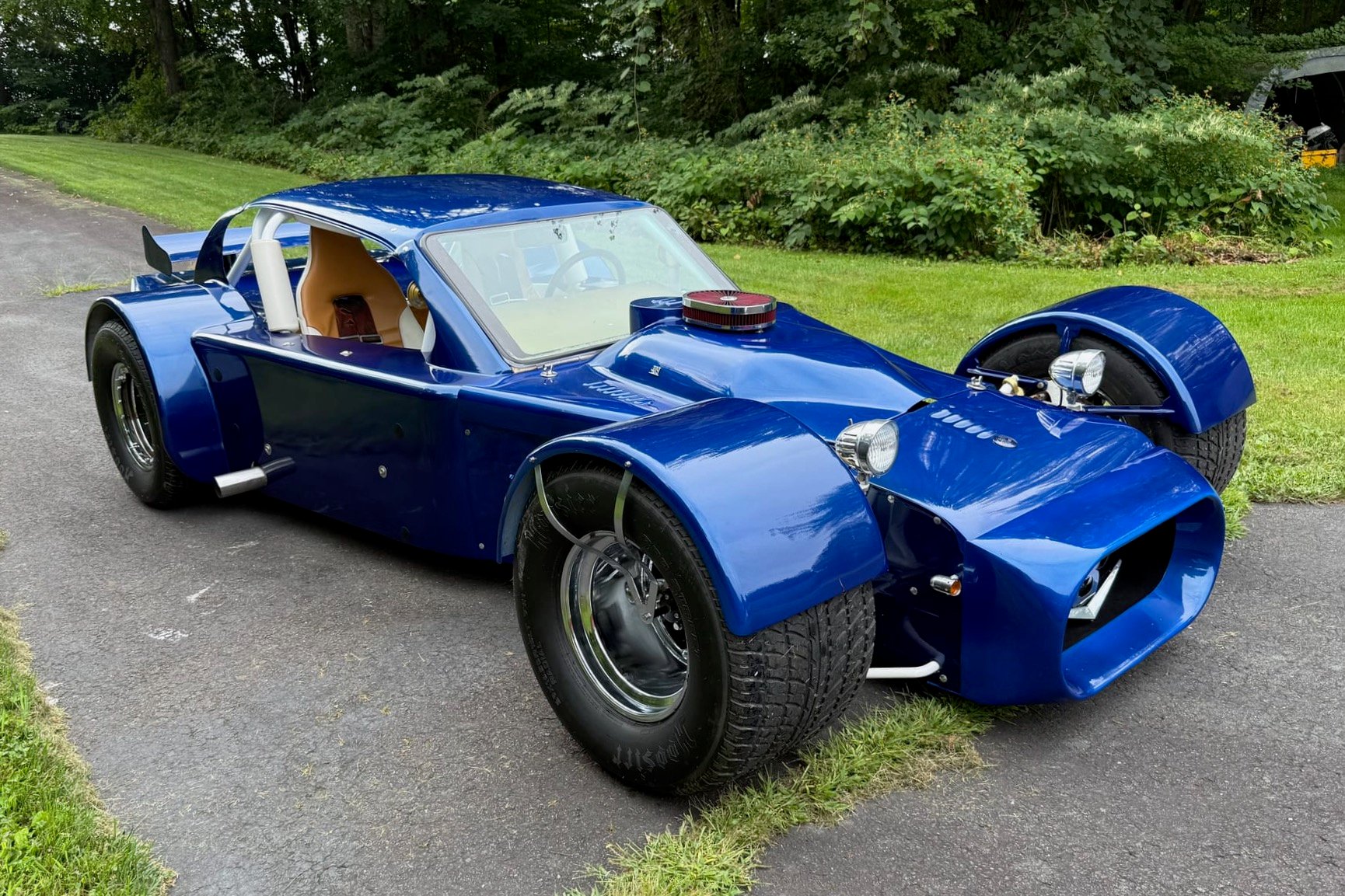


Colin Chapman built the Lotus Seven to be the lightest, simplest sports car possible. Somebody looked at that philosophy and decided to stuff a 6.7-liter Chevrolet V8 into it, weld up a roll cage, bolt on push bars, and take it circle track racing.
The result, which recently surfaced for sale on Bring a Trailer, is one of the most gloriously wrong things anyone has ever done to a Seven-style chassis. And it works precisely because it shouldn’t.
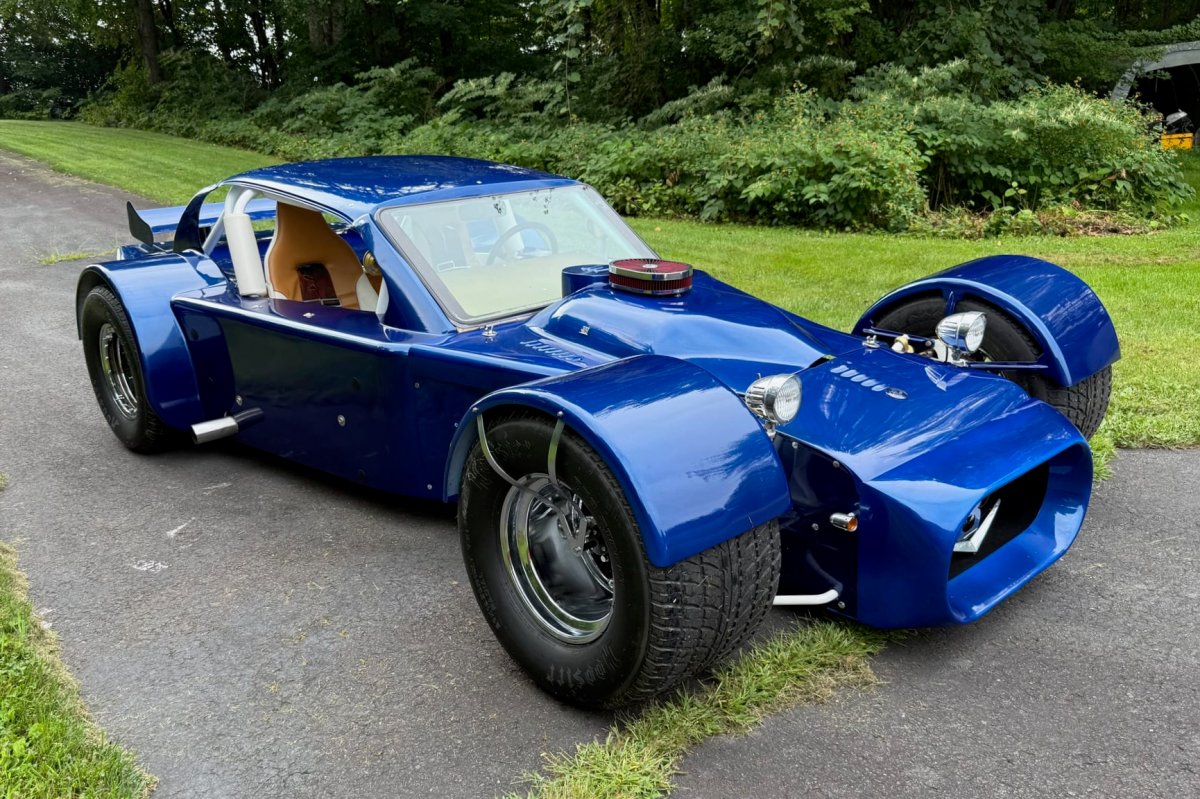
The car isn’t actually a Lotus. It’s a tube-frame chassis draped in Seven-inspired fiberglass bodywork, with a steel roof and enough structural bracing to handle the kind of lateral loads Chapman never imagined his little kit car would face. The 15-inch-wide wheels alone are wider than the original Seven’s entire front track probably needed to be.
Under that bulging hood sits a blueprinted 409-cubic-inch small-block Chevy, fed by a Holley four-barrel carburetor. Power goes through a Tremec five-speed manual to a Winters quick-change locking differential, the kind of rear end you find in Saturday night short-track specials, not British sports cars. The “7” badge in the grille has been swapped for a “V” cradling an “8.”
The rear fascia carries push bars, four taillights, a spoiler, and a quote from Mad Max: Fury Road. An odd flex for a car set up to run on asphalt rather than the post-apocalyptic wasteland, but coherence clearly wasn’t the builder’s primary concern.
Inside, things get stranger still. The fixed-back bucket seats wear two-tone leather. The transmission tunnel is trimmed to match.
A custom dashboard and shift knob are finished in gold, paired against blue bodywork and a white roll cage. It reads like someone who builds demolition derby cars by day and restores British roadsters on weekends, and couldn’t decide which project to work on next.
The car was reportedly built in the 2000s. Its provenance is murky at best. It carries a Lotus identification plate and is titled as a 1974 Lotus Elite, which is about as accurate as calling a monster truck a Miata.
The title is from Montana, which tells you everything you need to know about how it got registered in the first place.
Chapman spent his career trying to make race cars faster by making them lighter. He ran Formula 1, the Indianapolis 500, and dozens of lower-tier series. He never went near oval racing in America’s short-track heartland.
The Seven was his purest expression of minimalism, a car so basic that buyers assembled it themselves from a box of parts. This thing is the anti-Seven. It’s heavy, loud, overbuilt, and powered by an engine that weighs more than some complete Caterhams.
It takes Chapman’s most sacred creation and bends it into something that belongs on a bullring in rural Virginia on a warm Friday night, trading paint with Camaros and Monte Carlos.
The listing doesn’t mention how much it weighs, how much power the 409 makes, or whether it has ever actually turned laps. Nobody seems to know who built it. The whole machine is a question mark bolted to a roll cage, wearing a dead man’s name tag, and somehow that only makes it more interesting.




Share this Story