
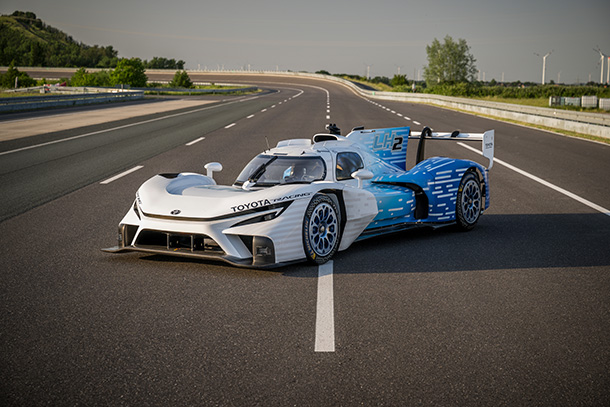


The liquid hydrogen combustion engine is about to scream down the Mulsanne Straight. Toyota Racing confirmed its TR LH2 Racing Prototype will complete demonstration laps at the Circuit de la Sarthe on June 11 and June 13, marking the first time a liquid hydrogen-powered prototype has turned laps in public at Le Mans.
The timing is deliberate. Those demo runs bracket the 94th running of the Le Mans 24 Hours, where Toyota’s conventionally fueled TR010 HYBRID Hypercar will be fighting for the overall win. Same chassis, different fuel. Toyota wants you to see the comparison and start imagining the future.
This has been a slow, methodical campaign. Toyota first shoved hydrogen into a racing engine back in 2021, running a gaseous hydrogen GR Corolla in Japan’s Super Taikyu series through Rookie Racing. By 2023, that car had switched to liquid hydrogen, which is denser, harder to handle, and far more promising for endurance racing where energy density matters.
The Le Mans flirtation started that same year with a single demonstration lap and the unveiling of the GR H2 Racing Concept, a show car meant to tease a potential hydrogen class in the World Endurance Championship. In 2025, Toyota rolled out the GR LH2 Racing Concept at Le Mans. Now, twelve months later, the word “Concept” has been replaced by “Prototype,” and the car is actually moving under its own power on the full 13.626-kilometer circuit.
Rally stages have served as parallel proving grounds. A hydrogen GR Yaris ran demo laps at Ypres Rally in 2022. A Rally2-spec version appeared at Rally Finland last year and again at this January’s Monte-Carlo. Toyota is seeding hydrogen across every discipline it competes in, building the case that this isn’t a single-use science project.
The Le Mans prototype shares its carbon tub with the TR010, which means Toyota isn’t developing a bespoke hydrogen chassis from scratch. That’s smart engineering and shrewd politics. It tells the ACO and FIA that a hydrogen class wouldn’t require teams to start from zero — existing LMH or LMDh platforms could theoretically be adapted.
Whether the ACO bites is another question entirely. The Le Mans organizers have been openly sympathetic to hydrogen for years, but no formal category has been announced. Toyota is building the car first and daring the sanctioning bodies to write the rules around it.
A “Hydrogen Village” exhibition opens at the circuit on June 10, the day before the first demo laps. It will display the prototype alongside other Toyota hydrogen vehicles and technology. Corporate messaging about carbon neutrality aside, the real exhibit is the car on track, making noise and completing laps at race-relevant speed.
Five years of incremental steps — gaseous to liquid, concept to prototype, Japanese club racing to the biggest sportscar race on Earth — have led to this. Toyota is the only manufacturer investing this heavily in hydrogen combustion for motorsport. Hyundai has dabbled. BMW has talked. Nobody else has a prototype sharing DNA with a Le Mans Hypercar.
Two demonstration laps won’t decide anything. But they will put a timestamp on the record: in June 2025, a liquid hydrogen racing prototype ran the full Circuit de la Sarthe, built on a proven Hypercar chassis, by the team that has dominated Le Mans for the better part of a decade. If a hydrogen class ever materializes, Toyota will have been ready for years. Everyone else will be scrambling to catch up.


Share this Story