
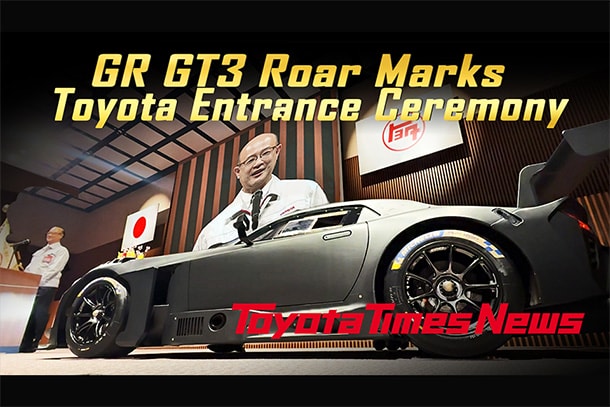


On April 1, Toyota Motor Corporation did something no onboarding PowerPoint could ever accomplish. Executive Vice President Hiroki Nakajima cranked a GR GT3 engine on stage in front of 2,317 new employees, and the room changed in an instant.
The entrance ceremony in Toyota City, Aichi, was the first major company-wide event under new President Kenta Kon, who took the reins from the Toyoda family’s direct leadership. Kon addressed the crowd as though speaking individually to each hire, grounding his remarks in the company’s founding principle of acting for others.
But it was the V8 that did the real talking.
When that GR GT3 fired up inside the hall, nervous faces turned into grins. Toyota has long understood the emotional power of internal combustion. Deploying it at a corporate ceremony, while rivals fall over themselves to project an all-electric future, tells you exactly where the company’s heart still beats.
Kon urged the new class to “work hard together with 70,000 colleagues in Japan and 380,000 around the world.” The scale of that number is easy to gloss over. Toyota remains the world’s largest automaker by volume, and every one of those 2,317 new hires walked into a machine that builds roughly 10 million vehicles a year.
Chairman Akio Toyoda, who stepped back from the presidency in 2023 but clearly hasn’t stepped away from the culture, lingered after the ceremony. “They’re so young,” he said. “The atmosphere was great — it really felt refreshing.”
Then came the line that only Toyoda delivers with a straight face and total sincerity: “Young people are the ones who will lead the future. Study hard, work hard, and hey, love cars.”
Love cars. Two words that have become Toyota’s internal creed under Toyoda’s influence. At a time when the industry talks about mobility platforms, software-defined vehicles, and robotaxi fleets, Toyota’s chairman is still telling fresh recruits to fall in love with the machine itself.
One new employee had actually met Toyoda at Fuji Speedway last summer, before they were even officially hired. That kind of detail doesn’t happen by accident. Toyota cultivates its car-culture identity the way tech companies cultivate campus perks — it’s a recruiting tool, a retention strategy, and a philosophical statement rolled into one.
The choice of the GR GT3 as the ceremony’s centerpiece is no small signal either. That car represents Toyota’s push into customer motorsport and GT racing, a program born directly from Toyoda’s belief that racing makes better road cars. It is not a concept EV. It is not a rendering. It is a naturally aspirated statement of intent.
There is a real tension in the global auto industry between companies racing to shed their combustion heritage and those betting that enthusiasm still matters. Toyota has placed its chips clearly. The company is investing in electrification — hybrids, plug-ins, hydrogen, and battery electrics are all in the pipeline — but it refuses to apologize for the internal combustion engine or the culture built around it.
Firing up a race car engine at an entrance ceremony is theatrical, sure. But theater has a purpose. Those 2,317 people didn’t just get a job on April 1. They got a visceral reminder of what they signed up for.
Akio Toyoda would tell you that’s the whole point.

Share this Story