
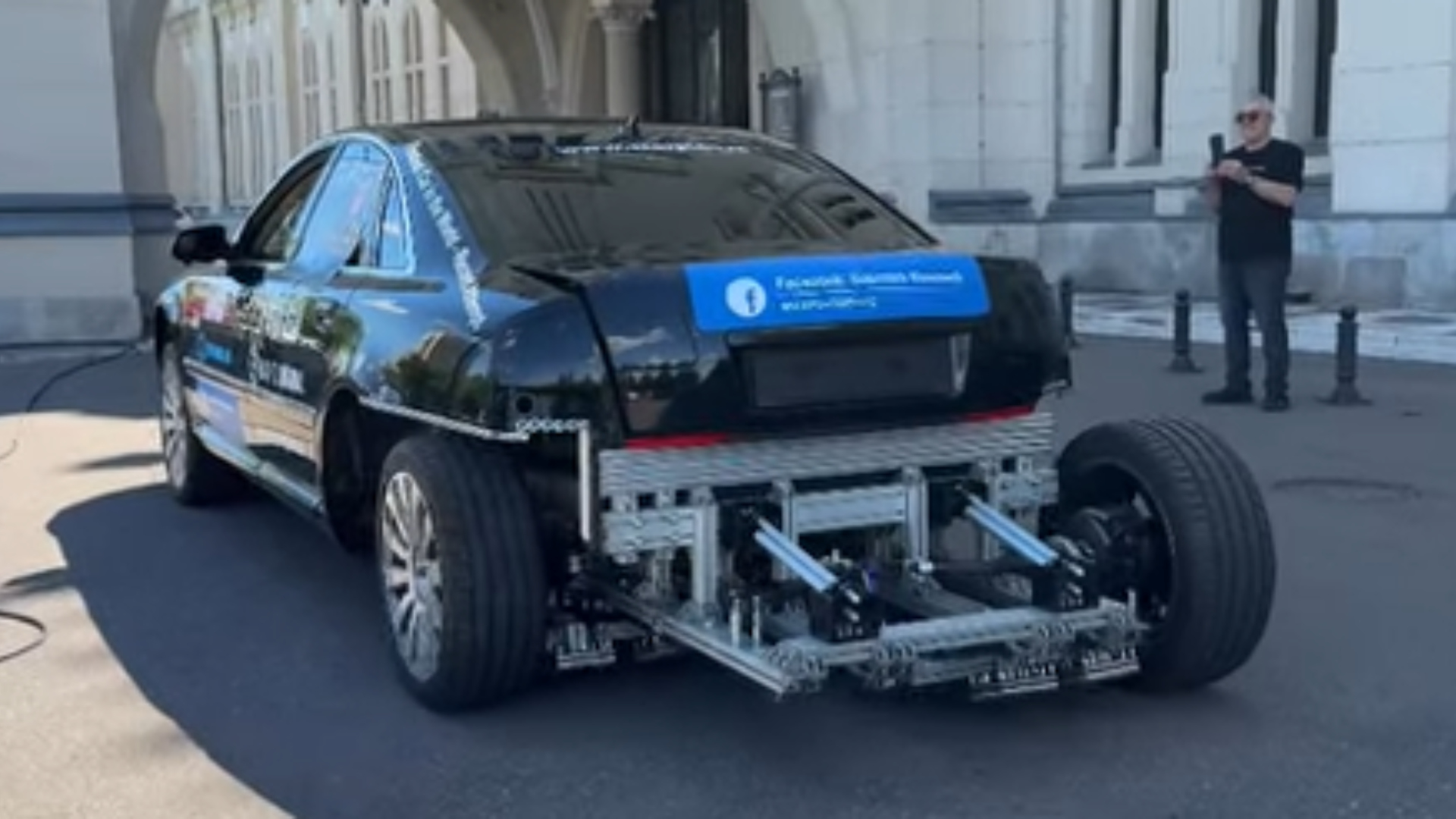


Romanian outfit Rosmar H has built a pneumatic prototype based on an Audi body shell that lurches down the road like a mechanical centipede having a seizure. It uses no gasoline, no battery, and no electric motor. Just compressed air, giant longitudinal pistons, and an almost admirable disregard for thermodynamics.
The concept is simple enough to explain and wild enough to question. Sequential pneumatic pistons mounted lengthwise pull the car forward in a lurching, rhythmic gait. Think less “smooth highway cruiser” and more “reanimated vehicle dragging itself from a swamp.”
The company has apparently been awarded a patent for a system designed to move vehicles stuck on mud, snow, ice, sand, or slopes steeper than 45 degrees. Though the specifics of that claim remain murky.
Rosmar H wasn’t trying to replace the internal combustion engine. It was trying to solve the age-old problem of getting un-stuck. The logic: if spinning tires can’t find grip, stop spinning them and move the car itself instead.
The energy source is a compressed air tank, visible on scale models the company uses for demonstrations. There is no combustion, no electrons flowing from a lithium pack. You’d theoretically top it off at home with an air compressor the way you’d charge an EV from a wall outlet.
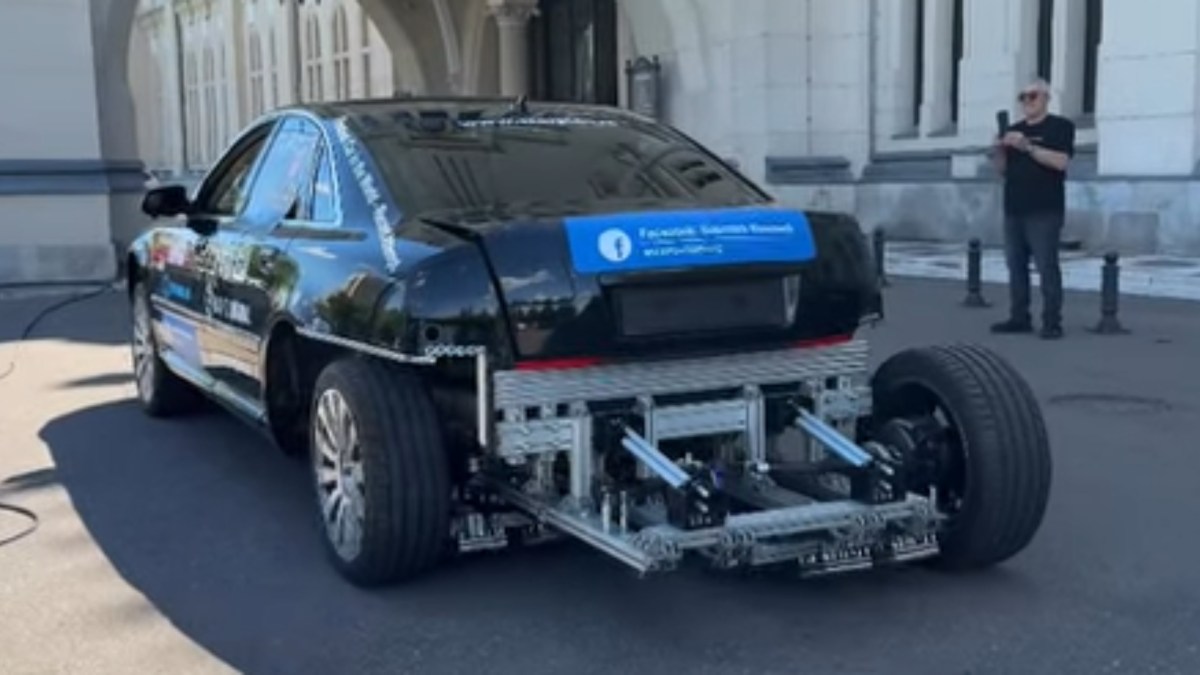
Rosmar H even claims the system recovers kinetic energy on each piston return stroke, recycling the car’s own momentum back into the tank. That’s where the physics gets uncomfortable. Every conversion of energy from one form to another bleeds losses, and the return stroke that “recharges” the air tank necessarily robs forward velocity.
It’s parasitic loss made visible, a car literally fighting itself with every step it takes.
A 25-gallon tank at a standard 2,000 psi holds somewhere between 0.65 and 1.3 kilowatt hours of usable energy. For context, a modest first-generation hybrid battery holds roughly the same. The GMC Hummer EV packs 170 kWh, so the gap between what compressed air can store and what modern vehicles demand isn’t a crack — it’s the Grand Canyon.
Rosmar H claims the full-scale version should hit 0-60 mph in 0.3 seconds. That number lives in the same neighborhood as Top Fuel dragsters and fantasy. No compressed air tank sized for a passenger car contains remotely enough energy to accelerate 4,000 pounds that violently.
The scale model demos look spirited enough, but scale models weigh a few pounds and have the aerodynamic burden of a shoebox.
None of this makes the project worthless. The notion of moving a chassis independently of its wheels in extreme off-road scenarios isn’t entirely without merit. Military recovery vehicles and mining equipment have explored adjacent concepts for decades.
But the leap from “novel traction device for stuck vehicles” to “replacement for the automobile powertrain” is the kind of jump that usually ends with a canyon floor and a puff of dust, Wile E. Coyote style.
The compressed air car has been promised before, by companies with far larger budgets and far more engineering talent. India’s Tata Motors flirted with the idea over a decade ago alongside French firm MDI. That car never reached production because the energy density problem didn’t go away just because someone wished hard enough.
Rosmar H’s creation is genuinely entertaining to watch. It lurches forward under its own stored power with the determination of something that refuses to understand why it shouldn’t work. Sometimes that’s how breakthroughs start, but more often, it’s how YouTube curiosities end.

Share this Story