
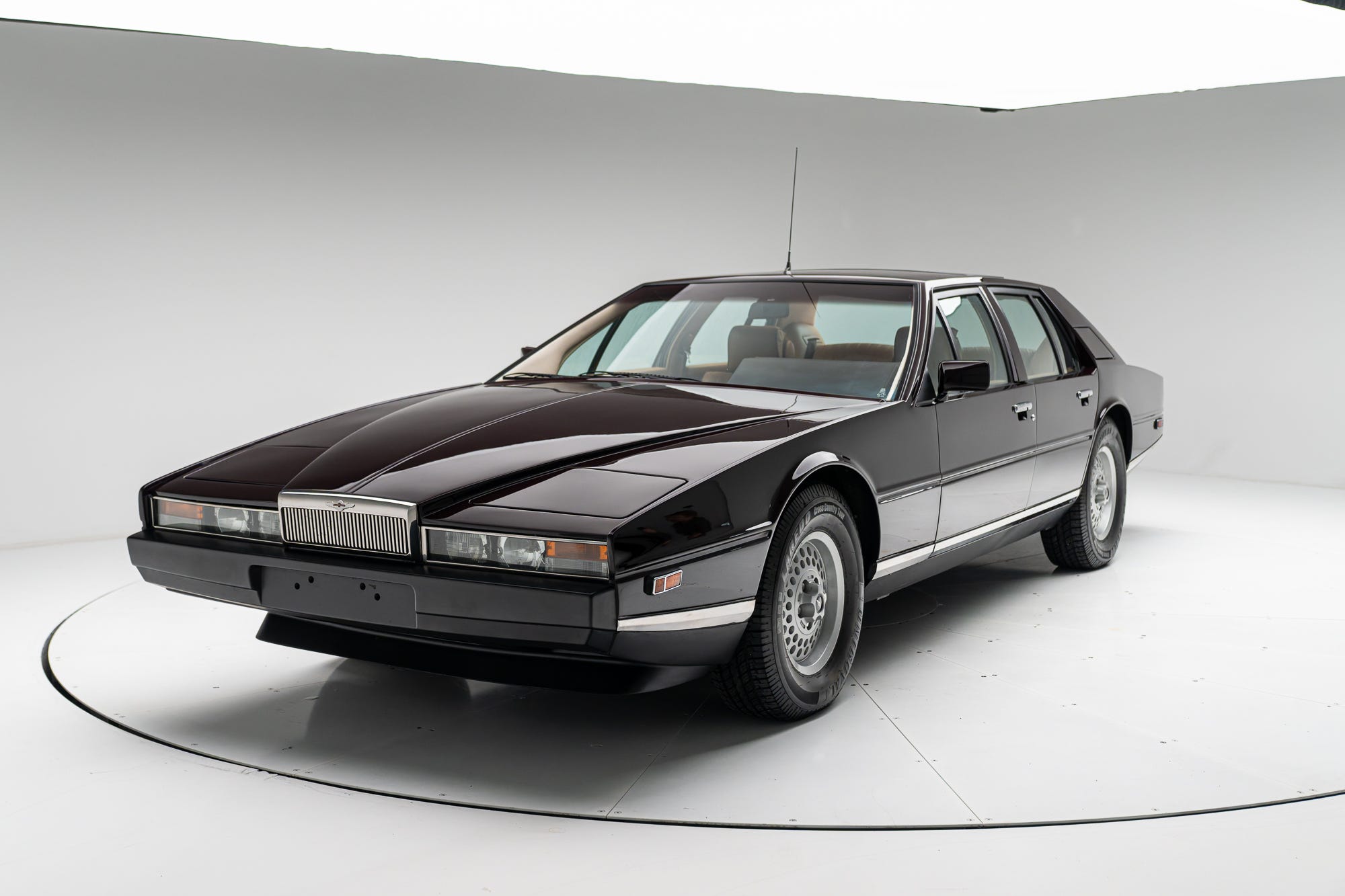


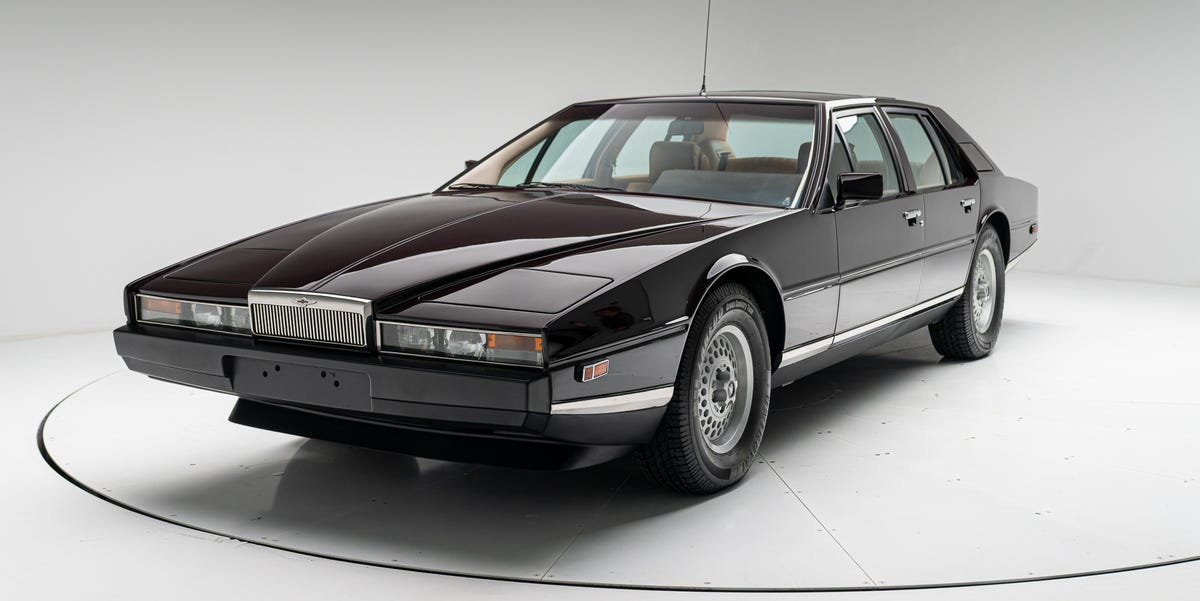
A maroon 1984 Aston Martin Lagonda just surfaced on Bring a Trailer, and it looks like it was beamed in from a future that never quite arrived. The auction closes June 15, but the real story here isn’t the car’s price. It’s the fact that this razor-edged oddity existed at all — and that Aston Martin actually sold enough of them to call it a win.
William Towns penned the Lagonda in the 1970s, when automotive designers treated straight lines and sharp angles like a religion. The result was a four-door sedan that looked less like a luxury car and more like something that should be parked on the flight deck of an aircraft carrier. Decades later, the design hasn’t softened. It still provokes.
This particular example is a left-hand-drive U.S.-spec car finished in that unmistakable dark maroon — the same shade, incidentally, that graced the Lagonda owned by Evel Knievel. If that doesn’t tell you everything about the kind of person this car attracted, nothing will.
Under the impossibly long hood sits a 5.3-liter V-8 borrowed from the Vantage, making 263 horsepower and 292 pound-feet of torque. Not earth-shattering numbers, but Aston Martin claimed the Lagonda was the fastest sedan in the world in its day. The transmission is a three-speed automatic sourced, of all places, from Chrysler.
British engineering, American gearbox. The seventies and eighties were a different time.
The interior is where the Lagonda truly enters science fiction territory. Soft-touch buttons replaced conventional switches. An LED instrument cluster, built by aircraft specialist Javelina, gave the dashboard the look of a fighter jet cockpit.
This car ups the ante further with a period NEC car phone, the kind of accessory that once screamed wealth and now screams 1984 louder than an Orwell novel.
Lagondas carry a reputation for fragility that borders on legend. Complex electronics married to British build quality of that era created a perfect storm of potential failures. But that reputation deserves some nuance.
A few years ago, Car and Driver profiled Lagonda owner Harjeet S. Kalsi, an electrical engineer who manufactured his own replacement relays for his 1982 model. With the factory’s fault-prone mechanical relays swapped out, his car ran faithfully for around two decades. The Lagonda’s problems were real, but they were also fixable — if you had the brains and patience for it.
That’s the tension at the heart of every Lagonda that comes to market. The styling is unforgettable. The engineering is ambitious. The execution was, charitably, uneven.
Yet Aston Martin moved enough of them during production to keep the company’s lights on during a period when survival was genuinely in question. The Lagonda didn’t just look like the future. It helped buy Aston Martin one.
This auction car hasn’t been driven much under its current ownership, which could mean careful preservation or benign neglect — two conditions that look identical in photos but feel very different when you turn the key. A prospective buyer will need to be both well-heeled and willing to get acquainted with forty-year-old British electronics, or at least willing to pay someone who is.
Still, there is no other sedan on the road that commands attention like a Lagonda. Not then, not now. It is a car that makes a Rolls-Royce look polite and a Mercedes S-Class look anonymous.
Whether that’s worth the inevitable headaches is a question only a certain kind of buyer can answer — the kind who, like Knievel, doesn’t mind a little risk with their reward.

Share this Story