
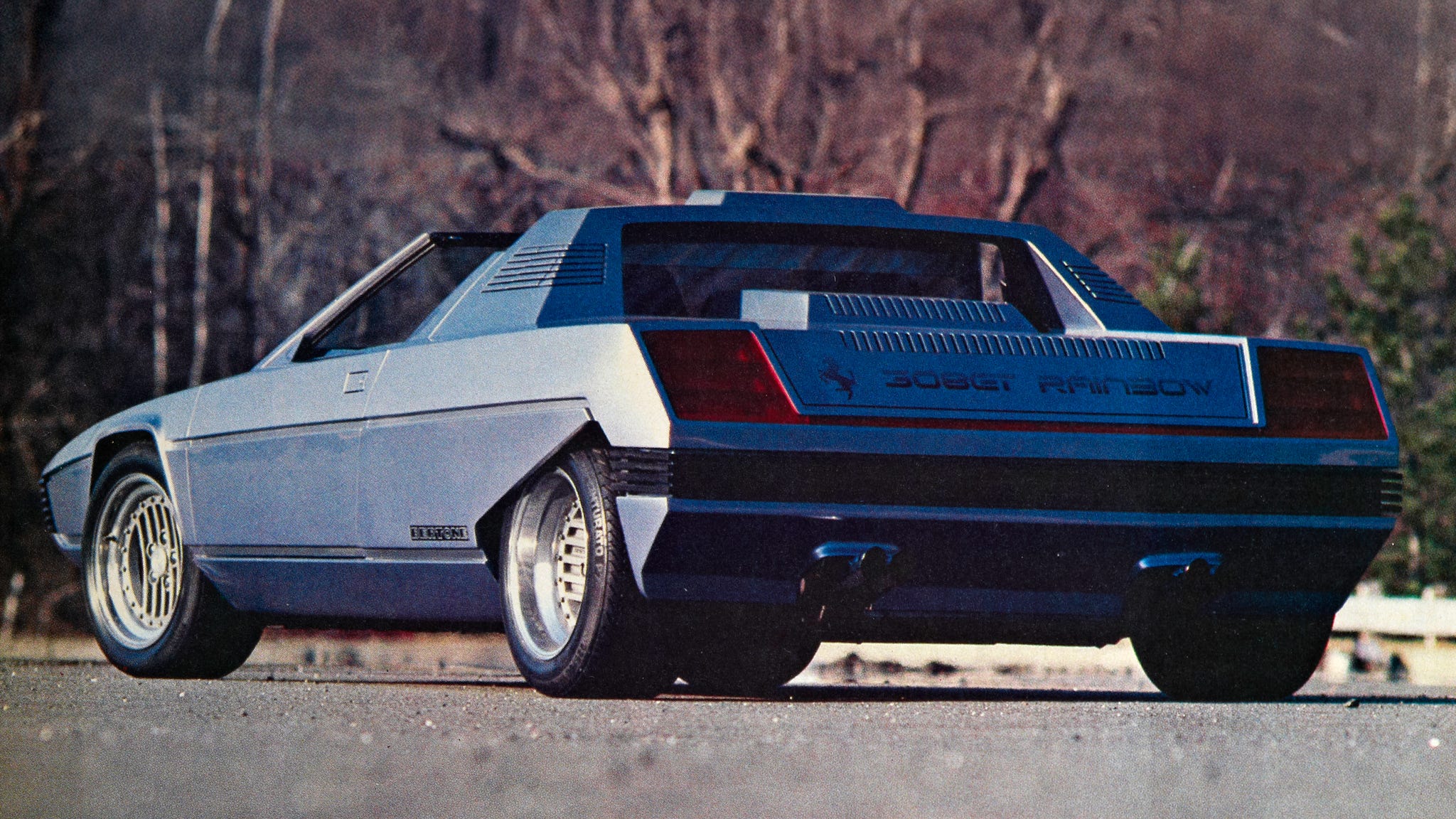


In 1976, Bertone rolled a wedge-shaped Ferrari onto the Turin Auto Show stand and solved a problem that still plagues car designers nearly five decades later. The Rainbow, built on a shortened 308 GT4 chassis, featured a rigid aluminum roof panel that slid backward on tracks and stored vertically behind the seats like a garage door. No hydraulics, no lifting a panel over your head and stuffing it somewhere. Just push it back and latch it.
The design was patented. Bertone wanted a manufacturer to license it. Nobody did.
That detail alone makes the Rainbow one of the most fascinating dead ends in automotive history. Marcello Gandini, the same man who penned the Lamborghini Countach, created a convertible mechanism so elegant in its simplicity that it required zero power assistance and nothing that could break or leak. When the top was stowed, a moonroof panel in the roof’s surface doubled as a rear window.
The car itself was no static prop. Underneath sat a European-spec Ferrari 3.0-liter V-8 making 240 horsepower, bolted to a chassis with four inches cut from between the axles, giving it a 96-inch wheelbase. The aluminum body brought total weight down to 2,735 pounds, some 400 pounds lighter than the steel-bodied 308 GTB.
Top speed was a legitimate 150 mph. Motor Trend’s John Paulding actually drove it in 1981, terrorizing Ferrari PR man Bill Baker through Bergen County, New Jersey. The engine pulled from 500 rpm at idle to 8,000 without complaint.
Fourth gear alone could handle anything from 20 to 120 mph. The suspension, even unsorted, delivered handling on what Paulding called “a different level” from ordinary machinery.
But the Rainbow was also deeply flawed in ways that revealed exactly why it stayed a show car. The roofline was so low that average-sized humans could only enter with the top retracted, leaning in headfirst. There were no seatbelts, no adjustable seat tracks, no rearview mirrors.
The driving position was, in Paulding’s words, “Go-Kart Classic: knees over elbows.” Rear visibility amounted to a slit of glass, an air cleaner scoop, and twin headrests blocking whatever was left.
These were the compromises of a car built to prove a concept, not to be produced. And the concept it proved was real. Every retractable hardtop that followed, from the Mercedes SLK in 1996 to the current Corvette’s removable panel, has been heavier, more complex, and more failure-prone than what Gandini sketched in the mid-1970s.
The Rainbow spent years touring international auto shows, was repainted from white to metallic blue in 1978, and even appeared in the Burt Reynolds “Cannonball Run” film. Bertone reportedly floated a price of around $200,000 for anyone brave enough to buy it.
Gandini’s career at Bertone produced the Countach, influenced the Fiat X1/9, and shaped the visual language of wedge-shaped supercars for a generation. The Rainbow borrowed DNA from nearly all of them. Its pointed nose, buttressed C-pillar, and Kamm tail echoed the X1/9, while its slab sides and angular wheel arches tracked with the Countach.
Paulding himself noted the proportions were off and the angularity pushed too far. It was striking, not pretty.
That tension between brilliant engineering and impractical packaging is the story of dozens of concept cars. What separates the Rainbow is that its single best idea, the one Bertone begged someone to adopt, remains simpler and more elegant than anything the industry has built since. The patent expired long ago.

Share this Story