
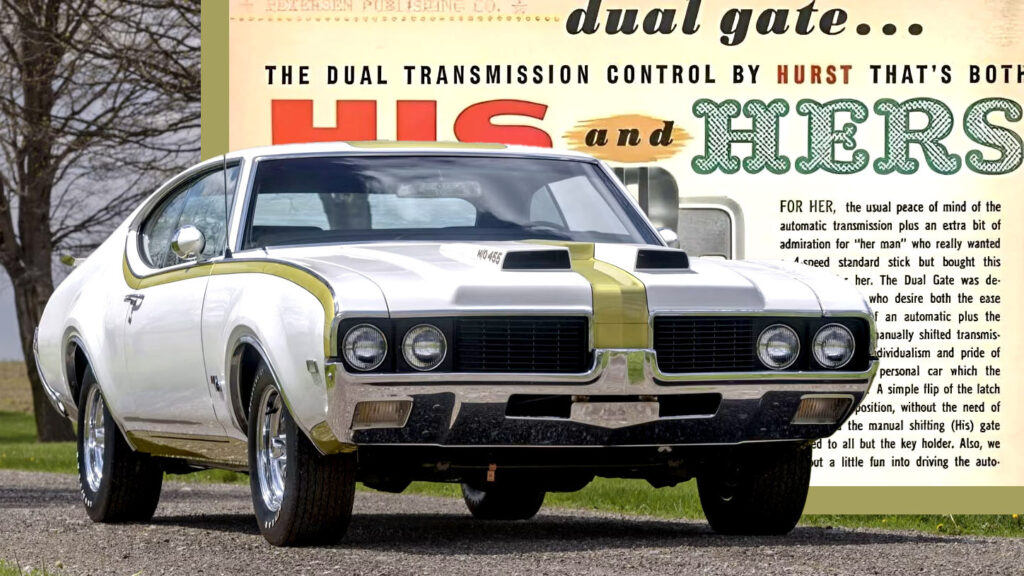


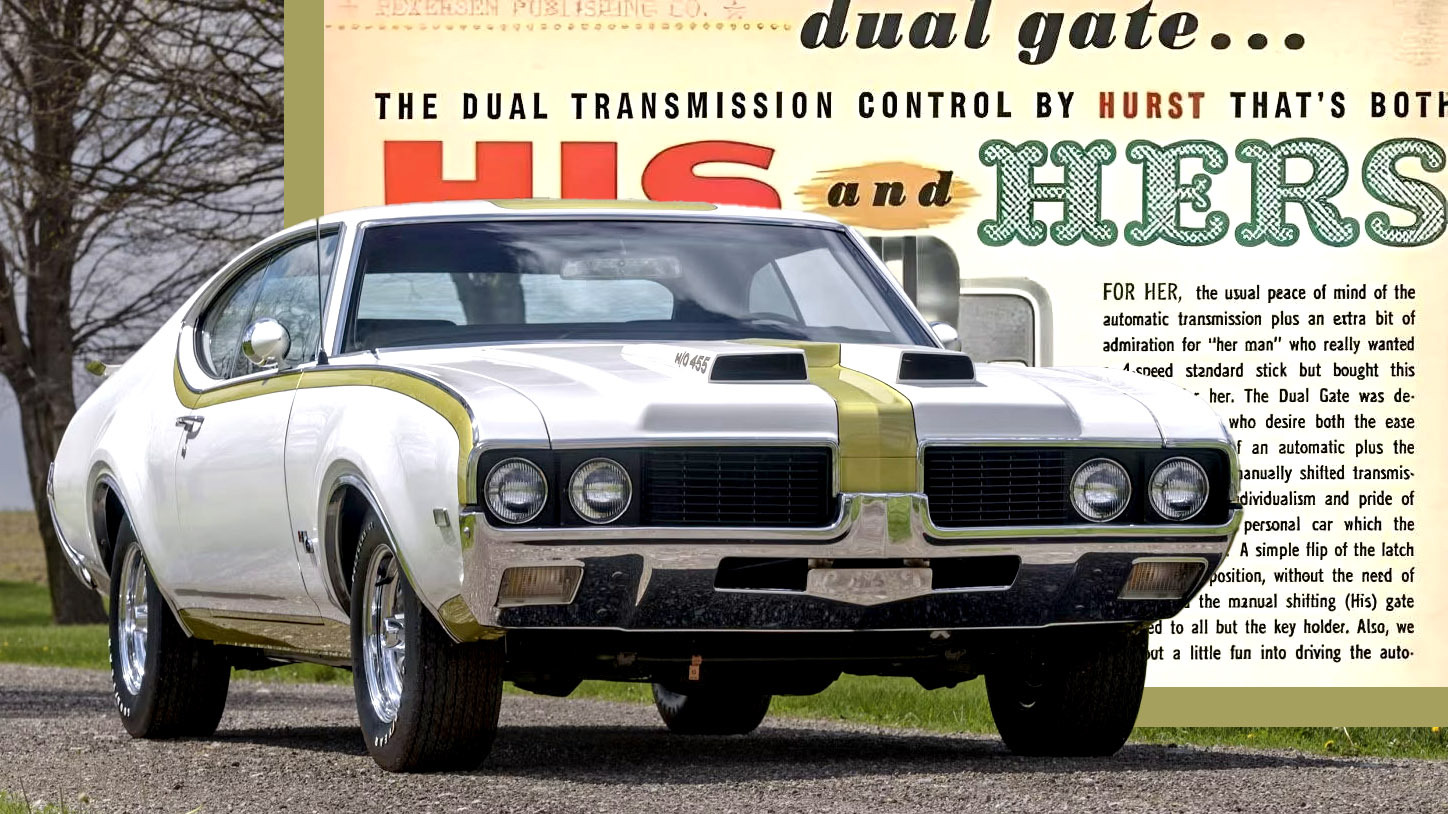
A 1969 Hurst/Olds just sold for $187,000 at Mecum’s Indianapolis auction. The car is spectacular — one of 906 built, frame-off restored with NOS parts, a 455 cubic-inch Rocket V8 under the hood. But the real conversation piece isn’t under the hood. It’s between the seats.
The Hurst Dual Gate shifter, marketed in its era as the “His and Hers” unit, gave drivers two distinct channels carved into a single console plate. Slot left and you had a standard automatic — select Drive and forget about it. Slot right, and you could manually command each shift through the Turbo 400 three-speed without the risk of accidentally banging past a gear. Two personalities in one piece of hardware, no microprocessor required.
The branding has aged about as well as a leisure suit. Period ads trafficked in gender stereotypes that would get a marketing department fired today. But strip away the cringe and the engineering underneath still holds up as an elegant answer to a question automakers are spending billions trying to solve right now.
Porsche just announced the 2027 Taycan will feature eight simulated gears layered on top of its two actual ratios, all conjured by software to make the EV driving experience feel less sterile. It’s a digital illusion designed to reintroduce a sense of driver involvement that the electric powertrain inherently strips away.
Hurst solved this problem in 1969 with a stamped metal gate and a lever.
General Motors had an official policy capping intermediate-platform engines at 400 cubic inches. The Hurst/Olds packed 455 cubes — 7.5 liters — into a body that technically wasn’t supposed to hold anything that large. The whole car existed because engineers and product planners knew how to bend the rules without technically breaking them.
The Dual Gate shifter fit that ethos perfectly. It wasn’t a radical reinvention. It was a clever mechanical workaround that gave the driver choice without adding complexity, weight, or cost.
You didn’t need a software update. You didn’t need a driving mode selector with seventeen options. You moved the lever two inches to the right and drove it differently.
This particular example, number 176 off the line, came to Indy in concours condition. The 380-horsepower V8 breathes through the factory exhaust setup. The Firefrost Gold and white paint scheme is correct, and every detail was restored to factory specification, which is partly why it commanded nearly $190,000 in a softening collector market.
But the broader point lingers. More than five decades separate the Dual Gate from Porsche’s simulated gearbox, yet both are trying to accomplish the same thing — make a driver feel more connected to what the car is doing. One uses lines of code running on high-speed processors. The other uses a physical gate you can feel click under your palm.
The muscle car era produced plenty of gimmicks that deserved to die. The His and Hers shifter, name aside, wasn’t one of them. It was honest hardware solving a real problem, and it did it so well that the entire industry is still chasing the same solution — just with a lot more silicon and a lot less soul.
Share this Story