
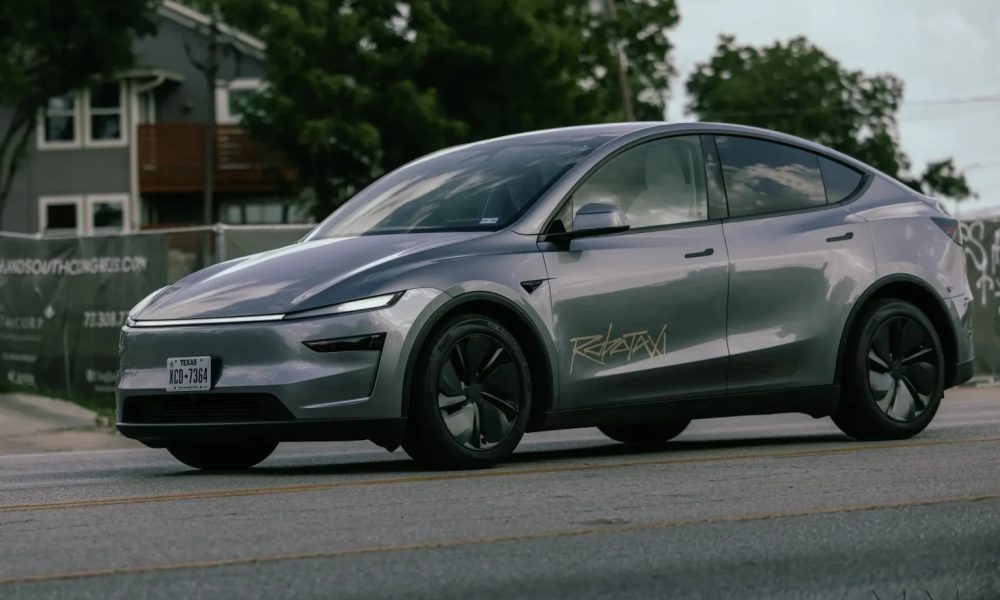


Tesla expanded its Houston Robotaxi geofence on Saturday, and the new boundary just happens to be shaped like a rocket. CEO Elon Musk called it a coincidence. The official Tesla Robotaxi account posted “Houston, we have liftoff.”
The prior service zone covered roughly 25 square miles across Jersey Village, Harvest Bend, and the Willowbrook corridor along U.S. 290 and State Highway 249. The new boundary stretches southeast toward Bellaire and closer to central Houston, swallowing the old zone inside a larger one. It is the first meaningful geographic expansion in Houston since the service launched there on April 18 alongside Dallas.
Houston riders can book unsupervised Model Y trips through the dedicated Robotaxi app. Cybercabs, the purpose-built two-seaters with no steering wheel, remain Austin-only for paying passengers. Dozens to nearly 200 of them have been spotted staging and testing on Houston lots, but public rides have not started.
The rocket-shaped map is less interesting for what it says about SpaceX than for what it says about Tesla’s autonomy ambitions. The company now runs unsupervised Robotaxi services in six cities: Austin, Dallas, Houston, Miami, Orlando, and Tampa. Cumulative driverless miles are in the millions, and the pace is picking up.
Austin got the most dramatic proof of that last weekend. During the Formula 1 United States Grand Prix, Tesla flooded the area around Circuit of the Americas with Cybercabs and Model Y Robotaxis. A photo showed a long convoy of gold Cybercabs stacked bumper to bumper on a road near the track.
Cybercab Spotter, an account that logs Austin sightings, counted 1,250 on qualifying day alone, smashing the previous record of 1,072. Tesla quietly extended the Austin service area to wrap around the circuit and pushed the cutoff to 1 a.m., up from 11 p.m. just weeks earlier. The Texas automated vehicle registry listed 463 Cybercabs in Austin by Sunday, up from the 300-plus Tesla claimed on October 10.
Waymo, which also runs in Austin through Uber, does not reach COTA and made no race-day announcement.
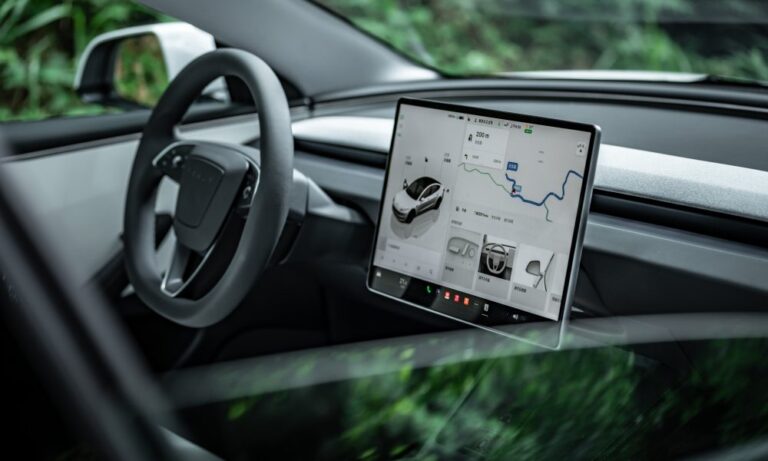
Software is moving just as fast. Within two weeks of a rider requesting rear camera access inside the Cybercab, Tesla shipped it. Passengers can now pull up a live rearview feed mid-trip, tap to cycle through other cameras, and activate a quiet mode that kills the screen entirely.
In a vehicle with no mirrors and no rear window, these are not luxury features. They are basic spatial awareness.
Dallas is next in line for Cybercab rides in November. Tesla’s AI chief Ashok Elluswamy has said 2 a.m. operations are coming “pretty soon,” with 24/7 service targeted before year-end. The company also plans to deliver Cybercabs to outside fleet operators before 2026 closes, which would put autonomous vehicles it does not directly control on public roads for the first time.
Waymo launched its own fully driverless Houston service in August, making the city one of the few markets where both companies compete head to head with no safety driver in the car. The geofence expansion puts Tesla’s coverage closer to central Houston, tightening that overlap.
The rocket outline on the map will grab social media attention for a day or two. The real story underneath it is quieter and more consequential. Tesla is stretching its autonomous territory across Texas and Florida at a pace that looked unlikely even six months ago, and the fleet numbers are starting to match the rhetoric.
Whether the Cybercab pipeline can keep up with the geofence expansion is the question nobody at Tesla has answered yet.
Share this Story