
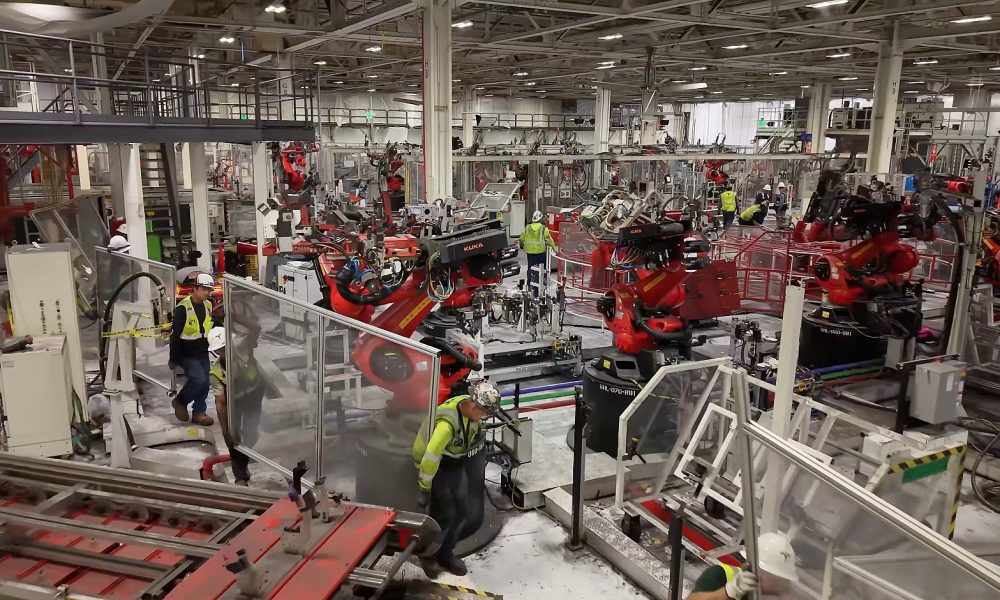


Forty-six days. That’s all it took Tesla to rip out the assembly line that built the Model S and Model X, the two vehicles that transformed the company from a Silicon Valley curiosity into a legitimate automaker. The Fremont factory floor where Tesla’s luxury sedans and SUVs rolled off for over a decade is now a concrete blank, cleared for something that has nothing to do with cars.
Tesla posted video of the demolition — robotic arms yanked from their mounts, concrete pits jackhammered into rubble, conveyors hauled away like scrap. The caption read “End of an era,” and for once, the corporate sentiment wasn’t an exaggeration.
The Model S launched in 2012. It was the car that proved electric vehicles could be fast, desirable, and profitable. The Model X followed in 2015, with its falcon-wing doors and polarizing ambition.
Together, they carried Tesla through its most precarious years. The last ones rolled off the line in early May 2026, capped by a signature delivery ceremony on May 20. Custom orders had already stopped in April.
Now that factory space belongs to Optimus.
CEO Elon Musk telegraphed this move during Tesla’s Q4 2025 earnings call in January, calling the end of S and X production an “honorable discharge.” The replacement plan was never ambiguous: convert the Fremont line into a dedicated Optimus humanoid robot manufacturing operation targeting one million units per year.
Full-scale production on the converted line is expected to begin in late July or August. Tesla claims limited Gen 3 Optimus production is already underway at Fremont, with internal targets pointing toward tens or even hundreds of thousands of units by the end of 2026. A larger second-generation facility is under construction at Giga Texas, with potential capacity reaching into the millions.
The speed of this transition tells you everything about Tesla’s priorities. A 46-day teardown isn’t careful decommissioning. It’s a company in a hurry to become something else entirely.
Musk has said publicly he believes Optimus could surpass Tesla’s entire automotive business in scale and value. He’s called it potentially the most popular product of all time. Those are breathtaking claims for a robot that hasn’t yet shipped commercially in meaningful volume — but Tesla is betting real factory floor on them, not just slide decks.
Meanwhile, the rest of Tesla’s vehicle lineup continues. The Model 3 and Model Y dominate sales. The Cybertruck occupies its own strange niche. A new affordable model is in the pipeline. But none of those programs required the sacrifice of an existing production line to make room.
The Fremont factory has always been a symbol. It was the old NUMMI plant, a joint venture between GM and Toyota that closed in 2010. Tesla bought it for a fraction of its construction cost and turned it into the birthplace of the modern EV industry.
Every major milestone — the first Model S, the ramp struggles, the production hell Musk famously described — happened under that roof. That history is now rubble and scrap metal, cleared to make room for humanoid robots designed to work in warehouses, factories, and eventually homes.
Whether Optimus delivers on Musk’s predictions or becomes another timeline that slips, the physical reality is already settled. The machines that built the cars are gone.
Tesla isn’t just adding robotics to its portfolio. It’s subtracting vehicles to make room. That’s not diversification. That’s a bet.
Share this Story