
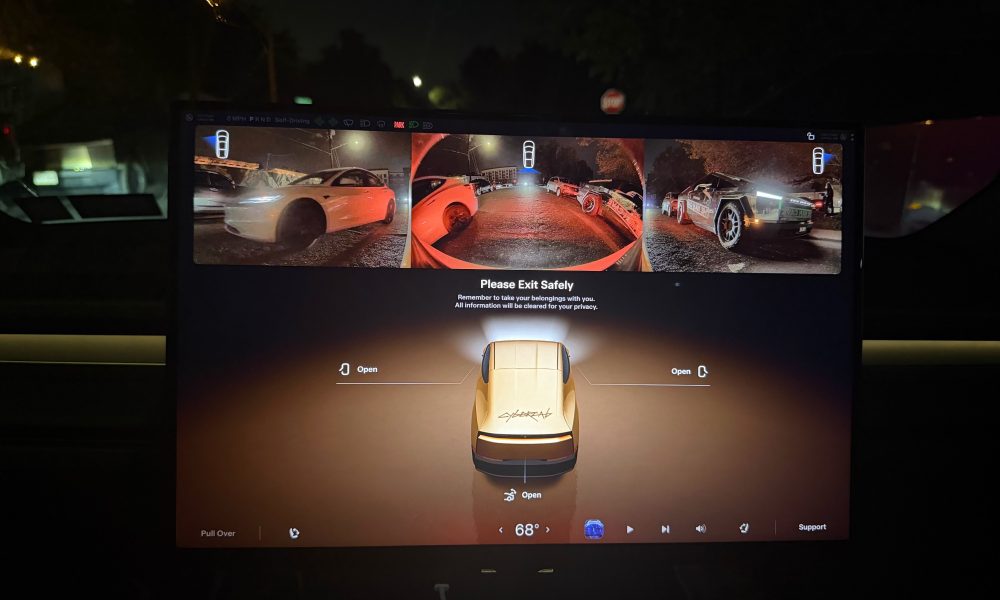


A feature request posted to social media earlier this month became a live update in Austin Cybercabs by Friday night. Rider Dan Burkland had asked Tesla to let passengers pull up rear and repeater camera feeds during trips, “especially for peace of mind.” Tesla UI engineer Evan responded with two words: “In development.” Fourteen days later, riders have it.
Austin rider Ethan McKanna was the first to post about the change, sharing a photo of a live rearview camera strip across the top of the Cybercab’s center display. Another Cybercab trailed behind on a bridge. Tapping the feed cycles through additional cameras, and swiping hides or shows the view.
Until this update, Cybercab passengers could only see exterior camera feeds on the “Please Exit Safely” screen at the end of a ride, a safety measure for checking for cyclists before opening a door. Mid-trip? Nothing. You sat in a windowless pod and trusted the machine.
That blind spot is baked into the vehicle’s architecture. No steering wheel, no mirrors, no rear window. The Cybercab was designed for autonomy, not for the human anxiety that comes with sitting in a car you cannot see out of.
Eight exterior cameras were already running, feeding Tesla’s self-driving software. Piping that video to the passenger screen was a software problem, not a hardware one.
A second feature arrived in the same wave. Quiet mode, which darkens the entire cabin screen, surfaced a day before the camera view. Austin rider Jackson Blatz posted video of the option Friday morning.
For riders who want to sleep, or simply don’t want a glowing screen at 2 a.m., the toggle is welcome. Tesla published no release notes for either change.
The speed of the turnaround is the real story. Two weeks from a public request to a deployed feature, with no fanfare and no announcement, is fast by any automaker’s standard. It is especially fast for a safety-adjacent feature in a driverless vehicle carrying paying passengers.
There is also a Grok fingerprint on the camera work. Yun-Ta Tsai, a senior staff engineer on Tesla’s AI team, said the camera view tuning was “optimized with Grok” and that part of the algorithm was written by programming fixed-function hardware directly, without consulting a datasheet. He did not specify which part. Grok Bot is already active across every Cybercab and the Model Y Robotaxi fleet in Austin after Tesla deployed the agent in September.
Both features land during a week packed with Cybercab updates. A redesigned Live Activity for iPhone and Apple Watch went live, along with trip sharing so friends or family can track a ride in real time. The cumulative effect is a product that looks less like a beta experiment and more like a service being groomed for commercial scale.
That scale is coming. On Tesla’s third quarter earnings call, Lars Moravy said the company is targeting Cybercab deliveries to outside customers before the end of 2026. Selling a doorless, mirrorless, windowless vehicle to fleet buyers demands a level of passenger comfort that goes beyond autonomy working correctly. People need to feel like they can see what is happening around them, even if they cannot touch the wheel.
Tesla has not said whether the rear camera view or quiet mode will roll out to Model Y Robotaxis running in the same Austin network. The Model Y has a rear window. The need is different, but the expectation, once set, tends to spread.
Share this Story