
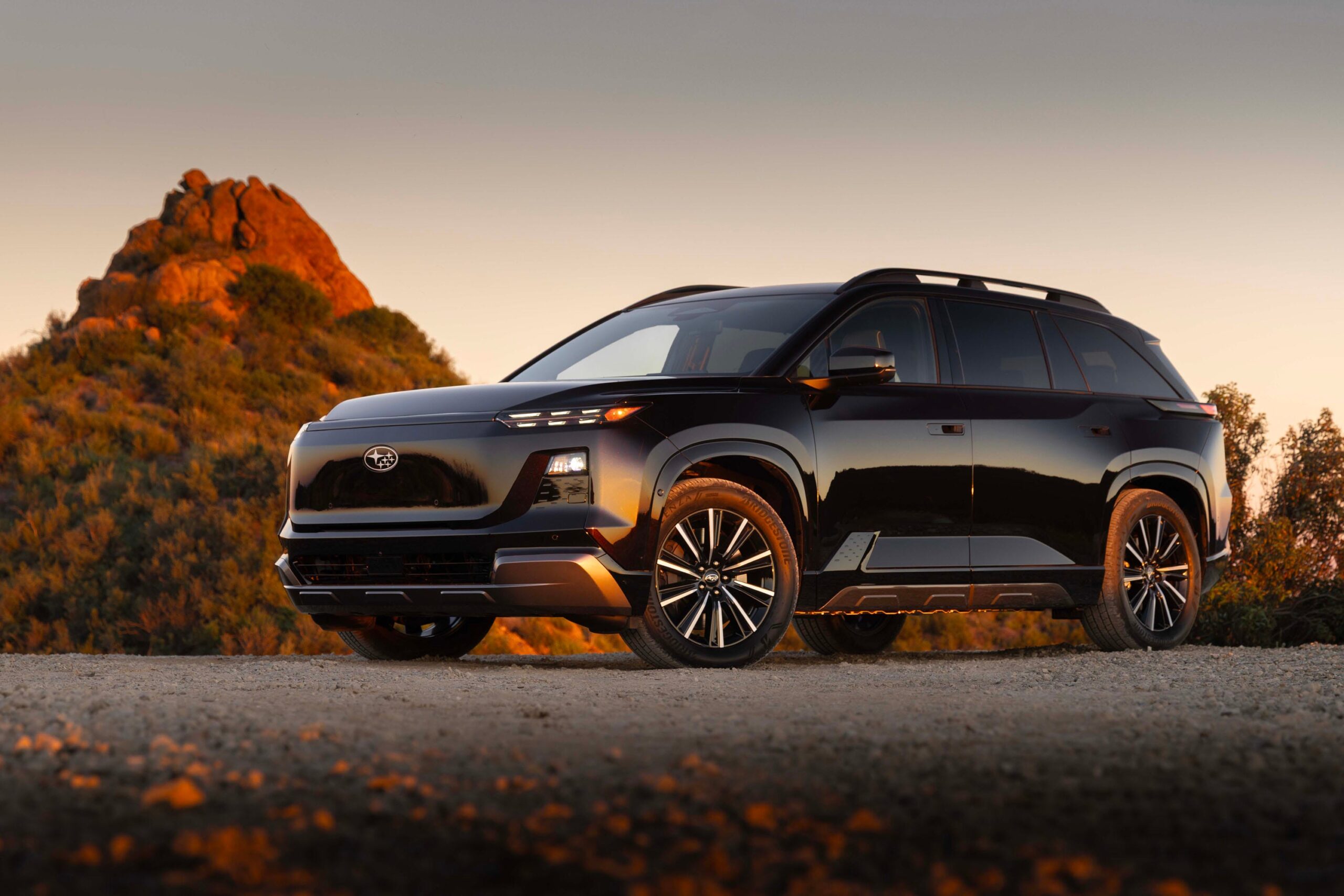


The Subaru Getaway was supposed to reach customers by the end of 2026 as a 2027 model. It won’t. Delays have pushed the brand’s first three-row electric SUV into early 2027, now wearing a 2028 badge.
That slip matters more than a calendar shuffle. The Getaway is Subaru’s largest EV yet, and it lands in a segment where Kia and Hyundai have already set the terms.
The basics are respectable. Every Getaway gets a dual-motor all-wheel-drive powertrain making 420 horsepower, a claimed 0 to 60 mph time of 5.0 seconds, and a standard NACS port that plugs straight into Tesla’s Supercharger network.
Estimated pricing runs from roughly $55,000 for the Premium to about $60,000 for the Limited and $65,000 for the Touring. Subaru hasn’t confirmed those numbers.
Then there’s the sibling. The Getaway comes out of a joint venture with Toyota, and the Highlander EV is mechanically and stylistically similar. Walk into a Toyota store and you’ll find nearly the same vehicle wearing a different nameplate.
One difference works in Subaru’s favor, at least for brand identity. Toyota offers the Highlander EV with a single-motor front-wheel-drive setup, but Subaru does not.
All-wheel drive is standard. That’s exactly what the faithful expect from the Pleiades badge.
The spec sheet against the competition is less flattering. Car and Driver clocked an all-wheel-drive Kia EV9 at 4.5 seconds to 60 and an all-wheel-drive Hyundai Ioniq 9 at 4.4 seconds. Subaru’s own claim trails both.
Towing tells the same story. The Getaway is rated for 3,500 pounds, while the EV9 pulls 5,000.
For a brand that sells itself on weekend escapes, kayaks, and campers, that gap is hard to miss. And as with any EV, range drops hard once a trailer is hooked up.
Range itself is only a partial answer. Two batteries are offered, a 77-kWh pack and a 96-kWh pack.
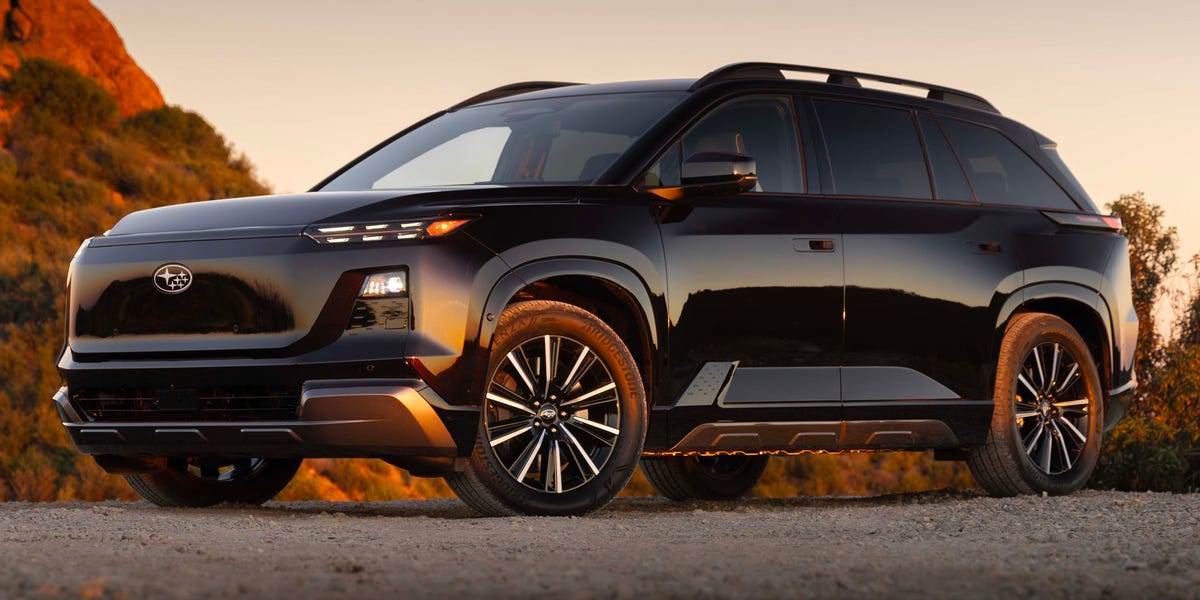
Subaru says the larger pack delivers over 300 miles. The smaller one doesn’t have a range estimate yet. On a 150-kW charger, Subaru quotes about 30 minutes to go from 10 to 80 percent.
Inside, the Getaway plays it safe and plays it well. Passenger space across all three rows is on par with the EV9 and Ioniq 9. The two-seat third row can handle adults on short trips and folds flat at the push of a button in the cargo area.
Cargo measures 16 cubic feet behind the third row and 46 with it folded. A 14.0-inch touchscreen, a 12.3-inch gauge display, wireless Apple CarPlay and Android Auto, three-zone climate control, and heated power front seats are all standard.
The mid-range Limited looks like the sweet spot on paper, adding 20-inch wheels, a 360-degree camera, a heated steering wheel, heated second- and third-row seats, and a ladder-style roof rack. It ships with a second-row bench, and captain’s chairs cost extra. The Touring brings nappa leather and a 13-speaker Harman/Kardon system.
Ownership terms are ordinary. Basic coverage runs three years or 36,000 miles, the powertrain gets five years or 60,000 miles, and electrical components get eight years or 100,000 miles.
There’s no free scheduled maintenance.
The Getaway also has to answer a question inside its own showroom. The gas-powered Ascent, Subaru’s existing three-row, starts at $42,340 and carries a 6 out of 10 from Car and Driver.
That means the Getaway asks families for at least $12,000 more to go electric with Subaru. The alternative is walking next door and buying the Toyota.
Nobody has track numbers yet. Those arrive when the Getaway finally does.
Share this Story