
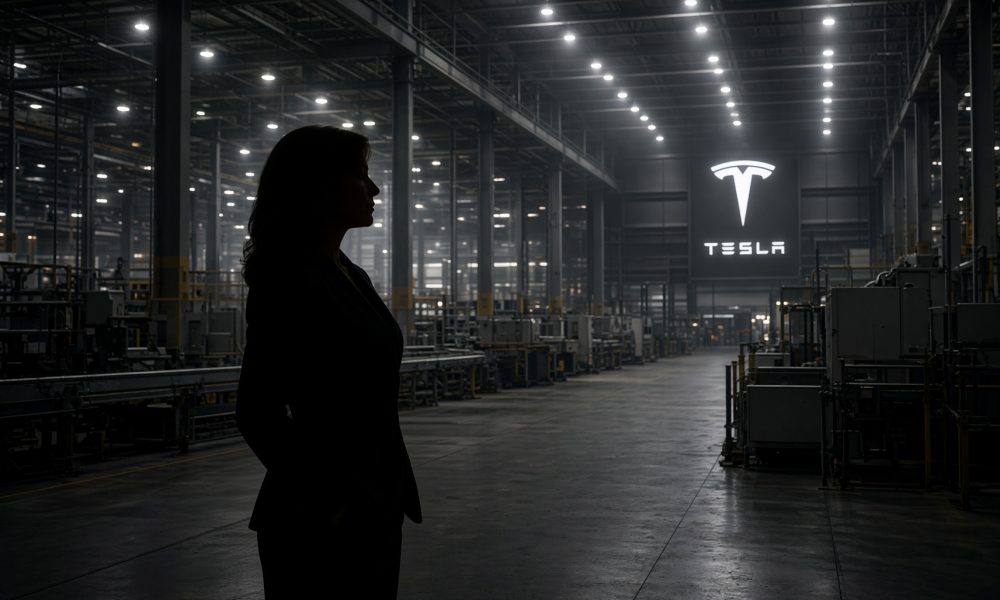


Gwynne Shotwell followed Tesla on X. That is the kind of thing that means nothing in isolation and everything in context.
The SpaceX president and COO made the move quietly over the weekend, and the merger crowd lit up immediately. No announcement accompanied it. No statement from either company. Just a follow button clicked at the exact moment Wall Street is pricing in the possibility that SpaceX buys Tesla in an all-stock deal.
Barclays analyst Dan Levy has told clients a deal could come before Tesla’s annual meeting, which must be held by December 6. He has sketched reference values of $2.1 trillion for SpaceX and $1.5 trillion for Tesla, with Elon Musk ending up holding about 37 percent of the combined entity and 56 percent of the votes. Wedbush’s Dan Ives puts the timeline further out, in 2027. The gap between those two forecasts is where all the tension lives.
Shotwell is the person to watch. At the All In Summit, sitting next to Musk, she said SpaceX personnel had already moved into xAI to fill leadership and engineering gaps. The businesses were integrating “faster than I thought,” she said, though “not fully integrated yet.”
Her portfolio has expanded since SpaceX absorbed xAI. She now oversees Grok, the AI compute buildout, and the full operational machinery of a company burning capital at a staggering rate.
The financial plumbing between the two companies is already connected. Tesla’s $2 billion xAI investment converted into a sub-one-percent SpaceX stake. The two companies share the Terafab chip project in Austin.
Musk exercised his 2018 Tesla options a week after SpaceX began trading publicly, a sequence analysts flagged as deliberate preparation for a stock-based transaction.
Now comes the earnings gauntlet. SpaceX reports Tuesday after the close, Tesla on Wednesday. Bloomberg consensus expects SpaceX to post $12.89 billion in revenue and its first profitable quarter since going public, with about 65 percent growth from Q2.
Analysts project roughly $6.4 billion from AI and $4.9 billion from Starlink, which should hit 14.3 million consumer subscribers. Capital spending, however, is forecast at $19.6 billion, leaving free cash flow near negative $11.6 billion.
That capex number is the one that matters most if a merger is on the table. SpaceX’s stock has already taken a beating from heavy spending, sitting 28 percent below its June high at Friday’s close of $146.03. If SpaceX burns another mountain of cash and the stock slides, any exchange ratio becomes harder to sell to Tesla shareholders.
Musk told analysts in July that combining companies “cannot be discussed on an earnings call.” But merger questions are sitting in both companies’ shareholder Q&A portals, and the Say voting window closes Monday at 4 p.m. EDT. The topic is not going away just because management cannot address it from the stage.
Tesla shareholders have their own math to do. The company expects 2026 capex above $25 billion. Converting Tesla shares into SpaceX stock means accepting exposure to a company spending even more aggressively on AI infrastructure, Starship, and Starlink expansion.
Shotwell’s follow may have been reflexive, or idle, or entirely meaningless. But the woman who runs SpaceX’s day-to-day operations chose this particular week to publicly connect herself to Tesla’s social media presence. Two earnings calls in 48 hours, a December deadline looming, and a deal structure already circulating on Wall Street.
The follow button is cheap. What comes next is not.




Share this Story