
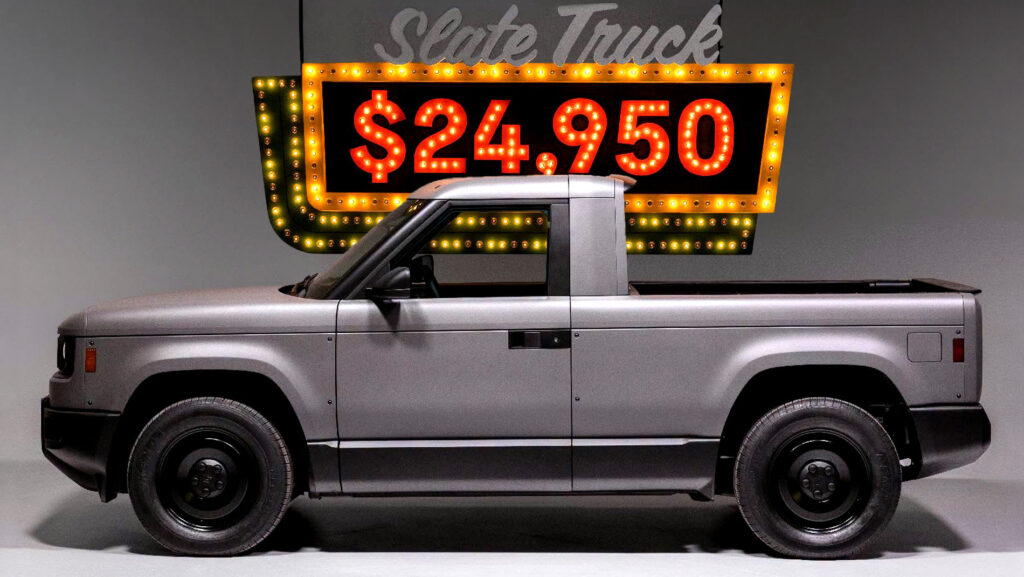


Jeff Bezos-backed Slate opened its order books today with a number that demands attention: $24,950 for an all-electric pickup truck. Before taxes, before fees, before destination charges, and very much before anything resembling the equipment list most Americans now consider non-negotiable.
No power windows. No infotainment screen. No key fob. Across all three body styles — the Blank State pickup, the Squareback SUV, and the Fastback SUV — the configurator reads like a deliberate provocation against every automaker chasing the $60,000 electric truck buyer.
The SUV variants land at $29,950 and $31,950 respectively. Even at those prices, the feature set stays conspicuously lean.
Slate’s pitch is simple enough: buy the bones, add the flesh later. The startup wants to sell a basic vehicle first and upsell accessories and configurations down the road. It’s the opposite of how Detroit has operated for decades, where margin-rich trims and option packages are baked into the business model from day one.
One pleasant surprise sits buried in the spec sheet. Range projections climbed to 205 miles on the standard battery pack, up from earlier estimates. That won’t threaten a Model Y or a Rivian R1T, but for a two-seat work truck priced under $25,000, it clears the bar for daily-use credibility.
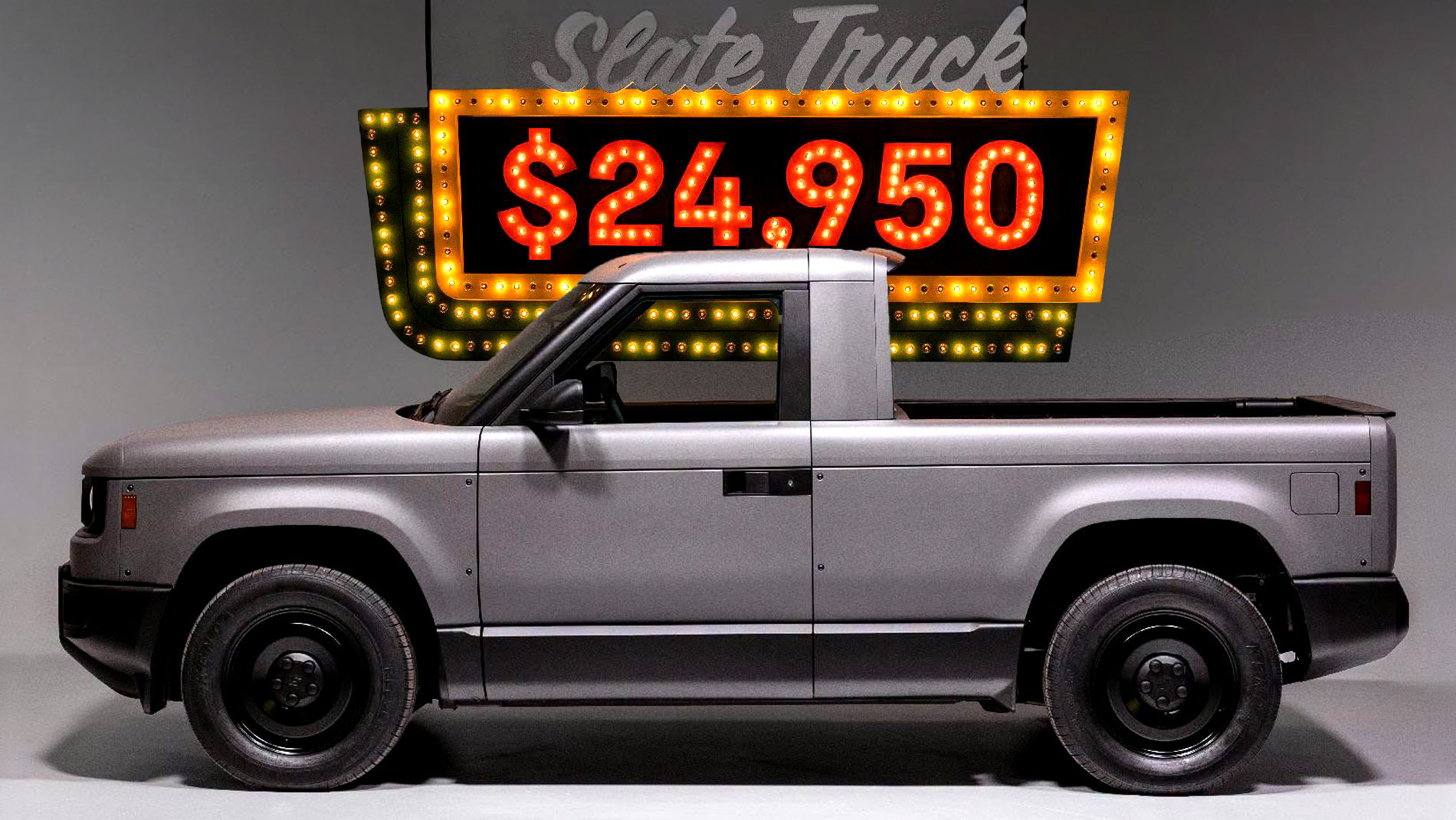
Towing tops out at 2,000 pounds. That’s a riding mower and a small trailer, not a boat. This is not a truck that replaces an F-150. Slate knows that, and the company is chasing buyers who need a bed and a battery, not a lifestyle brand.
The timing is brutal, though. When Slate first surfaced, the $7,500 federal EV tax credit was still on the table, which would have pushed the effective price below $18,000. That credit is gone, and the $24,950 sticker now stands naked without the government subsidy that once made this math almost impossible to ignore.
Customers can reserve with a $300 non-refundable deposit. Slate claims roughly 180,000 reservations already in the pipeline. First deliveries are targeted for late 2026, which in startup time could mean anything from Q4 next year to sometime in 2027 if production hiccups materialize — and they almost always do.
The 180,000 figure looks impressive until you remember that converting a $300 reservation into a $25,000 purchase is where every EV startup’s optimism meets gravity. Rivian learned it. Lordstown learned it fatally. Fisker learned it on the way to bankruptcy court.
Slate’s real gamble is philosophical. The entire American auto industry has spent two decades adding weight, screens, sensors, and subscription services to vehicles, then raising prices to match. Slate is walking the other direction, stripping the truck down to its mechanical purpose and daring buyers to accept less.
That strategy works brilliantly in markets like India and Southeast Asia, where affordable mobility sells in volume. Whether American truck buyers — conditioned by decades of leather seats, 12-inch touchscreens, and 400-horsepower bragging rights — will actually hand over money for a vehicle without power windows is an entirely different question.
The product exists. The price exists. The reservations exist. What doesn’t exist yet is a single delivered truck, a single factory running at rate, or a single quarter of revenue. Late 2026 will tell us whether Slate built a business or just a very compelling press release.
Share this Story