
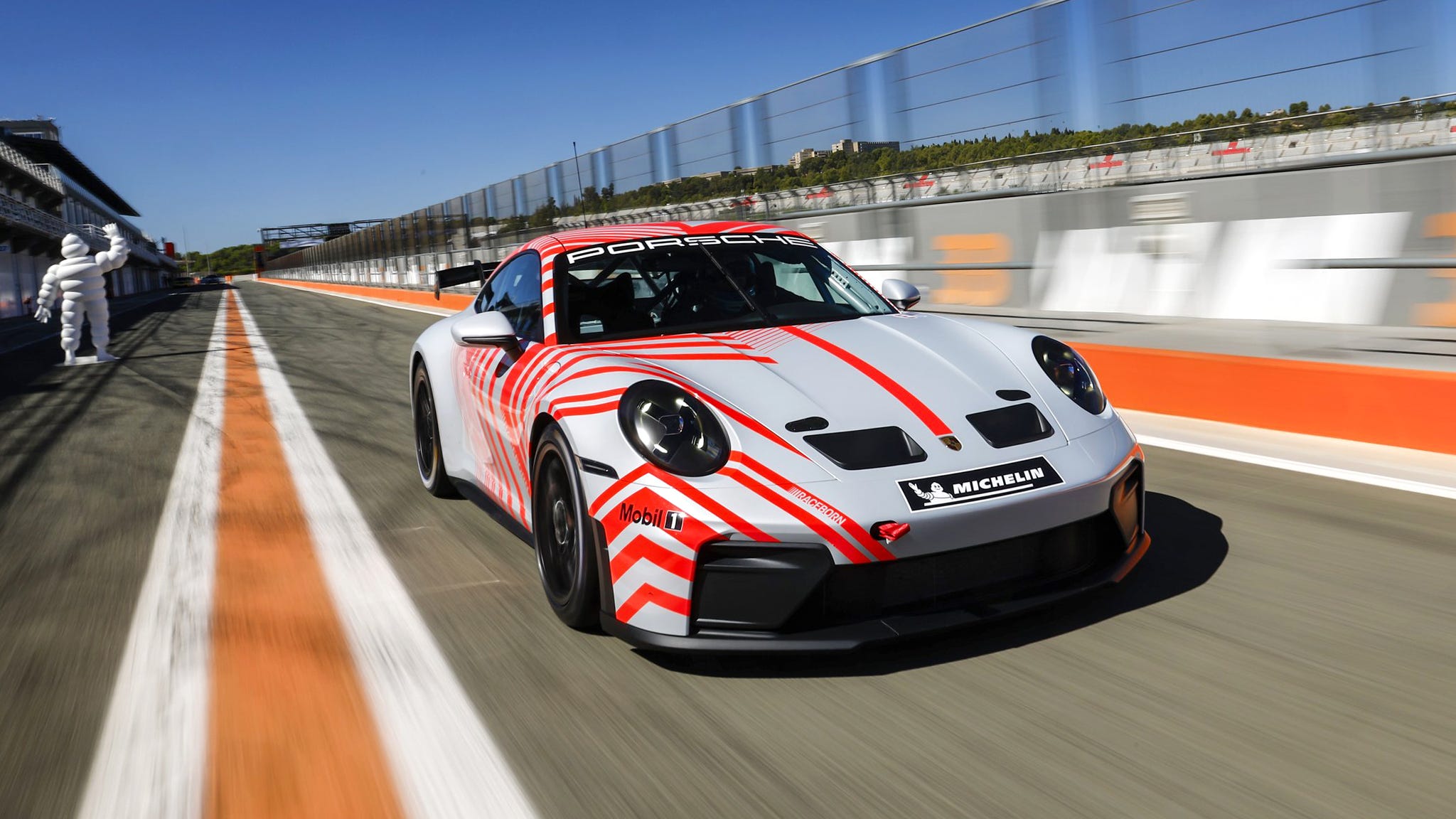


Porsche just built a factory race car that costs less than a fully optioned street 911 GT3. Let that sink in for a moment.
The new 911 Challenge, announced in late August, carries a starting price of $275,000. A road-going 911 GT3 starts at $239,850 before options, and nobody buys one without options. Bolt on the Manthey kit alone and you’re past $310,000. The Challenge undercuts that while delivering a purpose-built, track-only machine stripped of every compromise a street car demands.
This is Porsche’s new entry-level race car, slotted beneath the $375,000 911 Cup and the 911 GT4R unveiled in June. It targets drivers who are new to racing, those without the budget or schedule for higher-tier competition, and dedicated track-day enthusiasts who want a real weapon without the full commitment of a professional program.
Starting in 2027, the Challenge will be eligible for several one-make series in North America. Those include the Porsche Sprint Trophy Porsche Owners Club championship on the West Coast, the Porsche Sprint and Endurance Challenge North America by Yokohama, and the Porsche Sprint Trophy Porsche Club of America by Yokohama. If you just want one for lapping days, get in line. Porsche is filling orders from racing customers first.
Both the Challenge and Cup are built on GT3 foundations, though Porsche has quietly dropped “GT3” from their names. The distinction matters. The full 911 GT3 R competes against other manufacturers under international GT3 class regulations in series like IMSA WeatherTech, FIA WEC, and SRO World Challenge. The Challenge and Cup operate under their own single-make rules, which keeps costs more predictable and competition tighter.
Porsche won’t officially claim the title of world’s largest supplier of customer race cars by volume. No manufacturer is required to disclose production or sales numbers for its competition models. But spend five minutes watching any GT racing series anywhere on the planet and you’ll trip over 911s. If Porsche isn’t number one, it’s close enough that the distinction is academic.
The $100,000 gap between Challenge and Cup pricing tells the real story of what Porsche is chasing. Running costs for the Challenge are designed to be substantially lower than the Cup car, which matters far more to a weekend racer than the sticker price. Consumables, crash repair, engine rebuilds, and transport eat budgets alive in club racing. A car that’s cheaper to buy and cheaper to run opens the funnel to a wider pool of customers, each one a potential future buyer of a Cup car, a GT4R, or eventually a GT3 R.
This move comes at a fascinating moment for the company. Porsche recently showed off its electric Boxster prototype and revealed the Mission S hypercar, which abandoned its originally planned all-electric powertrain because customer demand for EV hypercars simply wasn’t there. The pivot back toward combustion in its halo products mirrors what’s happening in its motorsport pipeline. The customers spending real money want internal combustion, and Porsche is listening.
The 911 Challenge represents something Porsche does better than almost anyone: finding a gap in its own lineup that nobody asked about and filling it with a product that immediately makes sense. Whether the racing series built around it generate enough participation to sustain themselves is the question that won’t be answered until cars hit tracks next year.

Share this Story