
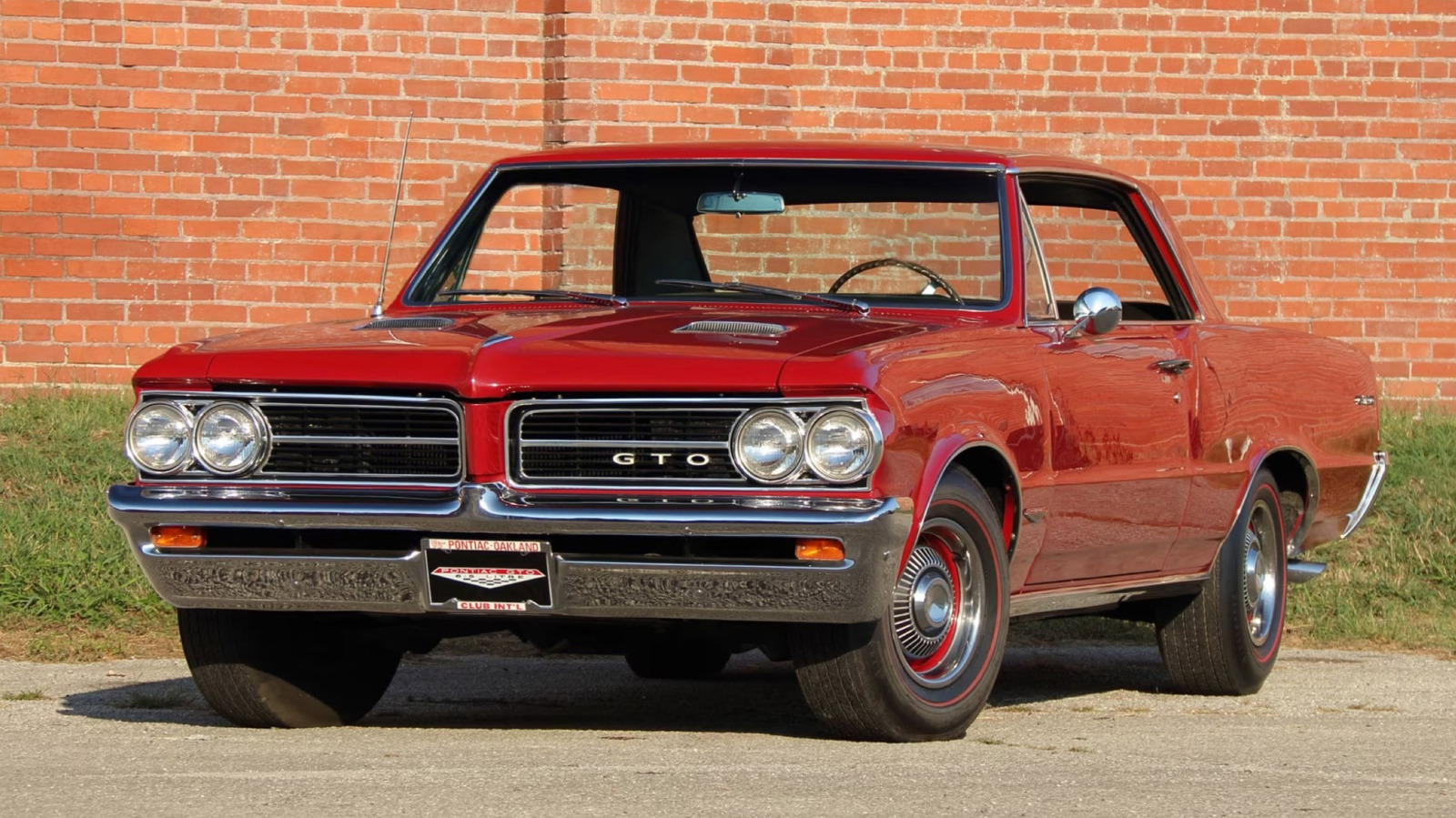


Three letters. That is all Pontiac needed to ignite the muscle car era and irritate Maranello in the process.
GTO. Gran Turismo Omologato. Ferrari coined the term in 1962 for its 250 GTO, a V12 racing weapon built to satisfy FIA homologation rules requiring 100 road cars before a model could compete. Ferrari, never one to play by the book, convinced the governing body it had built all 100 when only 36 actually existed.
Two years later and 4,500 miles west, Pontiac slapped those same three letters on a hopped-up Tempest and sold more than 32,000 of them in a single model year. If Ferrari cheated to get its GTO approved, Pontiac’s appropriation of the name was its own brand of poetic justice.
The man most often credited with the scheme is John DeLorean, then Pontiac’s chief engineer, though colleagues Bill Collins and Russ Gee helped hatch the plan. The idea was deceptively simple. Take the 389 cubic-inch V8 from Pontiac’s full-size lineup and shove it into the midsize Tempest.
GM’s internal policy forbade big V8s in intermediate cars. But DeLorean found the crack in the wall. The ban only covered base engines, so package the 389 as an option, not standard equipment, and corporate wouldn’t blink. They didn’t.
The entry-level four-barrel 389 made 325 horsepower. The Tri-Carb triple two-barrel setup pumped out 348. Car and Driver clocked a GTO at 4.6 seconds to 60 mph and 13.1 through the quarter mile, numbers that cemented the car’s legend overnight.
There was just one problem. Pontiac ad man Jim Wangers later admitted the test car had been secretly fitted with a larger 421 cubic-inch V8. The hype machine had its thumb on the scale from day one.
But the GTO was never just an engine swap. The package included a floor-mounted three-speed manual with a Hurst shifter, dual exhausts, stiffer suspension, and heavy-duty cooling. Fake hood scoops and a “6.5 LITRE” badge spelled in British English tied the car to the exotic European world it had brazenly borrowed from.
It worked. Sales hit 75,000 in 1965. By 1966, when the GTO graduated from option package to standalone model, Pontiac moved 96,946 units. Ferrari’s entire 250 GTO production run was 36 cars. Pontiac was building that many before lunch on a good month.
The peak did not last. Tightening emissions rules, rising insurance costs, and shifting tastes strangled the muscle car market by the early 1970s. Pontiac killed the GTO after 1974.
A 2004 revival using the Australian Holden Monaro as its platform offered a respectable 400-horsepower LS2 V8, but the styling was anonymous and the public shrugged. It never topped 16,000 annual sales before disappearing again after 2006.
Today a Ferrari 250 GTO commands as much as $70 million at auction. A Pontiac GTO can be had for $30,000 to $85,000, though a 1970 Judge convertible with the rare Ram Air IV engine fetched $1.1 million in 2023.
One was a hand-built Italian racing machine produced in numbers small enough to count on your fingers and toes. The other was a mass-market American sedan with a big motor and borrowed initials. Guess which one more people actually drove.




Share this Story