
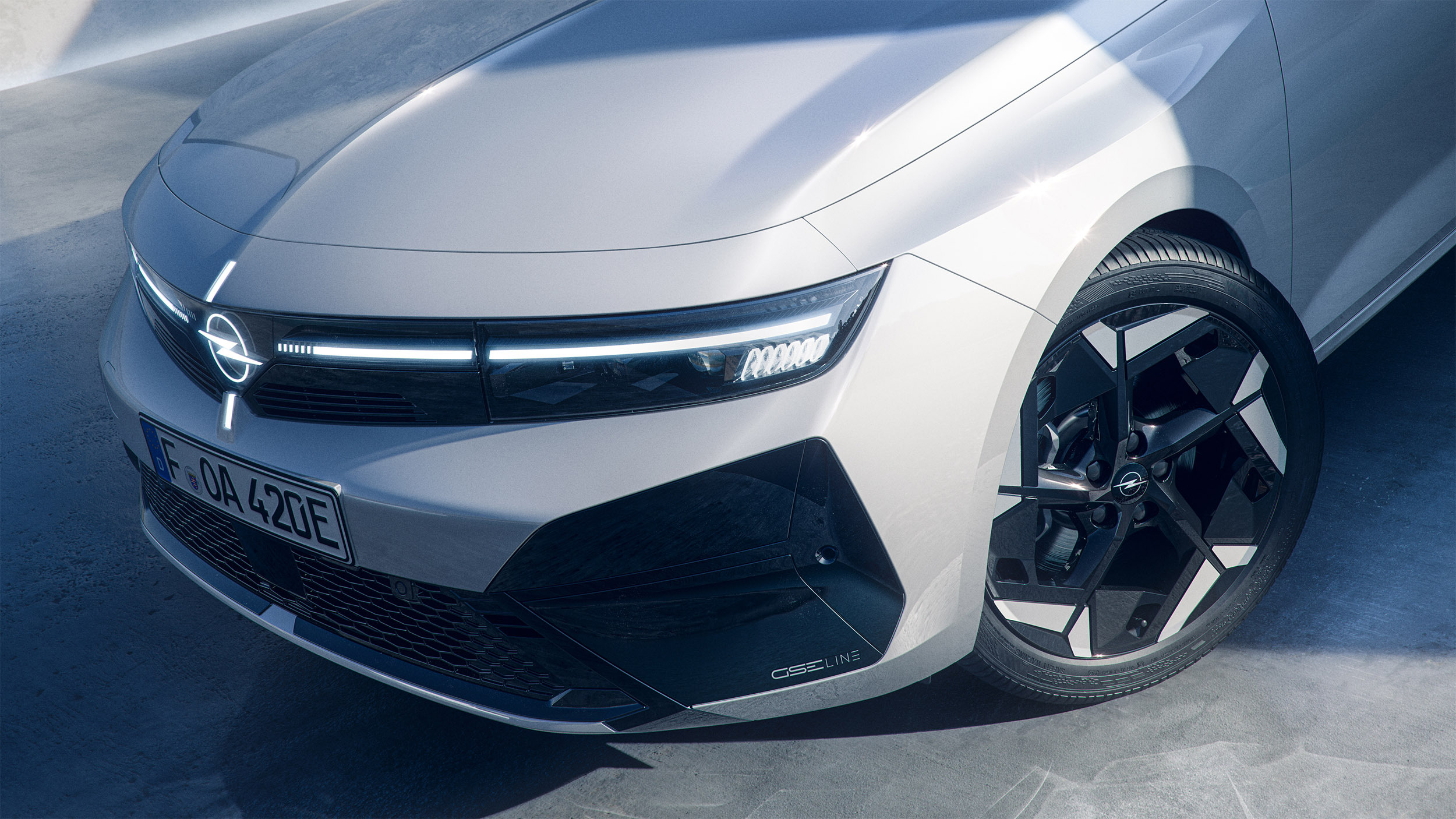


The new Opel Astra GSE Line makes 276 horsepower from a single electric motor. That matches the old turbo 2.0-liter in the Astra OPC J, the last proper hot hatch Opel sold between 2012 and 2018. And yet Opel itself won’t call this a hot hatch.
That tension tells you everything about where Stellantis is headed with its sportier trims.
The GSE Line replaces the outgoing GS trim across the entire Astra lineup, spanning gasoline, mild-hybrid, plug-in hybrid, and full electric powertrains. The flagship BEV version borrows its motor from the recently launched Corsa GSE and Mokka GSE, both built on Stellantis’s shared platform architecture. Same motor, same 276 hp output, different wrapper.
Visually, the package delivers glossy black accents around the front intakes, discreet “GSE Line” badging, a trim-specific LED color in the Vizor grille, and 17-inch diamond-cut wheels with an optional 18-inch upgrade. Inside, you get yellow contrast stitching, aluminum sport pedals, and optional sport seats with integrated headrests. The dual 10-inch display cockpit carries over unchanged.
What you apparently don’t get is a chassis to match the power figure.
Opel made no mention of suspension revisions, retuned steering, or recalibrated stability control. The old Astra GSe plug-in hybrid, which made just 222 hp, came with Koni FSD dampers, a 10mm ride height drop, stiffer springs, and sharper ESP calibration. The new GSE Line, packing 54 more horsepower in electric form, seemingly rides on the standard setup.
Marc Fetzer, Opel’s Vice President of Current Product, framed it as combining “extra sportiness” with “maximum practicality for everyday use” while offering customers “free choice” between powertrains. Read that carefully. The priority is breadth, not depth.
Every engine option gets the GSE Line badge. The sport is in the appearance, not necessarily the engineering beneath it.
This is the Stellantis playbook in action. A single electric motor gets deployed across Corsa, Mokka, and Astra. Trim levels are cosmetic packages layered on top.
The hot hatch, a car that demands bespoke suspension tuning, a limited-slip differential, and real chassis development, remains too expensive to justify for a brand that shares everything from doors to dashboards with Peugeot.
The old Astra OPC was a focused machine. It had a mechanical limited-slip diff, HiPer strut front suspension, Brembo brakes, and a turbocharged engine tuned specifically for the car. It existed because Opel’s engineers in Rüsselsheim had the autonomy and budget to build it. Under Stellantis, those days are over.
Opel will show the GSE Line publicly at the Paris Motor Show next month, with sales starting in spring 2027. More GSE Line models are coming later that year, likely including the Grandland SUV.
The Astra still has no answer for the Golf GTI. It has no answer for the Renault Mégane R.S. successor, either. What it has is a trim level that borrows a number from the OPC era and wraps it in a package that prioritizes showroom appeal over driver engagement.
Somewhere in a Stellantis spreadsheet, that math checks out. Whether it checks out on a B-road is a different question entirely, one Opel doesn’t seem eager to answer.

Share this Story