
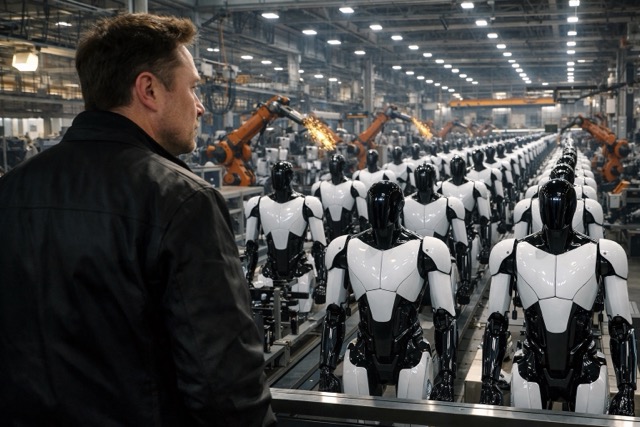


Elon Musk walked the Optimus production line at Fremont last week, arms crossed, flanked by hard hats and safety vests. The photo looked triumphant. His words told a different story.
“No, Optimus production will be extremely slow at first, as everything is new,” Musk wrote on X on July 1. “This is not like making a car.”
That distinction matters more than the photo op. The same factory floor where Tesla built Model S sedans and Model X SUVs for over a decade is being reborn as a humanoid robot assembly line. The last S and X units rolled off in early May.
Crews gutted the space and installed modular equipment — including lines sourced from Germany and dozens of sub-lines for actuators, batteries, and specialized components — in roughly four months. Musk called the conversion timeline “insanely fast.”
Fast to build a line, maybe. But filling it is another problem entirely.
Optimus Gen 3 contains approximately 10,000 unique parts. There is no century-old supply chain to lean on. No standardized actuator vendors. No established quality-control playbook for a dexterous humanoid hand that needs to sort battery cells and eventually fold laundry. Musk himself admitted early output rates are “literally impossible to predict.
Limited production is slated to begin in late July or August. Tesla’s official Fremont factory page now lists Optimus alongside the Model 3 and Model Y as core products. That’s a symbolic move that says more about ambition than current capability.
The Fremont line targets an eventual annual capacity of one million units. A second, larger Optimus factory is under construction at Giga Texas, with volume production aimed at summer 2027 and a long-term target of 10 million units per year. Those are staggering numbers for a product category that didn’t exist three years ago.
Tesla’s Optimus timeline has been a study in controlled escalation. The concept debuted in August 2021 with a person in a bodysuit walking across a stage. By late 2022, semi-functional prototypes shuffled awkwardly under spotlights.
In 2023, they sorted blocks and held yoga poses. By early 2026, over 1,000 Gen 3 units were reportedly operating inside Tesla factories for real-world learning and AI training.
None of that is mass production. It’s prototyping at slightly larger scale.
The tension here sits between Tesla’s manufacturing DNA and the reality of pioneering an entirely new product class. Tesla knows how to stamp steel, weld frames, and paint bodies at volume. It does not yet know how to produce thousands of bipedal robots with AI-integrated movement at any speed, let alone profitably.
Every actuator, every sensor fusion module, every joint calibration protocol is being invented in real time.
Musk has a pattern: float enormous targets, then walk them back just enough to look reasonable. The million-unit Fremont capacity and the 10-million-unit Giga Texas vision sit comfortably in the aspirational column for now. Analysts talk about S-curve ramps and trillion-dollar product lines. The factory floor talks about getting the first few hundred units out the door without a showstopper defect.
Early Optimus units will handle simple factory tasks — the kind of repetitive, low-risk work that justifies putting an unproven machine on a production floor. Broader industrial deployment and consumer applications remain distant targets, dependent on reliability data that doesn’t exist yet.
Tesla is simultaneously converting Fremont, building out Giga Texas, and trying to invent an entire manufacturing discipline from scratch. The company that disrupted the auto industry is now asking investors to believe it can do the same to robotics — while openly admitting it can’t predict how many robots it will actually build.
The Fremont line coming online this summer will produce the first real data point. Not projections, not AI Day demos, not X posts. Actual production numbers. That’s when the Optimus story shifts from vision to verdict.


Share this Story