
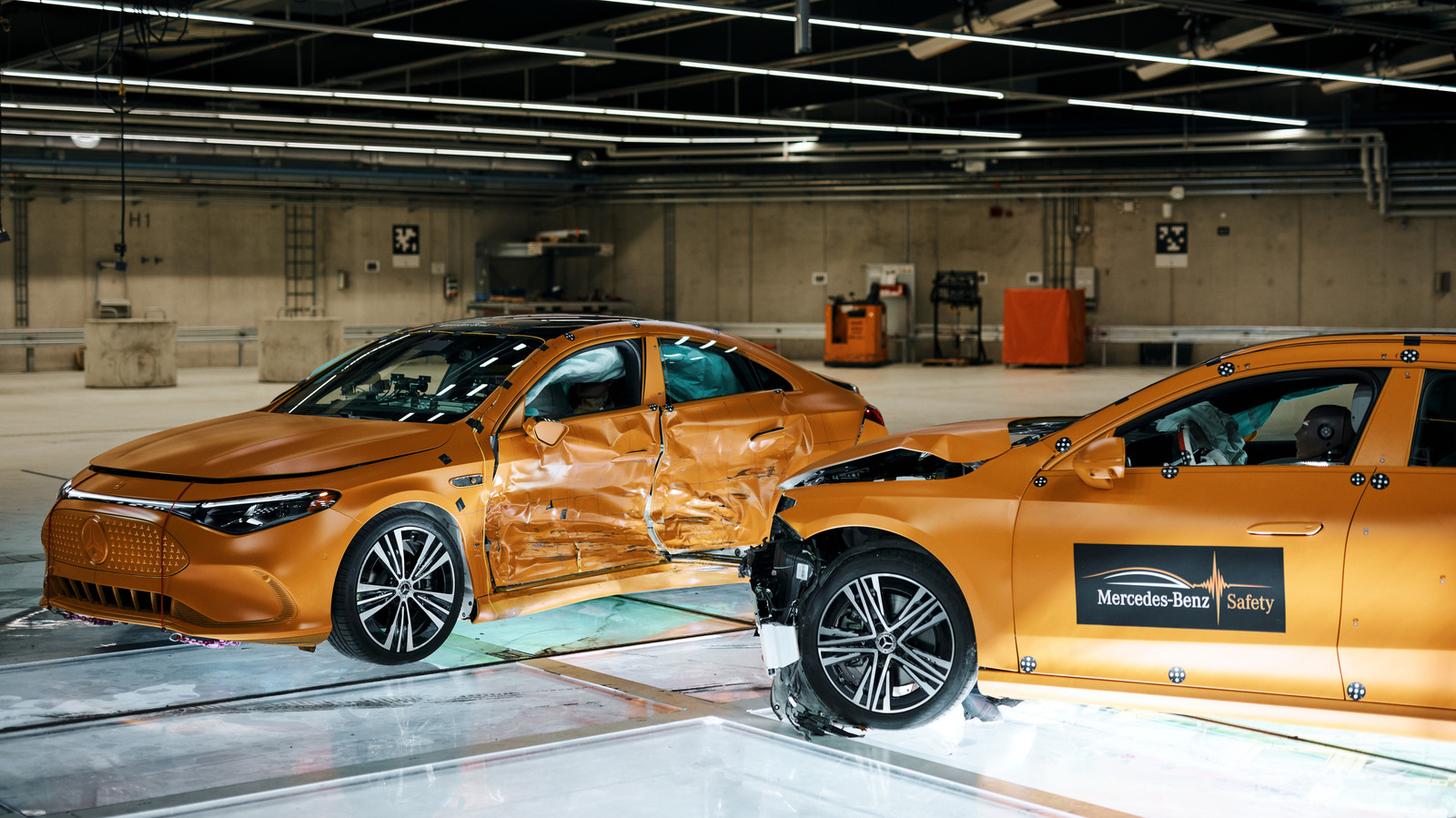


Mercedes-Benz took two of its new CLA models, pointed them at each other at 56 km/h, and let physics sort it out. A petrol-powered CLA Shooting Brake T-boned an all-electric CLA sedan in what the automaker claims is the first crash test ever conducted with two moving vehicles.
The stunt, staged to replicate a common intersection collision, was designed to showcase the safety credentials of the new CLA platform. Standard industry side-impact tests use a weighted crash cart. Mercedes wanted something more dramatic, and got it.
According to the automaker, all eight crash-test dummies recorded readings below biomechanical limits, meaning a low probability of serious or life-threatening injuries in either vehicle. The Shooting Brake’s crumple zone absorbed the brunt of the frontal energy while its airbags fired instantly. The sedan took the hit along its doors, with side glass shattering on impact, but interior airbags deployed throughout, including a center bag between the front occupants.
The test also served as a quiet rebuttal to lingering public anxiety about EV crash safety. When the electric CLA sedan was struck, its high-voltage battery automatically shut down and disconnected from the drivetrain. No thermal event, no fire risk. The Shooting Brake’s fuel system did the same, cutting supply to prevent ignition.
Then there is the matter of the pop-out door handles, a design element that has already been banned in China and faces potential prohibition in Europe over concerns that emergency responders cannot access vehicles quickly enough. In this test, Mercedes says the handles deployed automatically after impact, and the side windows opened on their own. It is a direct answer to critics who argue flush handles are a vanity feature that costs lives. Whether regulators accept a crash-test video as sufficient evidence remains to be seen.
Mercedes clearly choreographed the whole production for maximum effect. The narration accompanying the footage treats the test like a moon landing, which undercuts the engineering substance behind it. The data itself is solid. Two cars, both traveling at city speeds, collide perpendicularly, and every occupant walks away.
But there is a harder question Mercedes did not address. Both vehicles in this test sit on the same platform, weigh roughly the same, and share structural DNA. A same-family collision is the friendliest possible matchup.
The CLA sedan weighs somewhere around 4,000 lbs depending on spec. The new AMG GT SUV tips the scales near 5,985 lbs. Run that test and the conversation changes entirely.
Weight disparity remains the most dangerous variable in real-world crashes, and it is getting worse as heavier EVs and SUVs flood the roads. A symmetrical test between siblings tells you how good the structure is. An asymmetrical test between a compact sedan and a three-ton SUV tells you how good the structure is when it actually matters.
Mercedes proved the CLA can protect its occupants when the conditions are controlled and the opponent is familiar. The roads are neither of those things.

Share this Story