
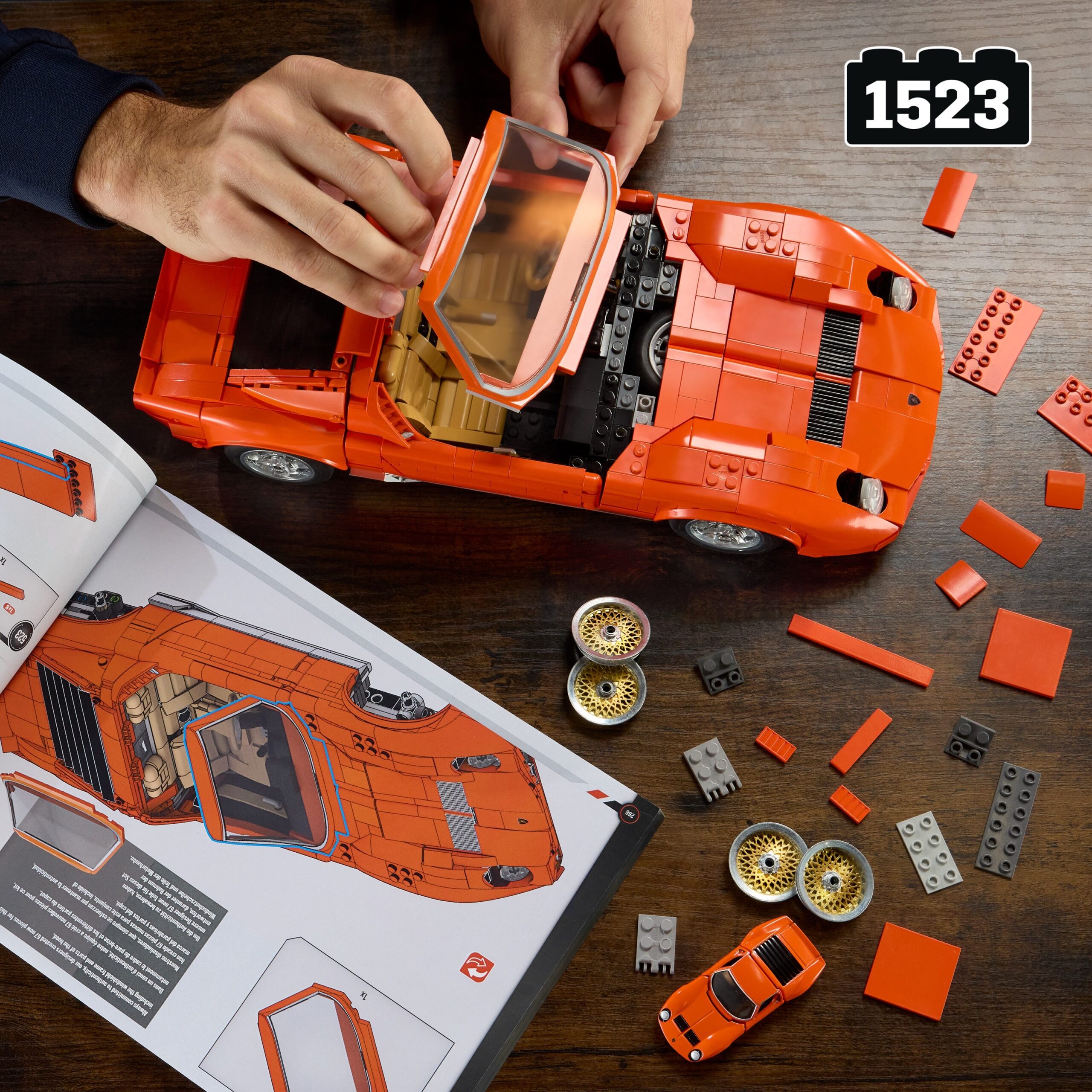


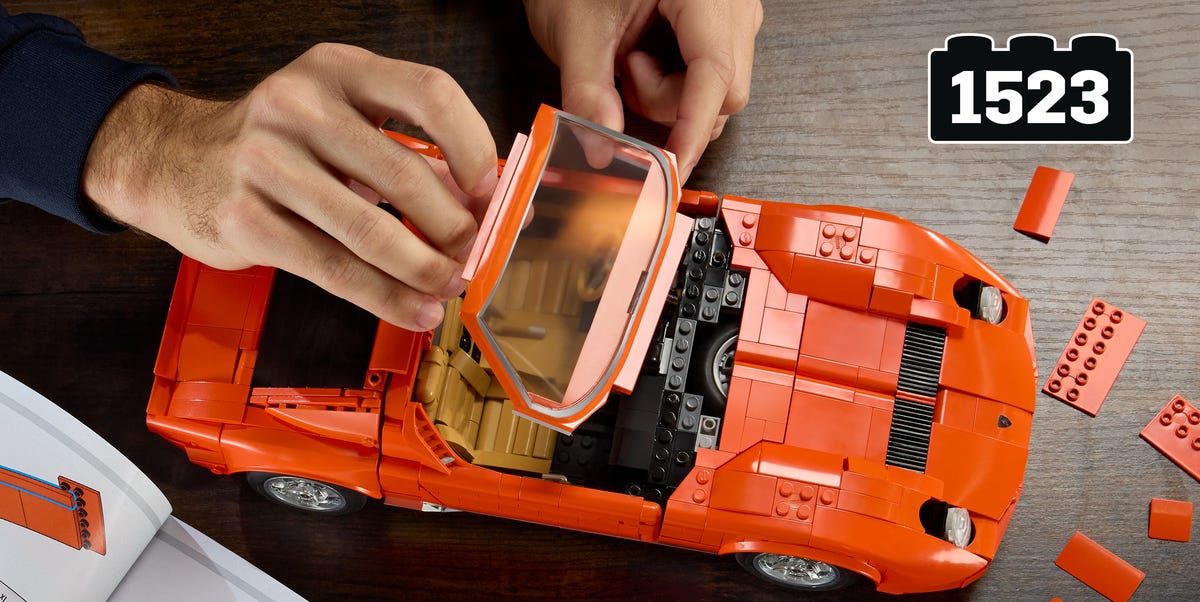
Mattel just dropped six new building sets into its Brick Shop lineup, headlined by a 1,524-piece Lamborghini Miura P400 SV in orange that lands at $129.59. The timing is deliberate — it coincides with the Miura nameplate’s 60th anniversary, and the set joins a Mercedes-Benz 300SL Gullwing as the second flagship in Mattel’s Premium Series.
This is Mattel playing offense in a category Lego has owned for decades. The Danish brick empire has built an entire sub-industry around licensed automotive sets, from Porsche 911s to McLaren F1s, commanding premium prices and fanatical loyalty. Mattel’s counter-strategy is straightforward: lean on the Hot Wheels brand, pick cars that enthusiasts actually obsess over, and undercut Lego on price while matching it on detail.
The mid-range is where the real action sits. Three new 1:16-scale models at $53.99 each include an Aston Martin Vantage GT3, a murdered-out Mk IV Toyota Supra with carbon-fiber-look pieces, and a 1984 Audi Sport Quattro in red. That Audi is a deep cut — a homologation special built so the rally car could compete in Group B.
Fewer than 300 road cars were ever made. Pairing it with the existing RS2 Avant set tells you exactly who Mattel is courting: people who know their cars, not just people who like building things.
The entry level gets three 1:32-scale sets at $21.59 each — a Lamborghini Huracán Sterrato, a 1983 Chevy Silverado street truck, and a Corvette C8.R in yellow racing livery. These are compact enough for a desk, sturdy enough for a kid to actually play with, and cheap enough to impulse-buy.
Every single Brick Shop set ships with a 1/64-scale Hot Wheels die-cast inside the box. It is a small touch that no competitor offers, and it is pure Mattel — leveraging an asset nobody else has. Lego can license a Ferrari badge, but it cannot hand you a metal car with 56 years of cultural weight behind it.
The vehicle selection across the entire Brick Shop catalog reads like a fantasy garage curated by someone who actually subscribes to car magazines. A teal 1990s Honda Civic sits alongside a Maserati MC20. The 300SL shares shelf space with the Miura. There is no algorithmic blandness here, no safe-bet SUVs or crossovers padding the lineup.
Mattel is clearly not trying to out-Lego Lego. The piece counts are lower, the prices are softer, and the scale options give collectors flexibility without demanding an entire bookcase. The 1:12 flagships are museum pieces. The 1:16 cars are the sweet spot for display without dominating a room. The 1:32 sets are stocking stuffers with substance.
The real question is whether Mattel can sustain momentum. Lego’s automotive portfolio is enormous, refreshed constantly, and backed by decades of consumer trust in build quality and instruction clarity. Mattel’s Brick Shop is still young, still proving that its bricks snap together with the same satisfying precision, still earning repeat buyers.
But the car choices alone suggest a team that understands its audience in a way that feels rare for a toy conglomerate. An Audi Sport Quattro is not a mass-market pick. A Miura is not a safe bet for kids. These are sets built for people who care about cars first and bricks second — and that niche, it turns out, is plenty large enough to build a business on.
Share this Story