
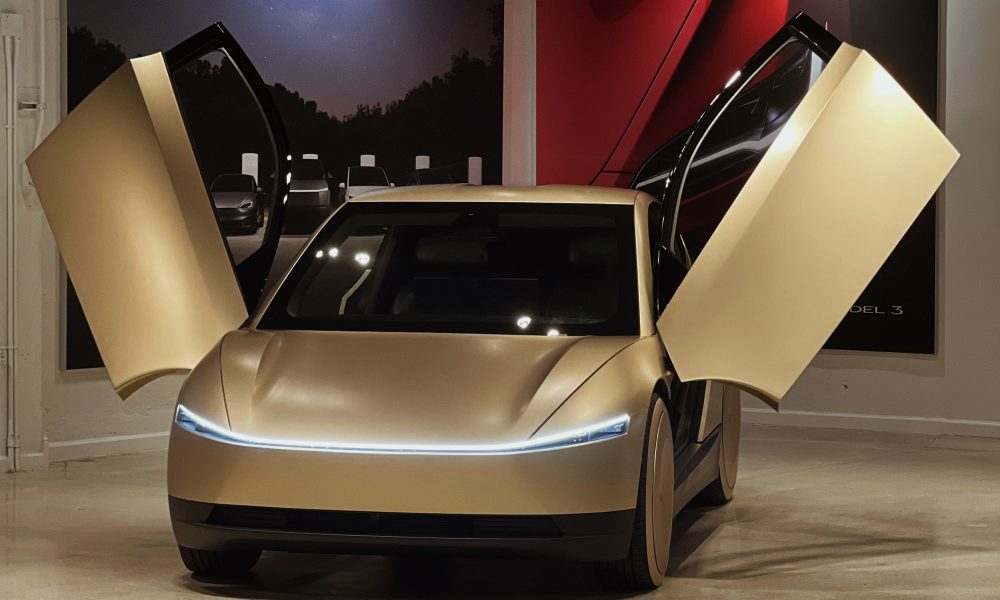


Tesla confirmed this week that the Cybercab’s gold finish isn’t painted on. It’s molded in. The color is part of the panel itself, baked into the polymer during a reaction injection molding process that compresses what traditionally takes hours in a paint shop down to minutes per panel.
The company posted the details on X, claiming the RIM process cuts manufacturing and supply chain emissions on those parts by 35 percent and eliminates 100 percent of the volatile organic compounds tied to conventional automotive painting. Those are big numbers for a process that most car factories treat as a necessary evil — and one of the most expensive stages in the entire production chain.
RIM technology has been around since the 1960s. That’s not the story. The story is that nobody has used it to replace exterior body panel painting at automotive production scale.
Tesla is embedding pigment directly into the polymer mix before it enters the mold. The panel exits already colored. No primer booth, no base coat, no bake oven, no multi-stage clear coat line.
A protective layer can be added at the mold stage or through a dramatically simplified post-process. This has been a long time coming. Elon Musk started pulling paint colors off the Tesla menu back in 2018 to simplify production.
Two years later, he told Automotive News that Tesla factories could eventually be 1,000 times more efficient than conventional plants, and he singled out the paint shop as one of the biggest bottlenecks. A traditional automotive paint facility costs upward of $200 million. It consumes enormous floor space, requires environmental controls, hazardous waste handling, and constant maintenance.
The Cybertruck was Musk’s first serious attempt to kill the paint shop entirely. Bare stainless steel meant no paint facility was needed at Gigafactory Texas. It was a bold play that ran headfirst into reality — the stainless panels proved difficult to form, expensive to finish, and polarizing to buyers.
The manufacturing ambition was right. The material choice was wrong. The Cybercab is the correction.
Instead of eliminating color altogether, Tesla found a way to eliminate the process that applies it. That distinction matters enormously. Customers still get a finished, colored vehicle while Tesla gets to skip the single most wasteful, capital-intensive, and time-consuming step in traditional car manufacturing.
A conventional paint shop runs vehicles through cleaning, phosphate coating, electrocoating, primer, base coat, clear coat, and curing — with quality inspections between each stage. The entire sequence can take eight to twelve hours per vehicle. Tesla is now claiming it does the equivalent in minutes for RIM-produced panels.
There are open questions. RIM panels need to prove they can match the durability, UV resistance, and chip resistance of traditional multi-layer automotive paint over years of road use. Repair and color matching after an accident could become a headache if the color is integral to the panel material rather than a surface coating.
Whether Tesla can scale this across its full lineup, with its broader palette of colors, remains to be seen. But the economics are hard to argue with. Eliminating a $200 million paint facility from a factory’s construction budget changes the math on every new plant Tesla builds.
Cutting VOC emissions to zero sidesteps an entire category of environmental regulation. And compressing hours into minutes at the panel level creates throughput gains that compound across thousands of units per week.
Tesla has talked about reinventing automotive manufacturing for a decade. The unibody casting was real. The structural battery pack was real. Killing the paint shop — the white whale Musk has been chasing since at least 2018 — now appears to be real too.
The Cybercab isn’t just Tesla’s first robotaxi. It’s the manufacturing laboratory where the company is finally proving the ideas it couldn’t execute with the Cybertruck.
Share this Story