
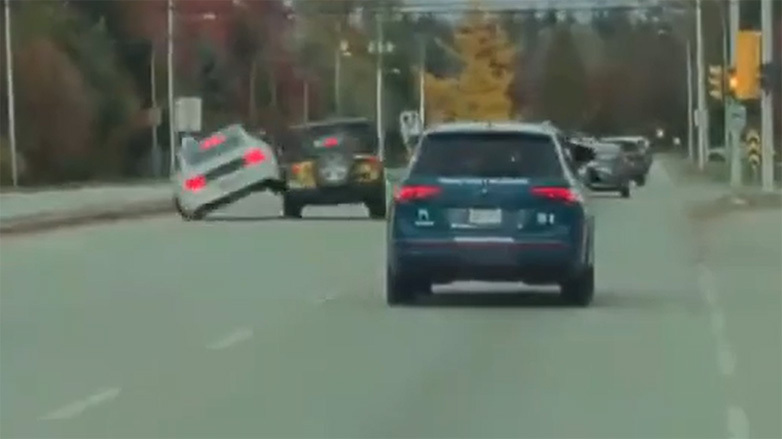


A Ford Mustang ended up on its roof after tire-to-tire contact with a Jeep at an intersection, and dashcam footage of the incident is making the rounds this week for one unsettling reason: the Mustang driver appears to have done nothing wrong.
The sequence, captured on video, shows the Mustang moving into a left-turn lane at moderate speed. A Jeep, cutting across multiple lanes from what appears to be a business exit on the far right, converges on the same space. The Jeep driver jerks the wheel right to avoid the collision, but it’s not enough, and the tires of the two vehicles make contact.
What happens next takes less than a second.
The Mustang launches upward, rolls, clears the median, and lands on its roof. The Jeep appears largely undamaged. No burnout, no road rage, no heroics — just geometry and rotational force conspiring against the lower car.
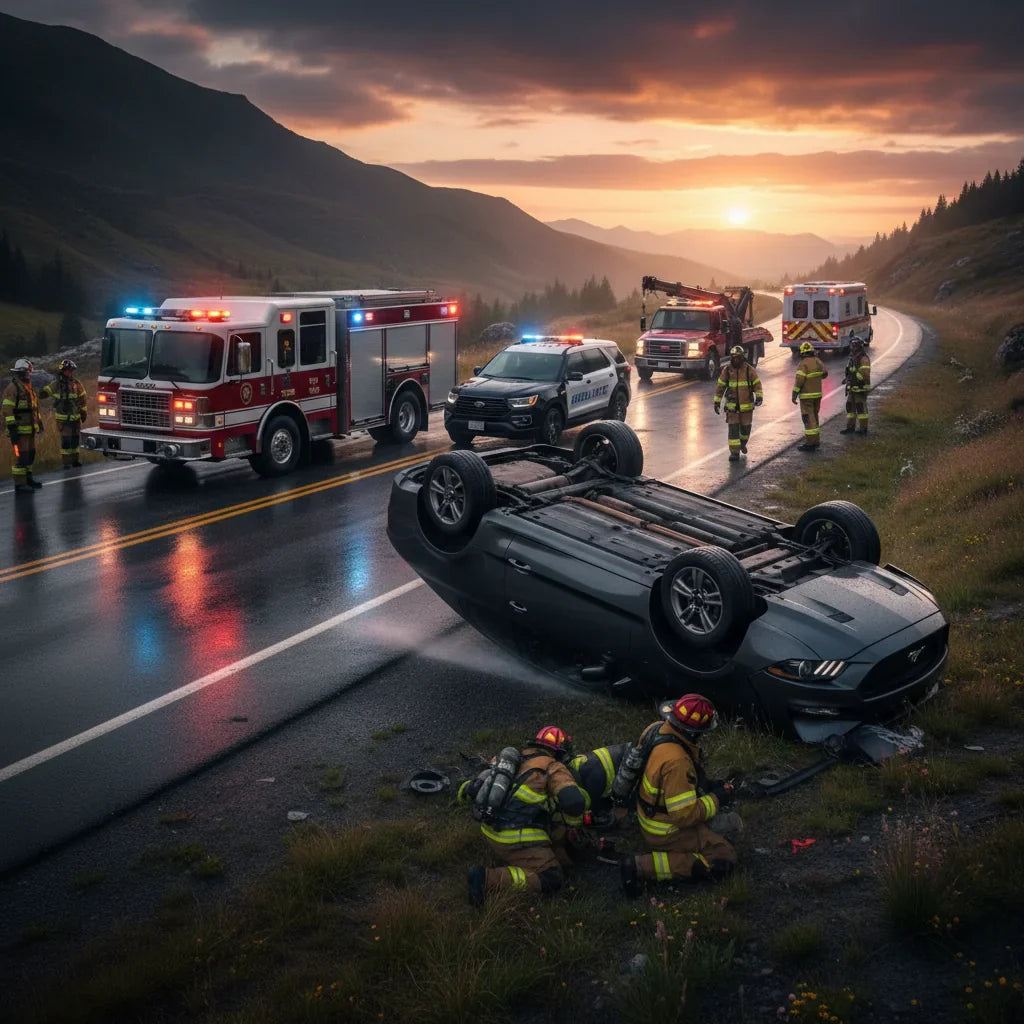
The physics are brutal and well-documented, even if most drivers never think about them. When a rotating tire meets another rotating tire at an angle, the contact point becomes a ramp. The Mustang’s suspension compresses, rebounds violently, and converts forward momentum into lift and rotation.
Once the center of gravity passes the tipping point, there’s no recovery. Electronic stability control, antilock brakes, and 50 years of chassis engineering become spectators.
This is what crash investigators call a “trip roll,” though in this case the trip wasn’t a curb or a pothole — it was another vehicle’s wheel. The Jeep’s higher ride height and taller tire sidewall created the ideal launch angle. The Mustang’s low center of gravity, normally its greatest asset in emergency maneuvers, couldn’t save it once the car was already airborne.
Modern Mustangs are genuinely capable machines in panic situations. The S650 chassis has quick steering, wide performance rubber, and an ESC system calibrated to rein in yaw before things get ugly. I’ve felt how composed the car is in hard lane changes and trail-braking exercises, but none of that matters when a Jeep’s BF Goodrich becomes your launch ramp.
The clip is a reminder that vehicle-to-vehicle contact follows its own brutal logic, separate from the tidy narratives of driver skill and safety ratings. You can check every mirror, signal every lane change, and maintain textbook lane discipline. If someone else cuts across four lanes and their tire catches yours at the wrong angle, the car goes upside down.
There’s a natural impulse to assign blame in these clips — find the reckless driver, the bad decision, the obvious error. Here, the fault appears to rest squarely with the Jeep driver, who initiated an aggressive multi-lane cut. The Mustang driver was already established in the turn lane, doing everything right, and still ended up staring at asphalt through a crushed roofline.
The uncomfortable takeaway isn’t about Mustangs or Jeeps specifically. It’s about the margin between routine driving and catastrophe being far thinner than anyone wants to admit. A few inches of tire overlap, a specific closing angle, and the right differential in ride height — that’s the entire recipe.
No amount of ESC tuning or crash-structure engineering has repealed the laws of angular momentum. The best defense remains the oldest one: space. Leave more of it than you think you need, especially near vehicles that sit higher and carry heavier wheel-and-tire packages.
The Mustang driver couldn’t have known what was coming. But the driver behind the Jeep’s wheel should have never been crossing four lanes in the first place. Sometimes the crash isn’t about who drove well — it’s about who drove into your lane.
Share this Story