
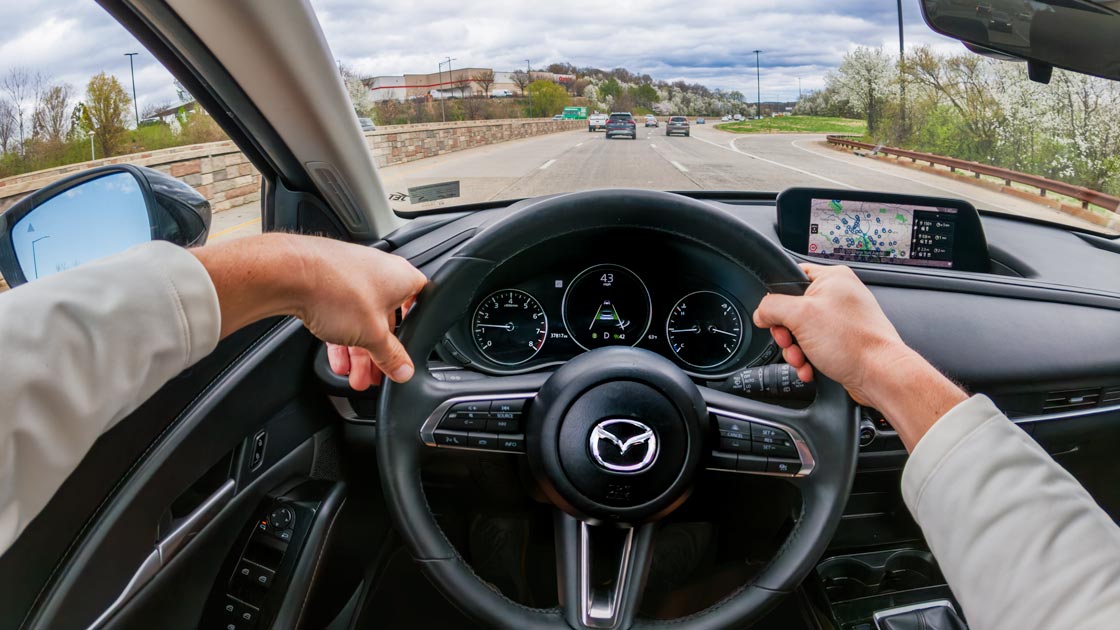


A 39 percent drop in property damage claims. That’s the number sitting at the top of a new Highway Loss Data Institute study examining Mazda’s advanced driver assistance systems across 2015–2023 model year vehicles, and it tells a story that extends well beyond one automaker’s press release.
HLDI, the insurance data arm of the Insurance Institute for Highway Safety, analyzed six bundles of safety features and four standalone systems. The finding that matters: stacking more technologies together doesn’t just add benefits, it multiplies them. Mazda’s most basic package, front automatic emergency braking with forward collision warning, cut property damage liability claims by 13 percent.
Layer on pedestrian detection, adaptive cruise control, lane departure prevention, rear AEB, high beam assist, and a driver attention monitor, and that number triples to 39 percent. Bodily injury liability claims followed a similar trajectory, dropping 9 percent with the basic bundle and 21 percent with the full suite. HLDI flagged that last figure as not statistically significant.
“These technologies are awesome,” said Matt Moore, HLDI’s chief insurance operations officer. Not exactly clinical language from an insurance researcher, but the data backs the enthusiasm.
The compounding effect isn’t just about piling on more sensors. Because the bigger bundles appeared on newer vehicles, they also carried more refined versions of each system. Mazda wasn’t just adding features over those model years — it was iterating on the ones already in the pipeline.
The latest front AEB performs measurably better than the version from 2015. Rear AEB proved particularly effective at wiping out low-speed parking lot collisions, the kind of fender-benders that fill insurance company inboxes.
Blind spot monitoring with rear cross-traffic alert, evaluated as a standalone system, pulled its weight too. Nearly 10 percent fewer property damage claims and 13 percent fewer bodily injury claims.
Not everything worked. Traffic Sign Recognition showed no clear benefit, which HLDI attributed to either system limitations or a sample size too small to draw conclusions. It’s a reminder that not every feature earns its keep just because it ships on the window sticker.
And here’s where the story gets complicated. While crashes went down, the cost of individual claims often went up. Modern sensors embedded in bumpers, windshields, and mirrors are expensive to replace.
When a car equipped with radar-guided AEB and camera-based lane keeping does get hit, the repair bill climbs. Moore offered a useful framing: crash avoidance systems disproportionately prevent low-speed incidents, the cheap ones. Remove those from the equation and the average severity of remaining claims naturally rises.
The net math still favors the technology. HLDI found that nearly all Mazda bundles and features were associated with lower total losses under property damage liability when frequency and severity were combined. That’s the metric that actually drives insurance premiums.
Mazda collected eight IIHS Top Safety Pick+ awards for 2026, more than any other brand, and Consumer Reports recently named it the safest new car brand under its new Safety Verdict rating. The HLDI study provides the insurance data receipts to match those lab results.
The broader implication reaches past Hiroshima. Every major automaker is shipping some version of these systems, but few have had their full portfolio dissected this granularly by independent insurance analysts. The Mazda data set, spanning eight model years and six progressively richer technology packages, becomes a case study in how iterative engineering compounds real-world safety gains over time.
The tension remains unresolved: cars that crash less but cost more to fix when they do. For now, the frequency reductions are winning that math. Whether that holds as repair costs keep climbing and sensor complexity deepens is the question insurers, automakers, and consumers will be negotiating for years to come.
Share this Story