
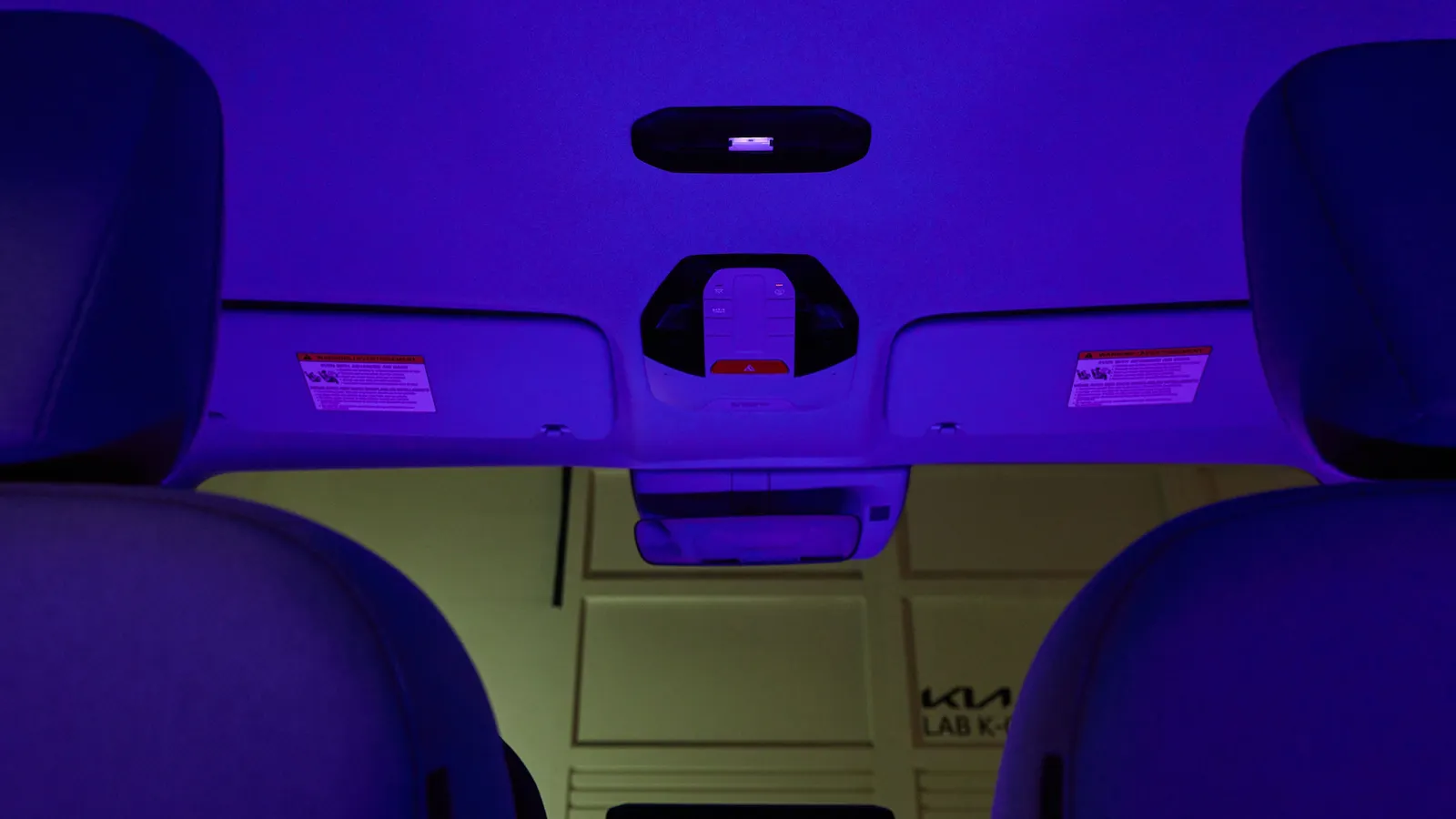


Hyundai and Kia have built an ultraviolet sanitization system that zaps bacteria and viruses inside a moving car while passengers sit in their seats. The companies call it “Plasma Care UVC,” and independent testing showed it eliminated 96.8% of airborne viruses in a simulated cabin within 30 minutes.
That number comes from South Korea’s Testing Laboratory, not from Hyundai’s own bench. It’s a meaningful distinction.
The core trick is wavelength. Conventional UV sanitizers, the kind tucked inside toothbrush holders and glove boxes, operate at 255 to 280 nanometers. That range kills microorganisms but is dangerous to exposed skin and eyes, which is why those systems only work in sealed enclosures.
Hyundai’s system uses Far-UVC light at 200 to 230 nanometers, a band that carries enough energy to shred microbial DNA but cannot penetrate the outer dead-cell layer of human skin. Hospitals and schools already use Far-UVC in high-traffic areas. Hyundai’s contribution is cramming it into the roof of a vehicle cabin, which presented a different set of engineering problems entirely.
Cars vibrate. They swing between subzero cold and dashboard-melting heat. They’re packed with sensitive electronics.
A plasma lamp designed for a hospital ceiling doesn’t survive that environment without serious rework. Hyundai’s engineers miniaturized the plasma-based emitter, hardened it against thermal cycling and road vibration, and added what they call “Optical Safety Control.” That’s a filter blocking any wavelength outside the safe Far-UVC window from reaching passengers.
“We expect it to serve as a valuable cabin hygiene solution that delivers a more pleasant mobility experience across future mobility scenarios, including autonomous driving and purpose-built vehicles,” said Han Joo Jang, a senior research engineer at Hyundai.
That quote is carefully loaded. Autonomous driving. Purpose-built vehicles. Robotaxis. Shared fleet shuttles where dozens of strangers cycle through the same cabin every day and nobody wipes down the seats between rides.
This is where the technology makes commercial sense. A private owner’s car doesn’t desperately need continuous airborne sanitization. A Waymo competitor running 18-hour shifts in Houston or Seoul absolutely does.
Hyundai is building the infrastructure for a mobility future it hasn’t fully launched yet, and cabin hygiene is one of the unsexy problems that could make or break public acceptance of driverless ride-hailing.
There’s a catch, and Hyundai is upfront about it. Plasma Care UVC is still an R&D project. It is not available in any production vehicle.
Commercialization depends on further testing, engineering validation, and navigating a thicket of international safety regulations governing UV exposure limits in consumer products. Getting a novel UV emitter certified for continuous passenger exposure across multiple regulatory jurisdictions is not a fast process. No timeline for production has been announced.
Still, the 96.8% figure in a realistic cabin-volume chamber is a strong opening hand. If Hyundai can clear the regulatory gauntlet and prove long-term durability, because plasma lamps degrade, filters cloud, and seals fail, this technology slots neatly into the autonomous vehicle hygiene gap that no competitor has publicly addressed at this level.
Hyundai isn’t solving a problem most car buyers are asking about today. It’s solving one that fleet operators will be desperate to answer tomorrow. The timing says more about Hyundai’s autonomous ambitions than any concept car ever could.


Share this Story