
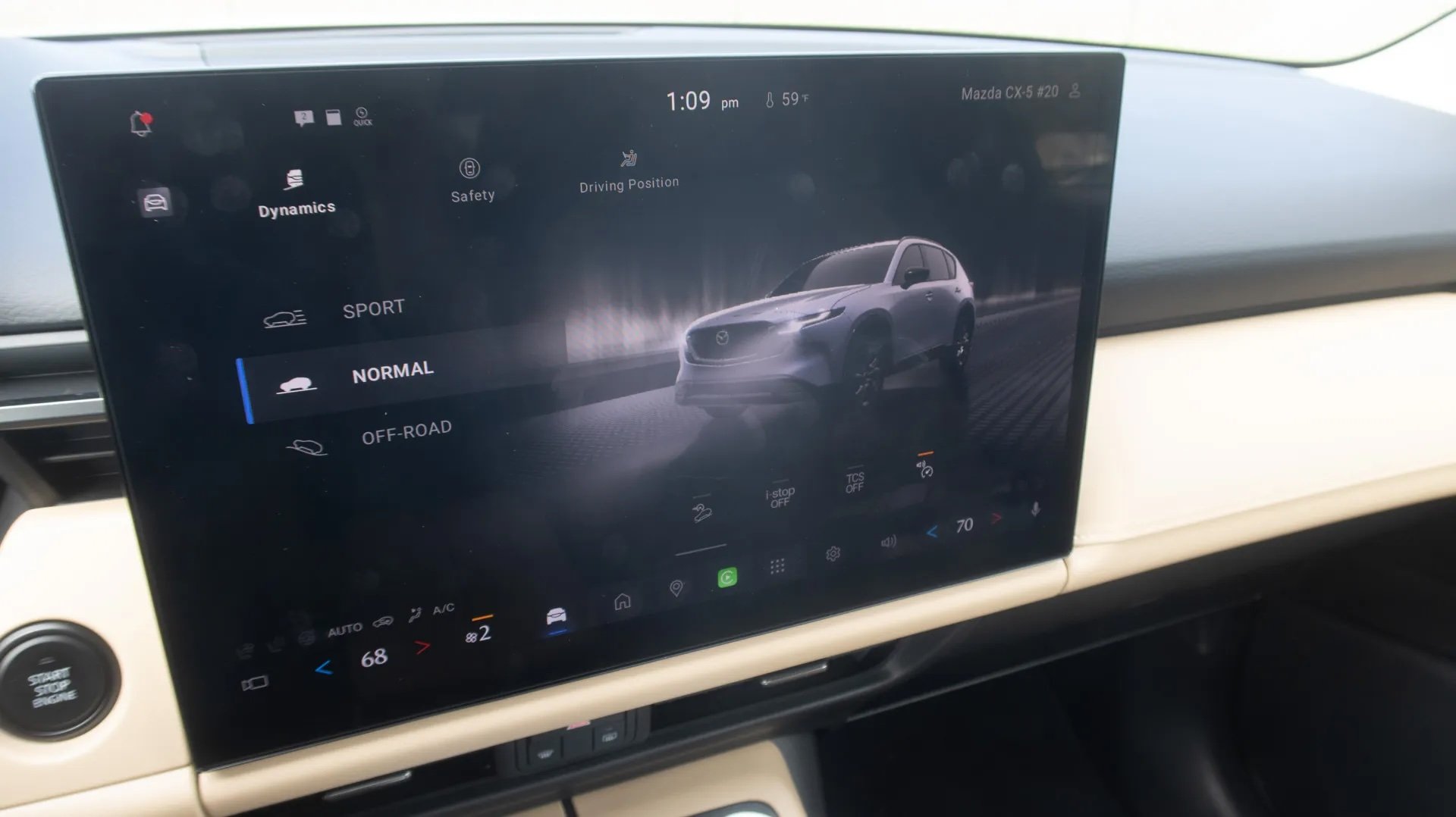


Mazda spent the better part of a decade as the auto industry’s most vocal crusader against touchscreens. The company famously removed touch capability from its infotainment systems in 2019, insisting that physical knobs and buttons were inherently safer. Engineers in Hiroshima pointed to research showing drivers’ hands would bounce on screens over rough roads, creating dangerous distractions.
It was a principled stand, one that earned Mazda praise from driving purists and safety advocates alike. That stand is now dead.
Koichiro Yamaguchi, program manager for the new CX-5, laid out the company’s reversal in terms that would have been heresy in Mazda’s own boardroom just a few years ago. His argument: physical buttons for climate control sit low on the dash, forcing drivers to look down and hunt through 15 similar-looking switches. A touchscreen, positioned higher and closer to the driver’s sightline, actually minimizes distraction.
Rather than that, it’s better to have this control on the screen,” Yamaguchi said. It’s a clean 180-degree turn, delivered without a hint of irony.
The timing is no accident. Mazda has been losing ground in interior quality perception as competitors from Hyundai to Honda have invested heavily in large, responsive displays that buyers now expect as standard equipment. Walk into any modern showroom and the screens are getting bigger, the buttons fewer.
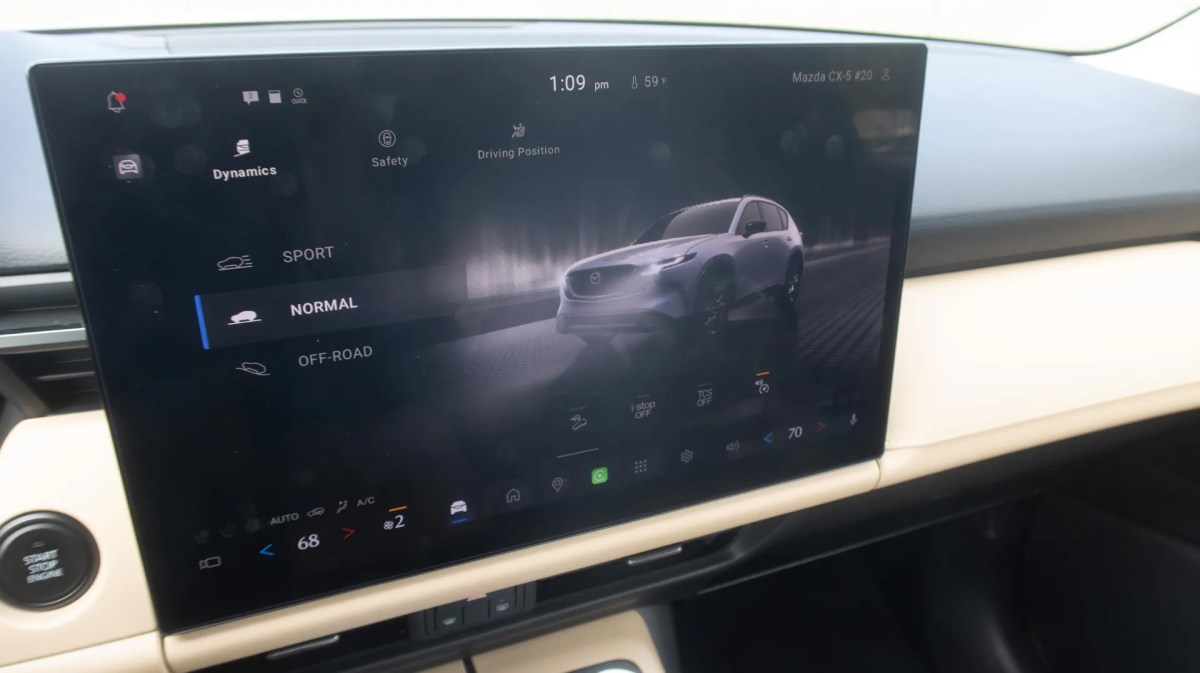
Mazda’s rotary-dial controller, once praised for keeping eyes on the road, started looking dated. Not charming-dated. Just dated.
There is a kernel of logic in Yamaguchi’s argument. Screen placement matters enormously, and a well-designed touchscreen mounted high on the dash can theoretically keep eyes closer to the road than a cluster of identical buttons buried near the center console. But Mazda’s old argument had a kernel of logic too — that touch targets on a bouncing screen require visual confirmation in ways a textured knob never does.
Both things can be true simultaneously. The difference is which truth is commercially convenient at the moment.
What Mazda didn’t say is just as telling. There was no mention of the extensive internal research the company once cited to justify its anti-touch position. No acknowledgment that the philosophy had changed. No bridge between the old stance and the new one — just a fresh rationale presented as obvious common sense, as if the prior decade of finger-wagging never happened.
This is how the industry works. Principles are flexible when sales targets aren’t being met. Mazda isn’t the first automaker to reverse a deeply held design conviction under market pressure, and it won’t be the last.
BMW once swore the iDrive wheel was the only safe way to interact with infotainment. Now its cars have touchscreens, gesture control, and voice commands stacked on top of each other.
The real question is whether Mazda’s new touchscreen implementation will actually be good. If the company traded a functional, if unfashionable, control scheme for a mediocre screen just to look current, it will have sacrificed the one thing that made its interior philosophy worth defending in the first place — the conviction that driving matters more than spec-sheet optics.
Mazda built credibility by being the contrarian. Now it’s just another automaker chasing the screen.

Share this Story