
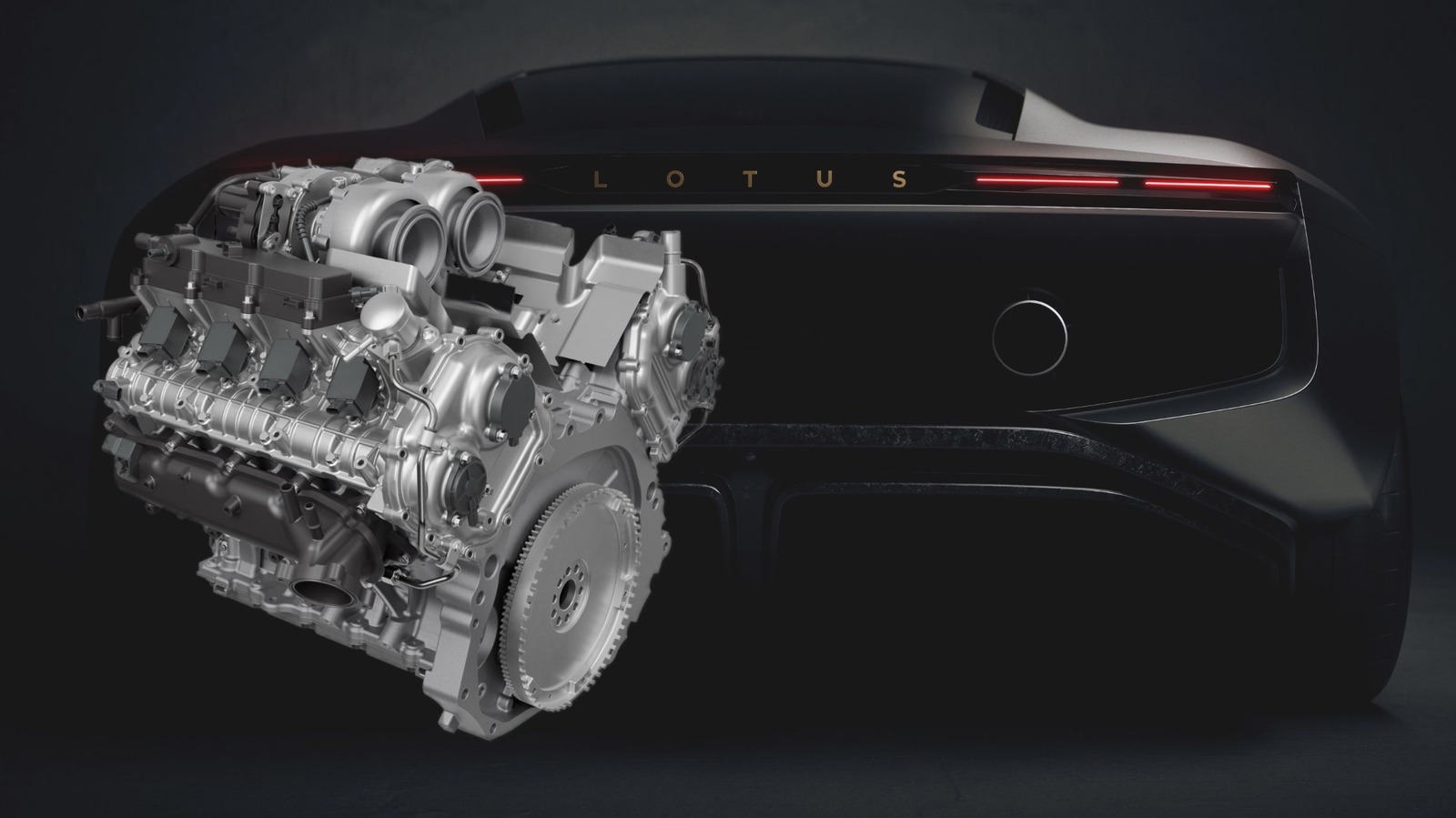


The engine weighs 441 pounds, makes more than 671 horsepower on its own, and comes from a company partly owned by Renault. That is the heart of the next Lotus supercar, a car the brand once promised would never need one.
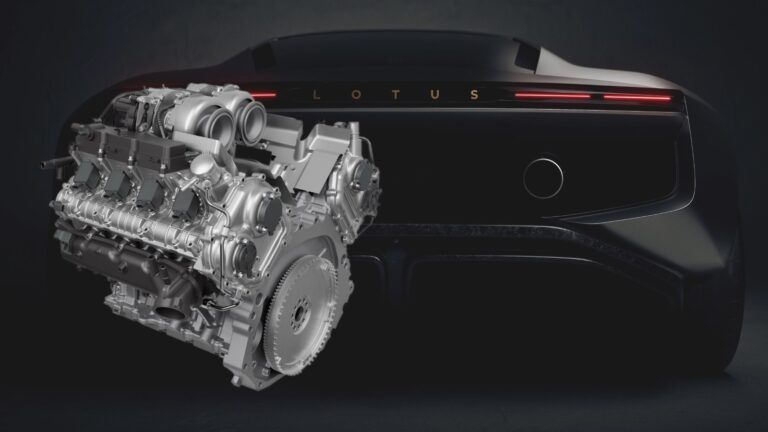
Horse Powertrain, the joint venture between Renault and China’s Geely, has detailed the W40, a 4.0-liter twin-turbocharged V8 bound for the Lotus Type 135. Geely also owns Lotus, so the money is moving between rooms in the same house.
The Type 135 is widely expected to revive the Esprit name, which disappeared when production ended in 2004. Lotus confirmed a combustion-powered supercar for 2028 earlier this year.
The W40 uses a hot-vee layout, with the turbochargers tucked inside the engine’s vee, the same trick AMG uses on its V8s. That keeps the package compact, the intake paths short, and the throttle response sharp. Horse quotes output of “over” 680 PS, or 671 hp, and 590 lb-ft of torque.
That is only half of the math. Horse designed the W40 for hybrid duty from the start, and Lotus CEO Feng Qingfeng has already floated a combined figure north of 1,000 PS, roughly 986 hp, for the Type 135.
Horse has not said which crankshaft the V8 uses. A cross-plane crank is the luxury-sedan choice, while a flat-plane crank is what Ferrari and McLaren use when they want an engine to scream.
A supercar points toward the latter. But Mercedes builds both versions of its newest V8s, and Horse could do the same.
The gearbox is Horse’s 8LDCT, an eight-speed dual-clutch unit. Nobody has mentioned a manual.
Below the V8 sits a second Horse engine. Entry-level Type 135s are scheduled to get the W30, a twin-turbo 3.0-liter V6 making 536 hp and 516 lb-ft before any electric help arrives.
That trails the 654 hp Ferrari’s 296 GTB makes from its V6 before its own electric boost kicks in. Lotus has a ladder to sell, though. The V6 car should cost meaningfully less, and buyers who want more can be walked up to the V8.
The smaller engine may also be the better Lotus. The V6 weighs 353 pounds, about 88 pounds less than the V8. At a company founded on shaving weight, that gap is not a footnote.
Nobody has caught the Type 135 testing yet. The only official image is a single teaser from May showing the rear of a supercar: two round tailpipes, four slim LED taillights, and the Lotus name spelled out between them.
That teaser looked a lot like the Theory 1, the concept Lotus revealed in 2024. Theory 1 was pitched as fully electric, the design flagship for a brand that had said it would sell only EVs by 2030.
Weak EV sales killed that plan. Lotus now targets a mix of 60 percent hybrids and 40 percent EVs, and it is far from the only automaker to blink.
So the shape drawn for an electric future may end up wrapped around a twin-turbo V8 and a dual-clutch box. The bodywork could survive the reversal intact. The powertrain did not.
What remains unanswered is the part enthusiasts will argue over longest. How does that V8 sound near redline, and can a Geely-family engine carry a badge Lotus built on its own terms?
Share this Story