
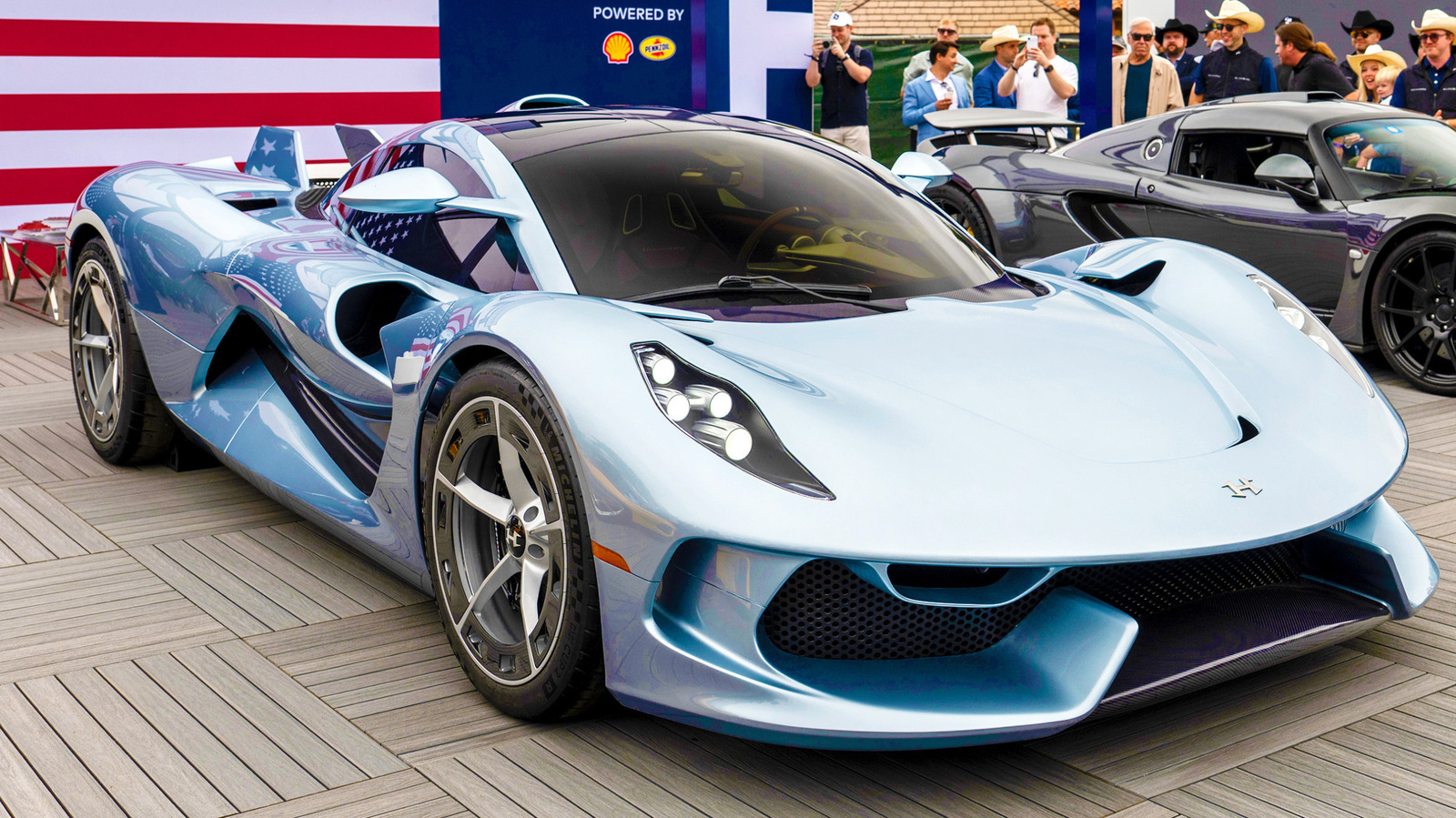


In 2014, a Hennessey Venom GT ran 270 mph down a runway once used by NASA’s Space Shuttle. Six years later, the Venom F5 reached production with a twin-turbocharged 6.6-liter V8 making up to 2,031 horsepower.
The next Hennessey hypercar makes roughly 1,200 fewer horsepower than that. All 71 cars are already spoken for.
That car is the Blackbird. It isn’t built to beat the F5, and Hennessey isn’t pretending otherwise.
For a Texas outfit whose reputation rests on top speed runs and four-figure output claims, that’s a sharp turn. The obvious sequel to 2,031 horsepower was a bigger number. John Hennessey says it didn’t have to be.
“We love horsepower and speed,” the founder and CEO told CarScoops. “But the answer to ‘what comes next?’ didn’t have to be a bigger number.”
What comes next is a naturally aspirated 6.2-liter V8 developed with Ilmor Engineering. It makes between 800 and 850 horsepower and revs past 9,000 rpm.
No turbos. No hybrid assist. No electric motors filling torque gaps.
Power goes to the rear wheels only, through a six-speed gated manual. There’s no automatic option, and there are no screens in the cockpit.
Hennessey builds the whole pitch around one belief about his buyers: they love driving. Take away the dyno sheet, and that’s the product.
He promises “immediate throttle response, linear power delivery, and a sound that makes every drive an occasion.” Those are exactly the things turbocharging tends to dull, and the things a spec sheet can’t measure.
The Blackbird also does something neither Venom was ever asked to do. Hennessey calls it a “touring hypercar,” with real attention paid to comfort, outward visibility, and room for a weekend’s worth of luggage.
A weekend bag in a Hennessey. The Venom GT was built to run flat out on a runway.
Hennessey isn’t alone here. Gordon Murray’s T.50 and the Nilu27 chase the same formula: high revs, natural aspiration, and a driver who has to work for it.
These cars are still seriously quick. They just refuse to sell themselves on it.
Hennessey’s case for the Blackbird leans on longevity. He believes the car will be “treasured for years” because of the bond between owner and machine.
He credits that bond to “a great-sounding V8, beautiful proportions, and physical controls that don’t depend on the latest screen or software to feel special.”
That last part is the sharpest point he makes. Screens date a cabin faster than anything else, and software ages worse. A gated shifter from any decade still works the same way.
On electrification, Hennessey stops short of picking a fight. Hybrid and EV adoption across the wider market, he says, is “a separate question.”
His territory is narrower. “For cars that connect deeply with their owners and automotive enthusiasts around the world,” he said, “we know that combustion power is something that’s hard to beat!”
He sees “a rich future for combustion-powered hypercars that offer something truly special.”
For now, the order book backs him. Seventy-one buyers signed up for a car that’s slower on paper than the one Hennessey already sells.
The company that spent a decade proving how fast it could go has sold out a car on the promise of how it feels. The engine still has to deliver on 9,000 rpm and that sound. The owners will be the ones who find out.
Share this Story