
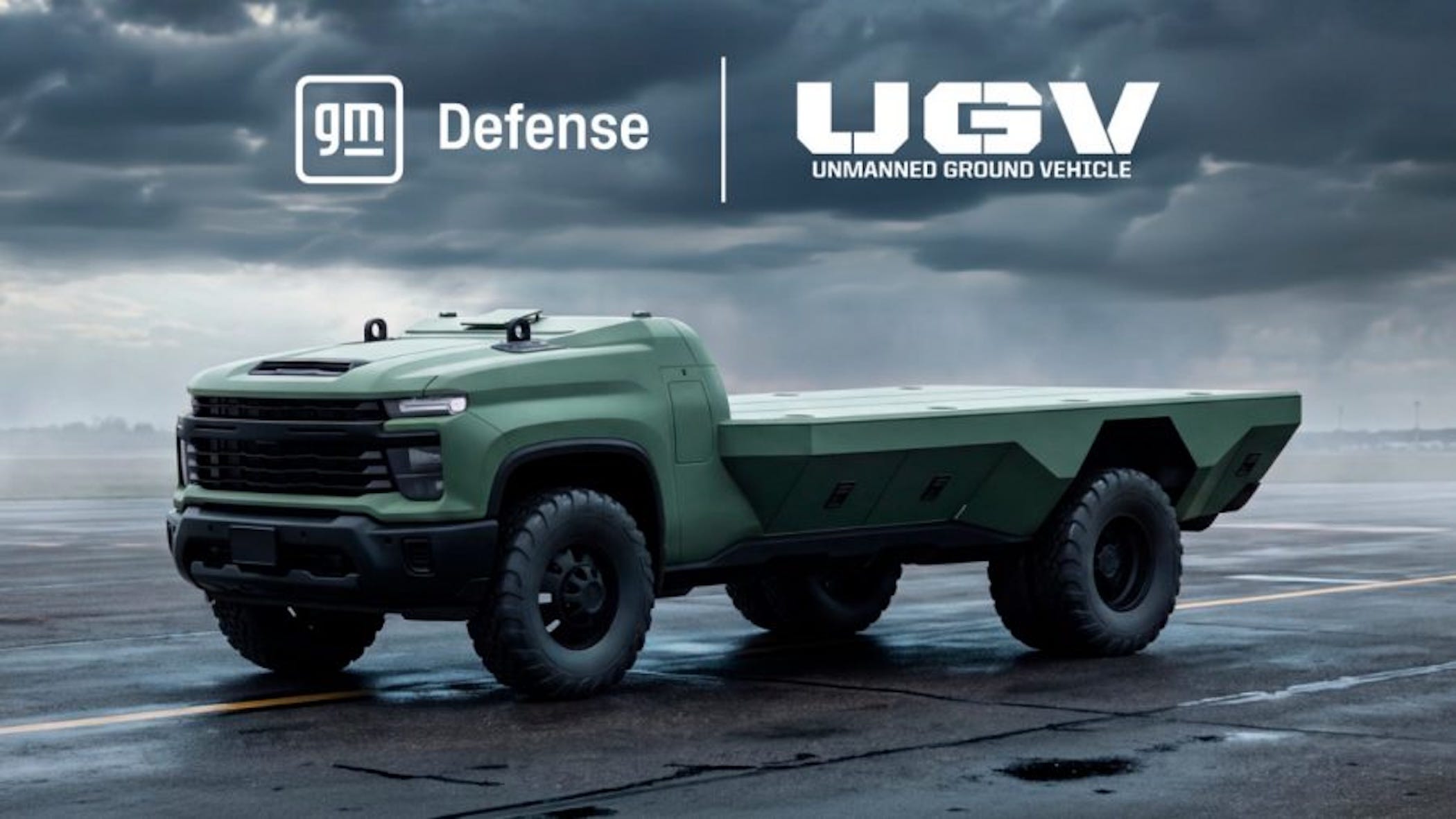


General Motors just unveiled a Silverado with no driver, no cab, and no civilian buyer. The vehicle debuted at the Association of the United States Army’s annual expo, where GM Defense showed a stripped-down, autonomous Unmanned Ground Vehicle built on the bones of a Chevrolet Silverado 3500HD.
The front grille is pure Silverado. Everything behind it is something else entirely. GM chopped the cab, replaced the pickup bed with a flatbed, and mounted the whole thing on dual-rear-wheel skateboard architecture designed for silent movement.
No seats, no steering wheel. Just an engine, a bed, and chunky wheels rolling toward a warzone.
GM Defense says the UGV is not built for combat. Its mission is silent logistics runs and medical evacuations, the kind of work that gets soldiers killed when done by manned vehicles in hostile territory. The truck uses drive-by-wire technology paired with Scout AI’s Gx Ground Agent system to navigate without a human behind the wheel.
Functional trials are slated for 2027.
The timing matters because GM Defense is already deep into its relationship with the Pentagon. In 2021, GM won a contract to build lightweight Infantry Squad Vehicles based on the Chevy Colorado ZR2. That deal originally called for 649 trucks. The Army now wants nearly 12,000 of them.
A five-passenger variant is expected to deploy across 39 brigades soon. GM Defense is also chasing a contract for a heavier ISV variant, reportedly based on the Silverado. That prototype heads to Army testing early next year.
So GM is simultaneously pushing a manned Silverado for troop transport and an unmanned Silverado for autonomous resupply. Two very different bets on the same platform, both aimed at the same customer.
GM Defense has been in and out of the military business for over a century. The division traces its roots to World War I and built vehicles and artillery through multiple conflicts. It got sold off in 2003 when GM decided defense wasn’t core to its business.
Fourteen years later, GM reversed course and re-established the unit. The Colorado ISV contract validated that decision. The autonomous UGV could cement it.
The competition is real. Ford has proposed a Ranger 6×6 for the UK military. Defense contractors with no automotive pedigree are pushing their own autonomous platforms. The Pentagon wants options, and it wants them fast.
The branch of the military that once relied on purpose-built tactical vehicles is increasingly comfortable buying modified versions of trucks that roll off the same lines as consumer pickups. That shift plays directly to GM’s strengths. Volume production, established supply chains, and a parts bin deep enough to keep military fleets running without custom logistics.
Whether the Army trusts a driverless Silverado to haul ammunition or evacuate wounded troops through contested terrain is another question entirely.
GM Defense has not disclosed the UGV’s powertrain details or whether it shares the Silverado 3500HD’s available Duramax diesel. The company also hasn’t said what level of autonomy the truck targets or how it would handle communications-denied environments where GPS and data links go dark.
Those details will determine whether this is a serious contender or a flashy expo piece. The 2027 trials will answer that, assuming the Army gives GM the chance to prove it.


Share this Story