
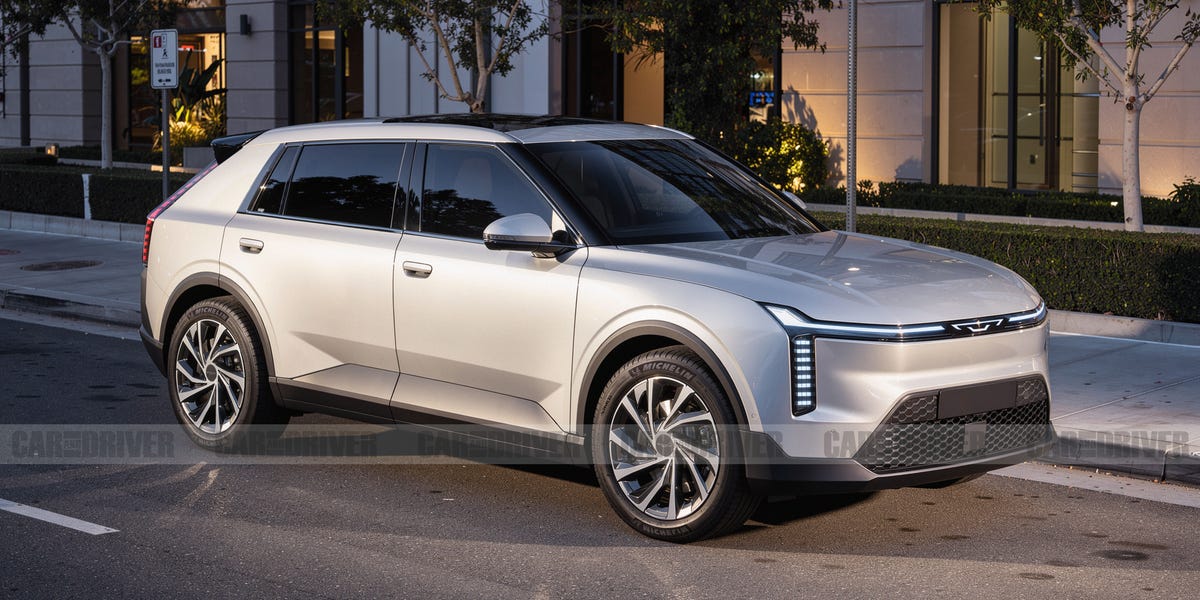


Chrysler, a brand that currently sells exactly one vehicle, is pinning its entire future on a compact crossover that won’t arrive until late 2027. The Airflow, named after the brand’s famously ahead-of-its-time 1934 sedan, will enter the most brutally competitive segment in the American market with a starting price potentially as low as $31,000.
That’s the plan, anyway. The reality is that Chrysler hasn’t sold an SUV since the full-size Aspen died in 2009. The 300 sedan bowed out after 2023, leaving the Pacifica minivan as the lone soldier in a one-car showroom.
For a brand that once anchored Chrysler Corporation alongside Dodge and Plymouth, the fall has been steep and long.
The production Airflow will look nothing like the smooth, EV-only concept Chrysler showed in 2022. Stellantis has ditched that direction entirely. The production version gets boxier styling with sharper creases, built on the new STLA One platform that can accommodate gas, hybrid, plug-in hybrid, and electric powertrains.
The EV version, if it ever materializes, has been pushed to the back of the line. That pivot away from electric tells you everything about where the wind is blowing inside Stellantis. The elimination of the federal EV tax credit has, by the company’s own admission, decimated its EV sales in the U.S.
So the Airflow will almost certainly launch with a hybrid setup borrowed from the new Jeep Cherokee, pairing a turbocharged 1.6-liter four-cylinder with two electric motors for 210 horsepower. A gas-only version making 177 hp is also expected, which would make it one of the weakest entries in the segment.
The Cherokee connection runs deeper than powertrain sharing. Both vehicles sit on the same STLA One architecture, and Chrysler plans to differentiate the Airflow by leaning into road comfort rather than off-road capability. In practice, it means Chrysler is asking buyers to choose a brand they’ve largely forgotten over the Toyota RAV4, Honda CR-V, and Nissan Rogue, three of the best-selling nameplates in America.
Pricing will be the sharpest weapon in the Airflow’s arsenal. A base model near $31,000 with top trims in the low $40,000 range would undercut several competitors, assuming Chrysler can actually hit those numbers. The STLA One platform uses lithium-iron-phosphate batteries for its electrified variants, a chemistry chosen specifically to keep costs down.
The Airflow won’t be alone for long. Chrysler has two smaller crossovers in the pipeline, the Arrow and Arrow Cross, both expected to start under $30,000. Those will be rebadged versions of the Fiat Grizzly currently bound for Europe.
Three new crossovers for a brand that has been selling nothing but minivans sounds ambitious. It also sounds like the kind of Stellantis badge-engineering strategy that has produced mixed results across its sprawling portfolio.
There’s a more performance-oriented cousin coming too. The Dodge GLH, riding the same STLA One platform, may get the 324-hp Hurricane 4 turbocharged engine that Chrysler almost certainly won’t offer in the Airflow. Keeping the hot powertrain exclusive to Dodge is a familiar corporate playbook, but it also means the Airflow enters the fight without a performance halo.
Chrysler has been here before, promising a comeback that never quite arrives. The brand has survived on institutional inertia and the Pacifica’s steady if unspectacular sales. Whether a compact crossover can revive a nameplate that most buyers under 40 have never considered purchasing is a question that won’t be answered until showroom traffic tells the real story.
Stellantis is betting that price and platform flexibility will be enough. The segment leaders aren’t standing still.
Share this Story