
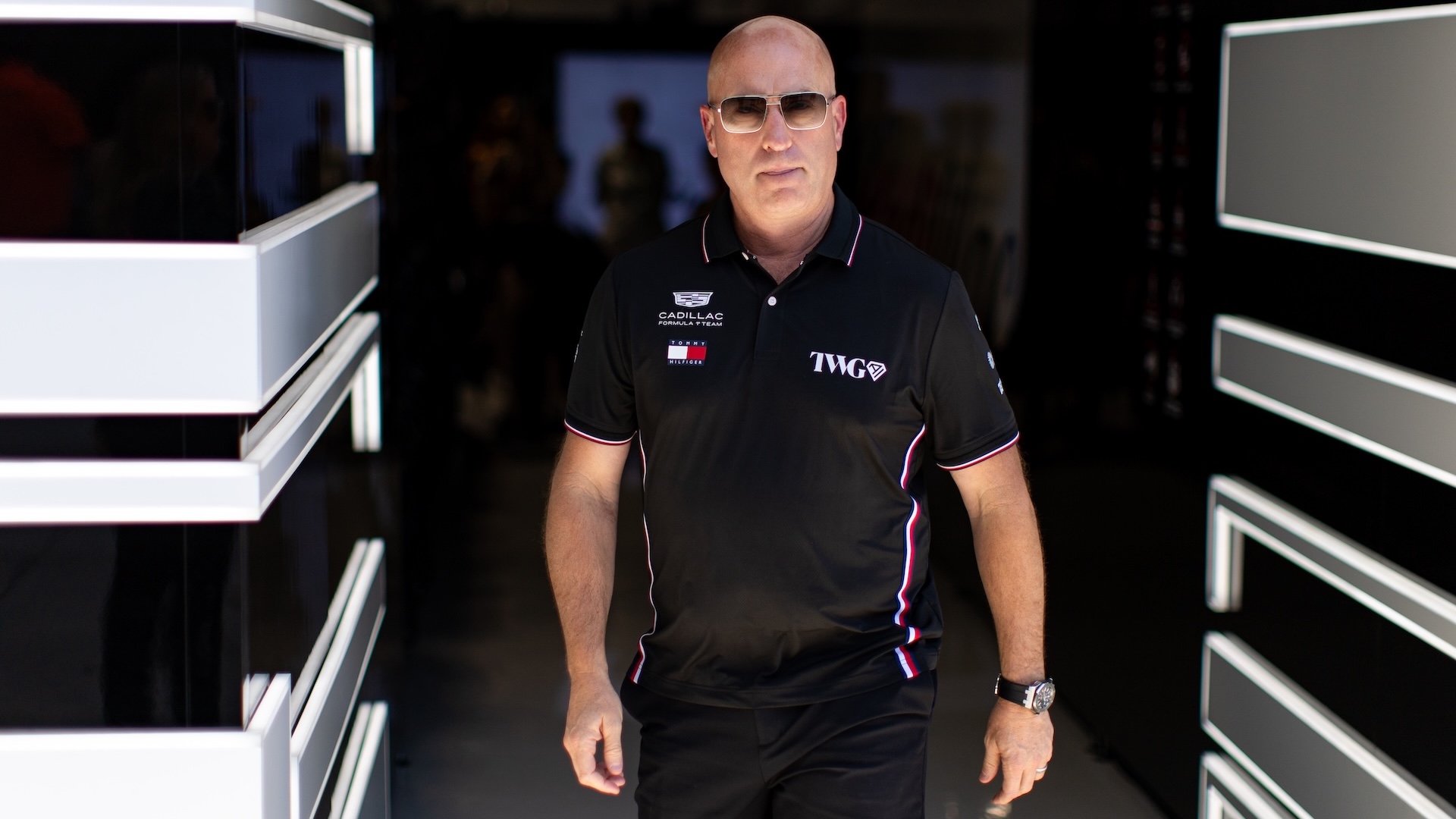


Five races into its existence, the Cadillac Formula 1 Team is still standing. That alone, given the brutal history of new entrants in this sport, counts as an achievement. But CEO Dan Towriss isn’t interested in mere survival.
He’s building three facilities across two continents, hiring at a clip of 10 percent per month, and trying to forge a competitive culture from scratch. All while racing against teams with decades of institutional knowledge.
Towriss sat down with The Drive’s Jerry Perez ahead of the Miami Grand Prix, the team’s first race on American soil. His comments revealed a leader acutely aware of the contradictions baked into this project: moving fast while being precise, scaling up while staying nimble, celebrating progress while a suspension failure in Montreal just destroyed his driver’s race.
“Cassidy is quick to remind us that we fought for the right to be stressed, for the right to work this hard,” Towriss said, referencing his wife, who has become an increasingly visible figure within the organization. “Then you remind yourself, you’re exactly where you want to be.”
That line is the most honest thing anyone in this paddock has said all year. It’s a nod to the years-long battle that began under the Andretti banner, a bid that was blocked, restructured, stripped of its original identity, and ultimately resurrected with General Motors muscle behind it. The scars from that process haven’t healed. They’ve just been repurposed as motivation.
The operational reality is staggering. The team’s headquarters in Fishers, Indiana is still under construction. Staff work across three locations — Indiana, Charlotte, and Silverstone — and the workforce is expanding so rapidly that cultural cohesion becomes a daily management challenge, not a quarterly HR exercise.
Towriss frames this as a feature, not a bug. His philosophy borrows from his insurance and investment background: build organizations that move without wasted effort. Under F1’s cost cap, every dollar misspent and every hour lost to internal politics is a direct competitive penalty.
“If everything is rigid, hierarchical, and overly structured, those organizations can’t adapt,” he said. It’s building the team with the idea that nothing is static, change is inevitable, so it’s built to evolve.
That adaptability was tested immediately. The season opened with cancelled Middle Eastern races, followed by regulation amendments that hit a fledgling team harder than established operations with deeper institutional memory. Towriss leaned on team principal Graeme Lowdon’s “one team” philosophy to absorb those shocks.
On track, the results are what you’d expect from an 11th team in its debut season — modest but occasionally promising. Sergio Pérez qualified respectably in Canada and climbed to 11th during the Sprint before a penalty dropped him back. Then a suspension failure on Sunday ended his race violently, a reminder that the car is still fundamentally immature.
Towriss waved it off. “There’s always gonna be a little bump on the road here or there.”
The old racing adage — want to make a small fortune in motorsport, start with a large one — doesn’t faze him either. He pointed to the financial backing of TWG Global and General Motors, organizations that “have counted the costs and understand what it takes.” This isn’t a vanity project running on fumes. The money is real, the commitment is institutional, and the timeline is long.
Whether that patience survives three or four seasons of back-of-grid finishes remains the only question that actually matters. Formula 1 has broken richer men with louder promises. But Towriss has something most of them didn’t — a genuine organizational mind, a partner in GM that needs this to work for brand reasons beyond the racetrack, and a wife who won’t let him forget how hard they fought just to get here.
The stress, it turns out, was always the point.



Share this Story