
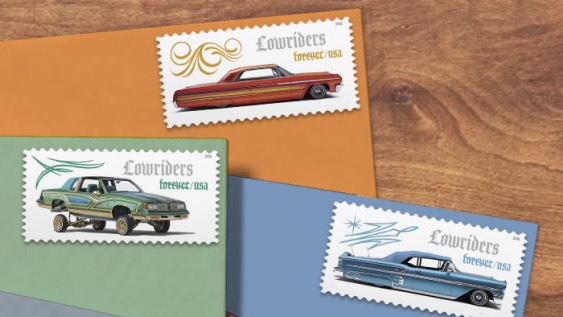


Five lowriders are now Forever Stamps. Let that sink in for a moment. The same cars that got their owners pulled over, thrown to the ground, and handcuffed in the 1980s are now officially commemorated by the United States government.
The U.S. Postal Service released its new lowrider stamp collection on March 13 at a ceremony in San Diego’s Logan Heights Library, deep in the heart of the community that built the culture. The pane of 15 stamps features five vehicles: a 1958 Chevrolet Impala called “Eight Figures,” a 1964 Impala called “The Golden Rose,” a 1987 Oldsmobile Cutlass Supreme called “Pocket Change,” a 1946 Chevy Fleetline called “Let the Good Times Roll/Soy Como Soy,” and a 1963 Impala called “El Rey.”
Three of the five are Impalas. Of course they are. The Impala was the canvas of choice for lowrider builders for decades, which makes Chevrolet’s decision to kill the nameplate in 2020 sting a little harder.
USPS art director Antonio Alcalá deliberately chose photography over illustration for the stamps, using images by Humberto “Beto” Mendoza and Philip Gordon. “Using illustrations would possibly be more about the artist’s imagination than about actual lowriders,” Alcalá said. Danny Alvarado added custom pinstriping to each stamp, and the Gothic-style typography echoes the chrome lettering lowrider clubs use to mark their own.
Alcalá even made the stamps one-third wider than standard commemorative size to show the cars in proper detail. That kind of care matters when you’re documenting rolling art.
The timing here is impossible to ignore. California only lifted its cruising ban in 2024, when AB 436 went into effect. For decades before that, lowriding was effectively criminalized across most of the state. Ride-height laws, modification restrictions, and anti-cruising ordinances gave law enforcement broad tools to target the community.
Jovita Arellano, president of the United Lowrider Coalition in National City, fought for that legislation. She remembers being pulled over, thrown to the ground, and handcuffed because her car supposedly matched a robbery suspect’s description. “You knew that you’re taking a chance back in the 1980s to go cruising without being pulled over or accused of anything,” she said.
Now her culture is on a Forever Stamp. “I’m gonna buy my stamps, but I’m never giving ’em away,” Arellano said. “To have a forever stamp, it just signifies that we are lowriders forever.”
Lowriding emerged from East Los Angeles and the Southwest borderlands in the 1940s. Young Chicano men, facing discrimination, lowered their car chassis as an act of defiance and identity. By the 1960s, lowriders became a visible symbol of the Chicano Movement.
By the 1970s, the culture exploded, with car clubs, elaborate hydraulics, crushed velvet interiors, and murals that told stories of family, faith, and history. Today, clubs exist in Japan and across the globe. A lowrider sits on the third floor of the Smithsonian National Museum of American History, stopping visitors cold.
Gary Barksdale, the Postal Service’s chief postal inspector, called lowriders “a masterpiece of engineering and artistry, a rolling canvas of art.” He praised the culture for “creating a space to celebrate pride, a sense of belonging and building a community.”
A sheet of 15 stamps costs $11.70 at any Post Office or online. USPS also released a set of five Field Notes notebooks featuring the stamp designs for $24.95.
It took 80 years for the country to go from criminalizing lowriders to putting them on postage. The cars haven’t changed. The paint still gleams, the hydraulics still hop, the Impalas still cruise low and slow. The only thing that changed is who’s finally paying attention.



Share this Story