
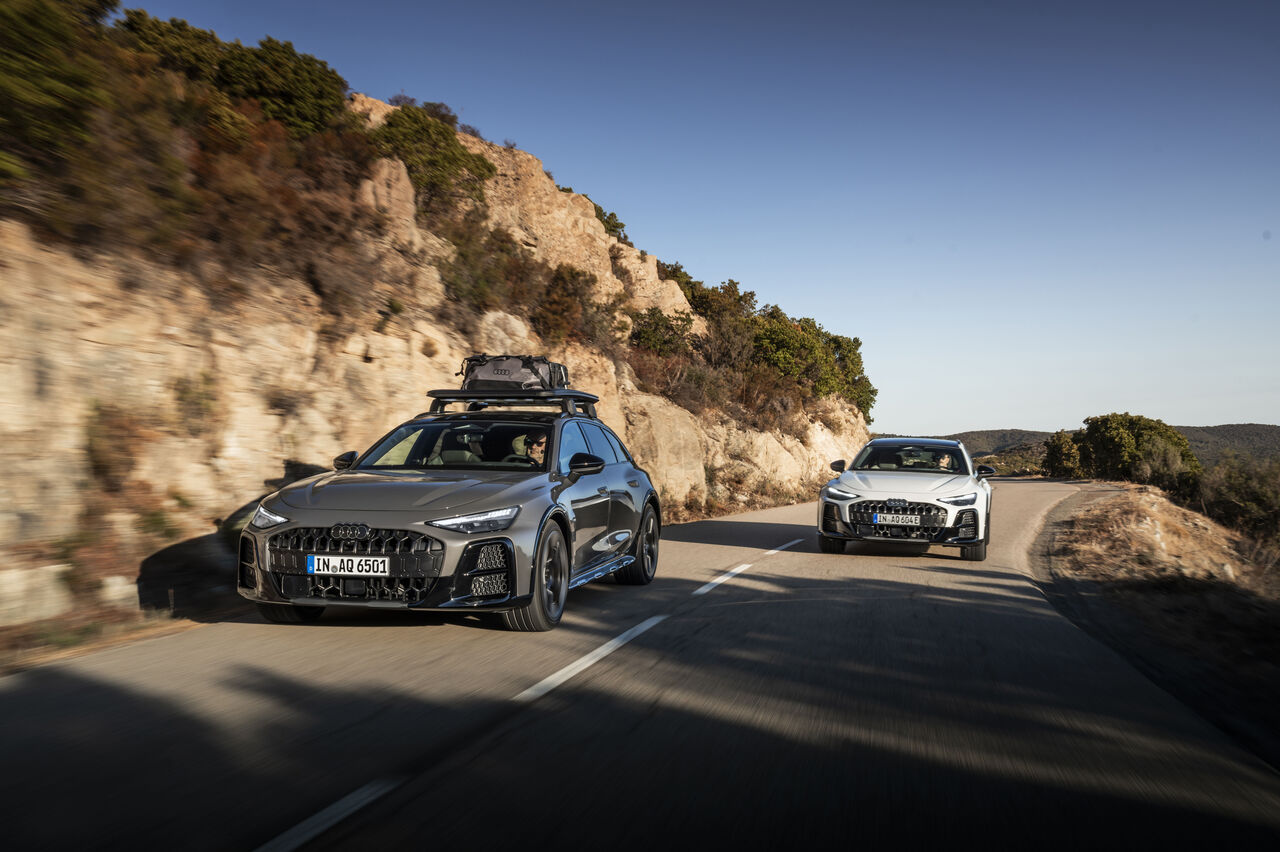


The new Audi A6 allroad is now on sale across Europe with a first for the nameplate: a plug-in hybrid option sitting alongside the familiar V6 diesel. Pricing starts at €77,250 for the 220 kW TDI and €80,250 for the 270 kW e-hybrid.
That €3,000 premium for the PHEV buys a car that claims weighted combined fuel consumption of just 2.3 to 2.8 liters per 100 km and CO2 emissions between 53 and 64 g/km. Impressive numbers on paper. But drain the battery, and consumption climbs to 7.0 to 7.7 liters per 100 km, landing it in CO2 class F, the same bracket as the diesel. The regulatory game and the real-world game remain two very different sports.
Both variants ride on Audi’s Premium Platform Combustion and share the quattro ultra all-wheel-drive system, which is the real engineering story here. Unlike traditional permanent AWD setups, quattro ultra runs in front-wheel drive most of the time. Two clutches, one at the transmission output and another in the rear differential, decouple the entire rear drivetrain when the system calculates that all-wheel traction isn’t needed.
The engagement process takes roughly 200 milliseconds. The system’s predictive algorithms process steering angle, throttle demand, lateral and longitudinal acceleration, body movement, and estimated friction coefficient to anticipate the need for rear-axle torque about half a second before it arrives. Audi says the transitions are imperceptible.
“What the driver feels in any situation is the traction and driving dynamics associated with quattro,” said Rouven Mohr, Audi’s board member for technical development.
When the system does engage, torque split is variable. Under hard acceleration on dry pavement, Audi claims more than 70 percent of torque can flow to the rear wheels. That is a substantial rear bias for a system that defaults to front-drive.
The quattro ultra technology itself is not new. It debuted in 2016 in the A4 allroad and has since spread across the A5, A6, and Q5 families built on the PPC architecture. What is new is pairing it with a plug-in hybrid powertrain in the allroad body style, a vehicle Audi positions for customers who want wagon practicality with off-pavement confidence.
The V6 TDI version uses MHEV plus mild-hybrid technology with an electrically powered compressor, producing 220 kW and returning 5.8 to 6.4 liters per 100 km on the combined cycle. It is the straightforward choice. No charging infrastructure required, no weighted-cycle illusions.
Audi has now built more than 15.6 million quattro-equipped vehicles since 1980, roughly one-third of its total production over that span. The brand leans hard on that heritage. The allroad has always been its most literal expression: raised suspension, body cladding, and the promise that your wagon can handle a gravel road without drama.
The tension in this car is the tension running through every premium European automaker right now. Electrification mandates push toward plug-in options. But the real-world efficiency case for a PHEV depends entirely on whether the owner actually plugs it in. With a discharged battery, the heavier e-hybrid returns worse fuel economy than the diesel.
Audi’s quattro ultra system is smart enough to predict wheel slip half a second before it happens. Whether buyers are equally predictive about which powertrain actually suits their daily reality is another question entirely.

Share this Story