
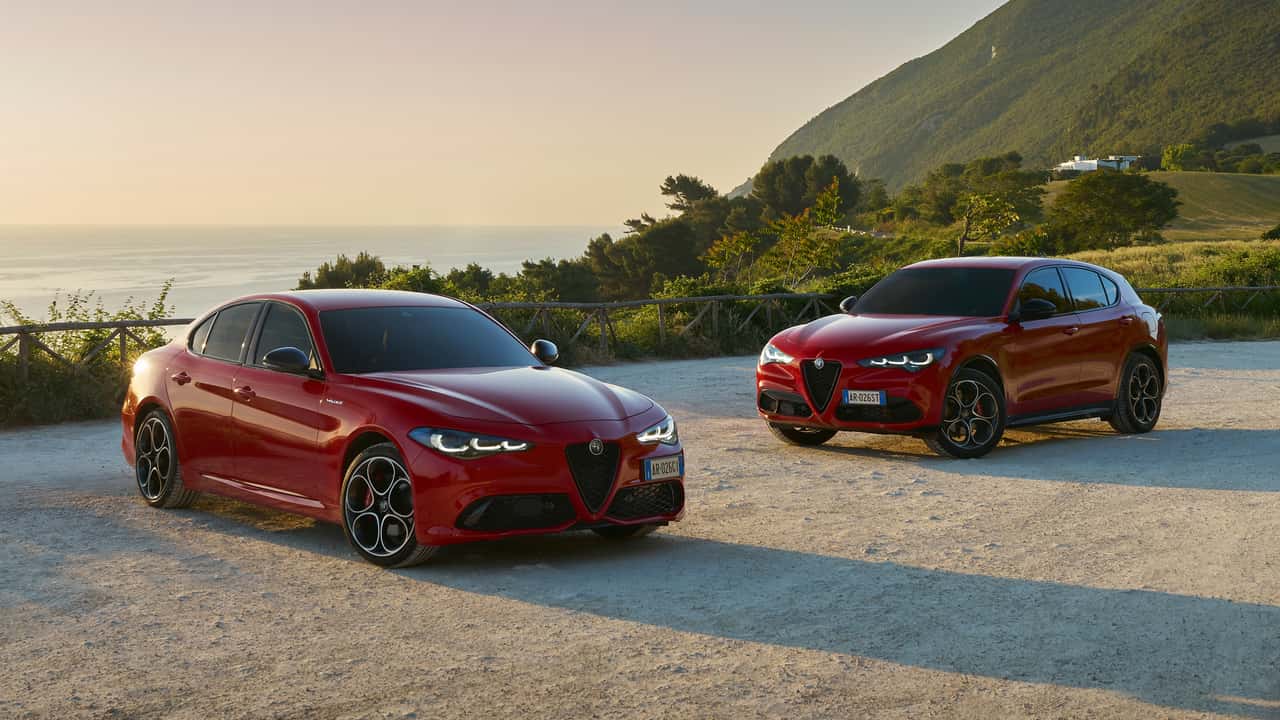


The 2027 Alfa Romeo Giulia and Stelvio are getting new trim levels, a new paint color, and a camera bolted to the A-pillar. What they are not getting is a replacement. Not this year. Not next year. Probably not before 2028.
The sedan debuted in 2015. The SUV followed in 2016. Both are now deeper into their second decade than any competitive product from BMW, Mercedes, or Audi would dare to be. Alfa Romeo just announced it’s keeping them on sale with another round of updates, including a mandatory driver-monitoring camera required by new EU safety regulations.
That camera, mounted in the A-pillar, watches for signs of distraction and fatigue. It exists because of the Advanced Driver Distraction Warning mandate now applied to every new car sold in Europe. Alfa Romeo didn’t choose to add it. Brussels did.
The mechanical lineup remains untouched. European buyers still get the 160-hp 2.2-liter turbodiesel in rear-drive form and a 210-hp version with Q4 all-wheel drive. The UK keeps the 280-hp 2.0-liter gasoline four-cylinder.
The Quadrifoglio models still run the 2.9-liter twin-turbo V6 making 520 hp. The Giulia Quadrifoglio stays rear-drive. The Stelvio Quadrifoglio gets Q4 and now rolls on standard 21-inch wheels, up from 20.
New trim names organize the range around Sprint, Veloce, and a fresh Edizione Luna Rossa variant. Quadrifoglio buyers get new black-and-white badges and a color called Anodized Blue. They also get a one-day course at the Alfa Romeo Driving Academy, which can be optioned on lesser trims too.
None of this obscures the central fact: Stellantis has no concrete timeline for next-generation replacements. Earlier this year, Alfa Romeo released a statement so vague it could have been written by a committee of lawyers and fortune tellers. The brand said it is “studying solutions” and will “leverage flexible platforms to progressively introduce multi-energy solutions, including hybrid and electric powertrains.”
Translation: the original plan to go all-electric has been quietly shelved, but nobody has agreed on what comes next.
The delay is a product of Stellantis-wide indecision about electrification. CEO Carlos Tavares pushed hard for battery-electric platforms, then watched the market cool. Alfa Romeo’s own CEO, Santo Ficili, said publicly that “the world is not ready everywhere” for EVs. So the brand is stuck between a combustion past it hasn’t fully abandoned and an electric future it can’t yet commit to.
There is a strange irony in all of this. Alfa Romeo never went through the industry’s obsessive phase of removing buttons and replacing everything with touchscreens. The Giulia and Stelvio interiors still have physical controls, a dashboard that integrates its screen rather than slapping a tablet on top, and a layout that feels designed by people who actually drive.
Brands like Volkswagen, Hyundai, and even Porsche spent years chasing minimalist digital cabins, only to reverse course and add knobs back. Alfa Romeo skipped that cycle entirely, not out of foresight, but because it never had the budget to redesign the interior.
The driving dynamics remain the real argument for these cars. The Giulia still offers one of the best steering feels in its class. The Stelvio still handles like a vehicle 400 pounds lighter than it is.
The Quadrifoglio V6 still sounds like something Ferrari forgot to patent. But charm and chassis balance only carry a product so far when the competition refreshes every five to seven years.
Alfa Romeo is now asking these two cars to carry the brand’s credibility in the D-segment for at least 13 years. Whether that’s confidence or neglect depends entirely on what shows up in 2028, if anything shows up at all.

Share this Story