
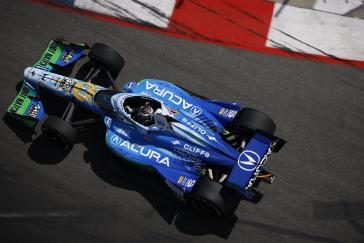


Marcus Armstrong’s No. 66 Honda-powered IndyCar will carry Acura branding when it rolls onto the grid at the 110th Indianapolis 500 next month. It will be the first time in the brand’s history that Acura has appeared on an Indy 500 entry.
That fact alone would make news. But pair it with Acura’s quiet confirmation that it will pause its IMSA GTP prototype program after 2026, and the picture sharpens considerably. This isn’t just a marketing activation. It’s a strategic retreat from one discipline and a calculated push into another.
The move began last weekend at the Acura Grand Prix of Long Beach, where Meyer Shank Racing’s No. 60 car ran a full Acura livery with Felix Rosenqvist behind the wheel. He qualified on pole and finished second. Not a bad debut for a rebrand exercise.
Acura plans to appear at additional high-profile IndyCar races this season, though it hasn’t specified which ones beyond Indianapolis. The partnership runs through MSR, which already fields Honda power and has deep ties to both Acura and Honda Racing Corporation USA through its IMSA GTP effort.
The timing is deliberate. IndyCar’s audience numbers have surged. Fox’s broadcast of last year’s Indy 500 was the most-watched in 17 years, and the first four races of 2026 have drawn the series’ largest television audiences since 2008. Acura is chasing eyeballs, and IndyCar has them right now.
Meanwhile, the Acura ARX-06 prototype program that has anchored the brand’s racing identity since 2018 is winding down. HRC US confirmed it will not continue in IMSA’s GTP class beyond this season. The numbers from that era are impressive — 25 wins, 34 poles, 10 championships across the ARX-05 and ARX-06 generations — but the program’s shelf life has run out.
David Salters, president of HRC US, praised the people behind those results while making clear the team intends to compete for the championship through the end of the year. Two cars remain in the fight: the No. 60 driven by Colin Braun and Tom Blomqvist, and the No. 93 piloted by Renger van der Zande and Nick Yelloly. On the No. 93, HRC US handles strategy and race engineering directly — a manufacturer-first arrangement that shows how deeply Honda embedded itself in the prototype effort.
Walking away from that investment is no small thing. GTP is the top class in North American sports car racing, and Acura has been a credible player. But the category is expensive, the competition from Porsche, Cadillac, BMW, and Lamborghini is fierce, and the return on investment in a niche endurance series doesn’t compare to what a single appearance at Indianapolis can deliver.
Acura’s last brush with IndyCar branding came in 2019, when MSR ran a one-off livery at Long Beach with Jack Harvey. Before that, you have to go all the way back to 1994 — Comptech Racing, a Honda-powered Lola, Parker Johnstone. The gap tells you how cautiously Acura has approached open-wheel racing as a brand exercise.
Now IndyCar is booming, IMSA’s GTP future is uncertain for several manufacturers, and Acura is repositioning. Hundy Liu, Acura’s brand marketing manager, framed it as building awareness “on a stage where Honda-powered teams and drivers have been so successful recently.” Honda engines have won six of the last eight Indy 500s. Acura is, in effect, putting a premium badge on hardware that already dominates.
The real question is whether this evolves into something more permanent. Acura says it is “exploring other high-profile opportunities in IndyCar during the 2026 season and beyond.” That language leaves room for a sustained presence — or a quiet exit if the math doesn’t work.
For now, though, the trade is clear: one of the most accomplished prototype programs in recent memory is being shelved so Acura can plant its flag at the Brickyard. Whether that’s shrewd brand strategy or a downgrade dressed in fresh livery depends entirely on what comes next.
Share this Story