
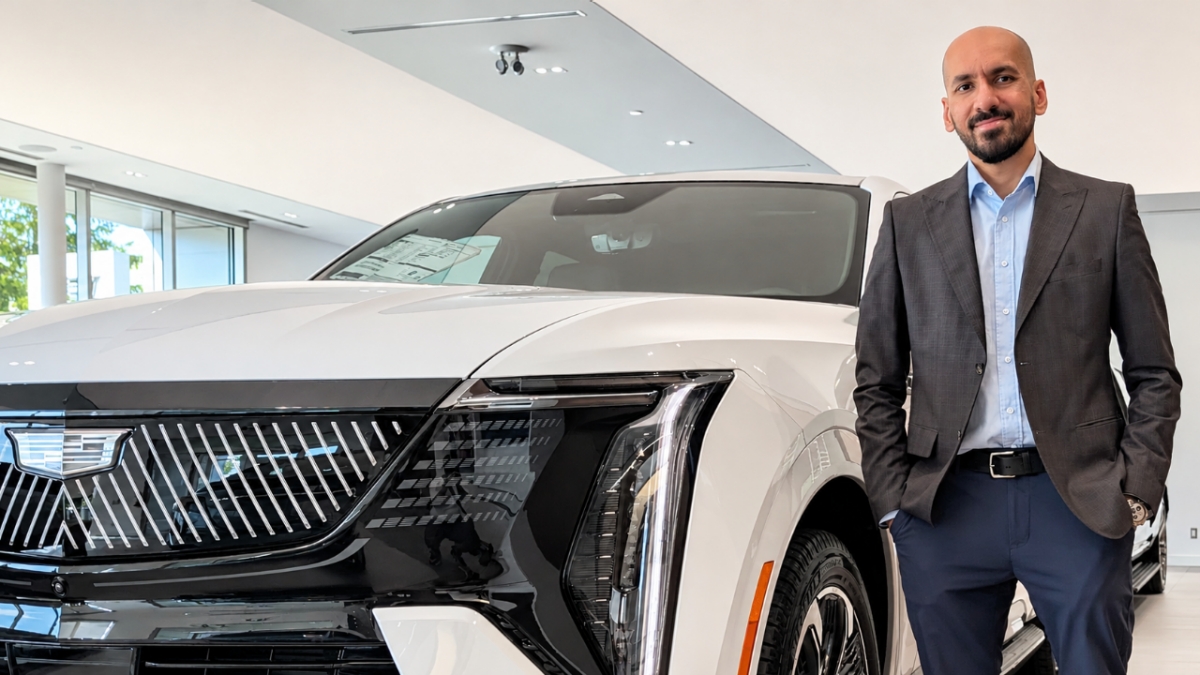


One customer in Haard Parikh’s Ontario sales district bought a new Chevrolet Silverado every couple of years, timed to their birthday. No spreadsheet at head office would flag that as a loyalty strategy. It was simply a person who liked their truck.
Parikh, now a Marketing Segment Manager at Cadillac Canada, tells that story in a new profile from GM’s own talent marketing team. It’s a recruiting piece, written to sell careers at General Motors. Look past the polish, though, and it says a lot about where good automotive marketing actually comes from.
Parikh joined GM in 2022 after several years in brand and digital marketing at other automakers. He already knew how products get positioned and how campaigns get built. What he didn’t know was what happened once the plan left the building.
So he went into District Sales, carrying sales and market-share targets for a territory of dealers. He stayed nearly four years.
“What the field taught me was how much happens between that initial message and the customer’s final decision,” he says.
His first correction came from a dealer who kept pouring money into local radio. Parikh, a search-and-social guy by training, had his doubts.
“I was initially skeptical, but the results supported their approach,” he says.
That’s the most honest line in the piece. A digital marketer watched an old-school medium beat his instincts because a dealer knew his own customers better than the playbook did.
The lesson repeated when Parikh moved from the Greater Toronto Area to Southwestern Ontario. What worked in a dense metro market landed differently in smaller, rural towns. Same brand, same national strategy, different buyers.
Inventory told a similar story. Chevrolet Equinox and Blazer stock looked healthy on paper, yet dealers kept telling him the mix didn’t match what local customers wanted. Plenty of vehicles meant little if they were the wrong trims sitting in the wrong towns.
Parikh doesn’t hand dealers a blank cheque. Their feedback didn’t automatically override the plan. He learned to pay attention when the same complaint kept coming back.
“Standing behind a plan does not mean being rigid,” he says.
In January 2026 he moved back into marketing, this time at Cadillac. At the luxury end of the business, everything he learned in the field matters more.
“A luxury brand is defined by more than the vehicle itself,” he says. At Cadillac, the dealership is the brand, from the first visit through years of ownership.
He offers one concrete example. When Cadillac launched its EV & Hybrid Owner Bonus, his team paired the national offer with regional data so dealers could see how it played in their own markets.
“A strong strategy must work beyond the numbers,” Parikh says.
None of this is news to anyone who has worked a showroom floor. Dealers have been telling factory reps some version of it for decades. What’s unusual is a GM marketer saying it out loud, in a company publication, and giving credit to the people on the lots.
GM frames his path as proof that careers there don’t have to run in a straight line. Fair enough. The more useful lesson is in the radio ads and the mismatched Equinox inventory.
Parikh calls District Sales the most rewarding job of his career so far. He’s still chasing the question that birthday Silverado buyer raised years ago: what makes someone come back?
Now he has to answer it for Cadillac.
Share this Story