
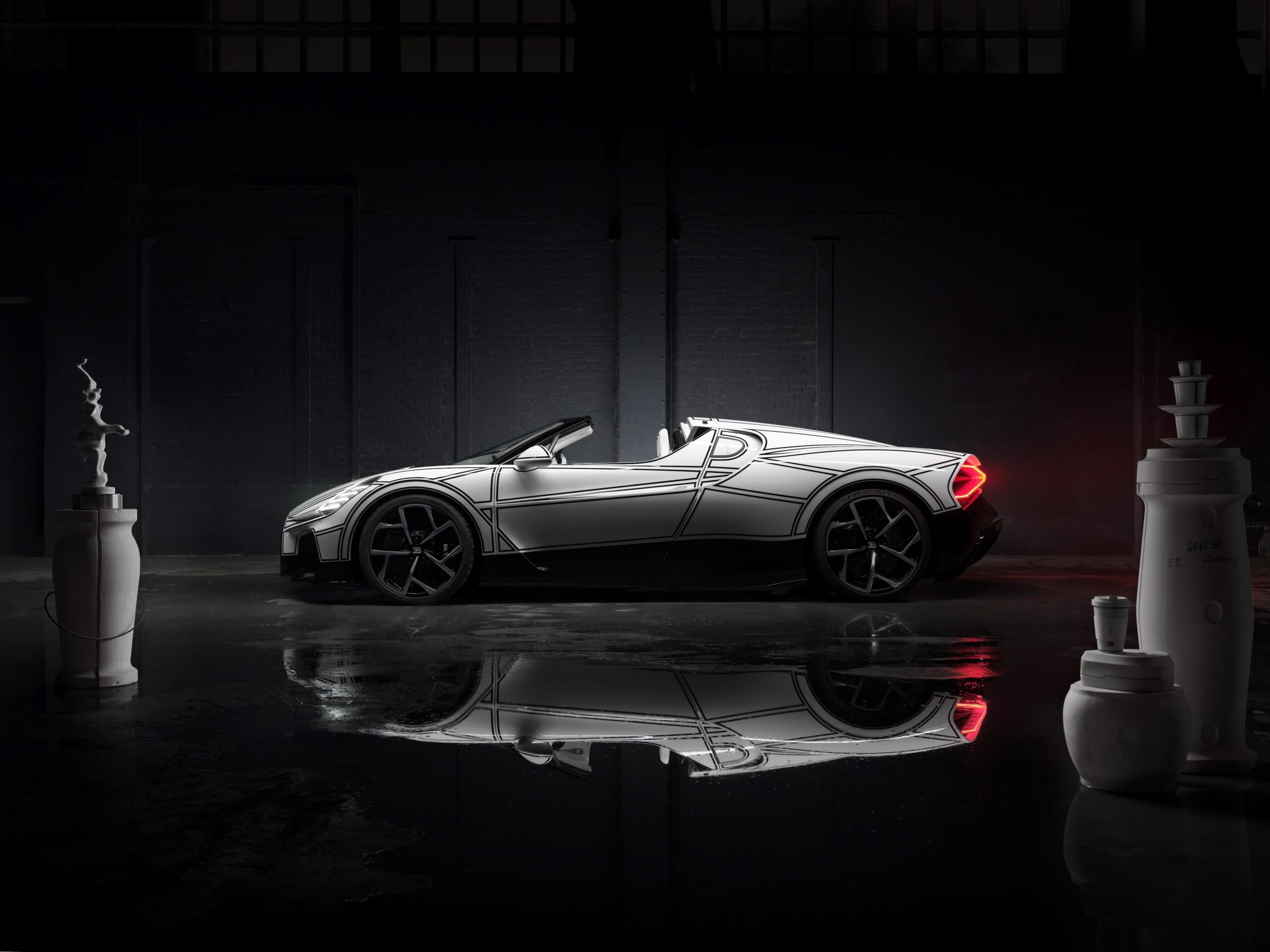


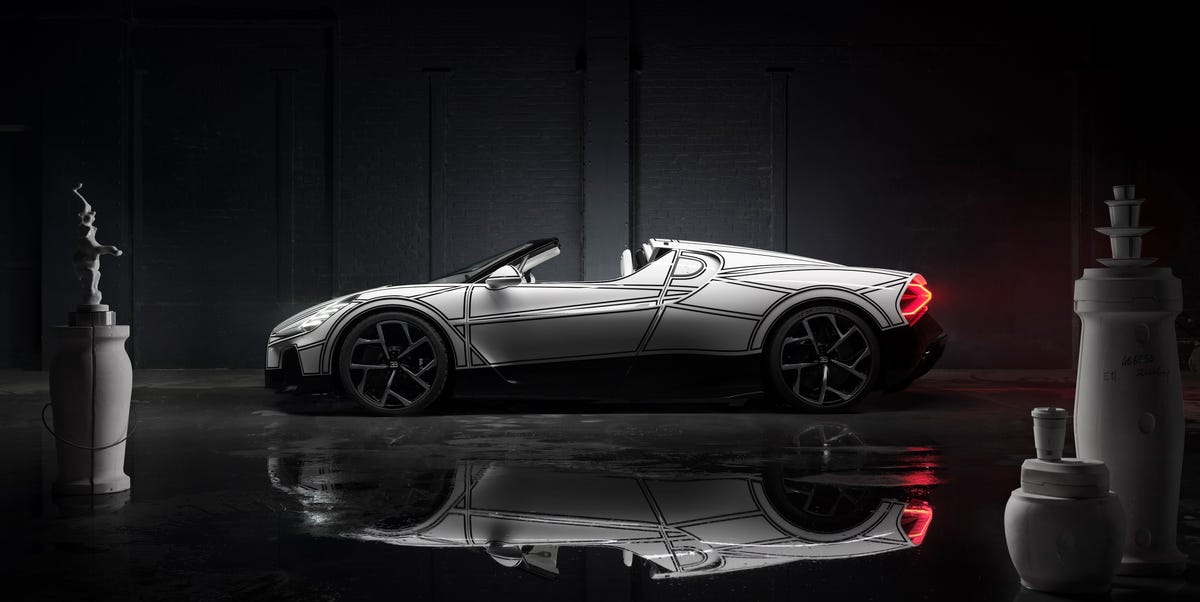
A German porcelain manufacturer helped Bugatti hand-paint geometric black lines across every surface of a white Mistral roadster, inside and out. The result is either a masterpiece or the world’s most expensive coloring book, depending on your tolerance for $5-million-plus fragile art objects.
The Mistral “Blanc Éternel” is the latest one-off from Bugatti’s Sur Mesure customization division, and it revisits a concept the company first explored 15 years ago with the Veyron L’Or Blanc. That car wore swirling blue-and-white porcelain motifs. This one goes harder — sharper lines, blacker contrasts, and a skeletal geometry that makes the Mistral look like an architect’s wireframe rendering brought to life.
Königliche Porzellan-Manufaktur Berlin, or KPM, is the collaborator. The same outfit that dressed the Veyron in porcelain is back, this time applying the material to the Bugatti badge atop the rear wing, the elephant mascot beside the side intake, the fuel and oil caps, and two engine cover inlays bearing KPM’s own logo. Each black line on the white body was positioned by hand before being painted. That’s not a decal job. That’s craftsmanship bordering on obsession.
Inside, the porcelain campaign continues with an almost confrontational commitment. Speaker grilles, center console trim, window switches, and the gearshift lever are all fashioned from the stuff. White leather surfaces carry the same hand-painted black-line treatment found on the exterior.
Bugatti doesn’t mention whether the porcelain pieces are reinforced against the kind of vibrations a quad-turbocharged W-16 engine generates. Presumably someone in Molsheim thought about that before handing over the keys.
The choice of the Mistral as the canvas is no accident. This is the final roadgoing Bugatti to carry the legendary 8.0-liter W-16, an engine that defined two decades of the brand’s identity. Its successor, the Tourbillon, moves to a hybrid V-16 — a different animal entirely. Dressing the Mistral in porcelain feels like embalming it. A beautiful send-off, yes, but one that acknowledges the era is definitively over.
The standard Mistral already commands north of $5 million. Bugatti hasn’t disclosed the Blanc Éternel’s price, and it won’t, because clients at this level don’t ask. The Sur Mesure program exists for buyers who consider a base Mistral insufficiently rare in a production run already limited to 99 units.
There’s a tension in a car like this that Bugatti never quite acknowledges. Porcelain is inherently fragile. A hypercar is inherently violent.
The W-16 makes 1,577 horsepower and will push the Mistral past 260 mph. Putting hand-painted porcelain on the gearshift of something that brutal is either the ultimate act of confidence or the ultimate act of theater. Nobody is taking this car to its limits, and nobody is resting a sweaty elbow on that porcelain center console after a hard run through the Alps.
And that’s fine. The Blanc Éternel isn’t built to be driven hard. It’s built to be admired, collected, and eventually auctioned at Monterey in 2045 for a sum that makes its original price look quaint.
Bugatti knows its audience. The porcelain isn’t decoration — it’s provenance, baked in from day one. The car arrives pre-museumified, a rolling exhibit that just happens to have the most savage engine the company ever built sitting behind the seats.
Whether that makes it more special or less depends entirely on what you think cars are for.



Share this Story