



A single collector now owns four Bugatti hypercars, each named after a bug. The latest is the W16 Mistral “Fly Bug,” a dragonfly-themed one-off unveiled this week from the marque’s Sur Mesure bespoke division in Molsheim. It joins the Veyron Grand Sport Vitesse “Hellbug,” the Chiron “Hellbee,” and the Divo “Lady Bug” — a quartet that sounds like a children’s book but costs more than most commercial real estate.
The car wears a custom paint called Dragonfly Blue, developed from scratch to shift between blue and turquoise depending on light and angle. An ellipse pattern spreads across the bodywork, growing denser toward the rear and dissolving into the darkness of the air intakes. The wheel rims are color-matched to the body, which Bugatti notes was tricky given the different materials and paint systems involved.
None of this changes what’s underneath. The Mistral still packs the quad-turbocharged 8.0-liter W-16 producing 1,600 horsepower, hits 62 mph in 2.4 seconds, and tops out at 282 mph — a record for an open-top production car when it launched. Base price sits around $5.8 million before bespoke work, and all 99 examples are spoken for.
The interior is where the obsession gets granular. Bugatti’s team in Berlin developed an exclusive multi-layered material — leather over Alcantara in a geometric pattern, color-matched to Dragonfly Blue — that gives cabin surfaces a three-dimensional quality. The ellipse motif carries across the door panels and, for the first time in company history, extends to the armrest area. Getting the material to sit perfectly across curved surfaces without imperfection required direct collaboration between the design and engineering teams.
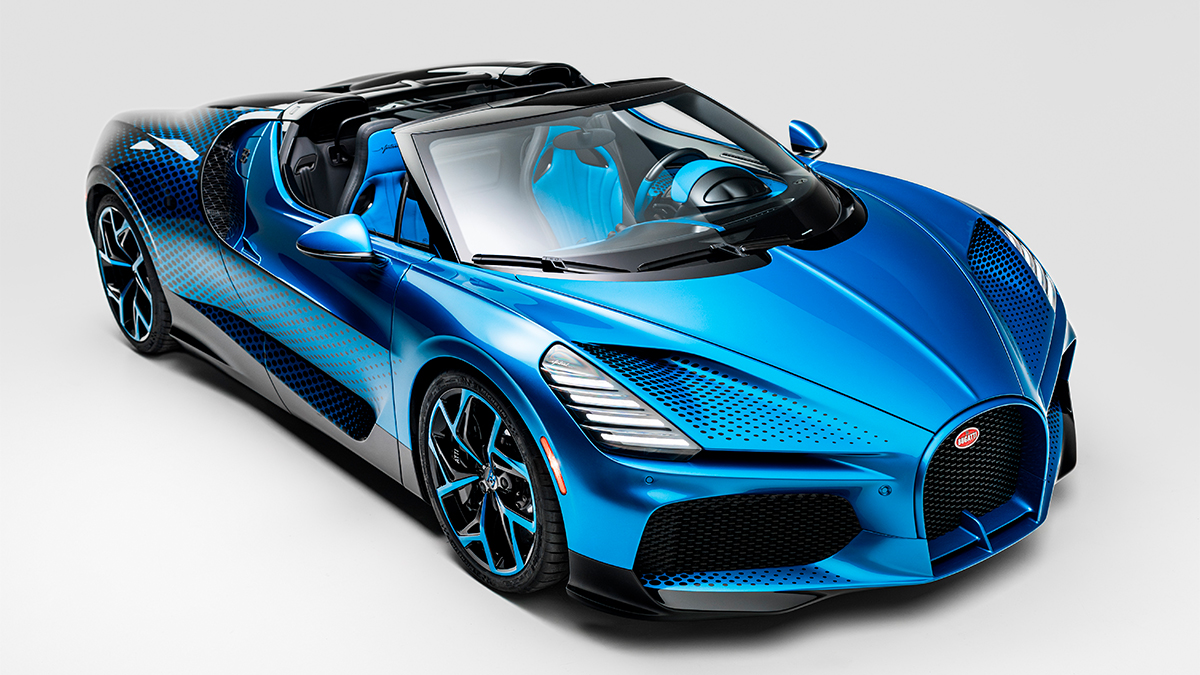
The most technically demanding detail was integrating the Bugatti Macaron — the iconic oval emblem from the horseshoe grille — into the painted ellipse graphic on the car’s flank. The owner requested it. The team had never done it before.
Reproducing the emblem’s fine ring of dots and precise lettering at the correct scale within a flowing graphic pattern took careful calibration. It is, Bugatti says, a first. Tucked into the gear selector is Rembrandt Bugatti’s “Dancing Elephant” sculpture, a nod to the founder’s brother and his legacy of animal art.
Frank Heyl, Bugatti’s head of design, called it “genuinely rare” — a collection of cars connected by a single creative vision built across multiple model generations. He credited the owner’s trust as the engine behind the project.
The previous cars in this collection reveal how the motif evolved. The Divo “Lady Bug” featured roughly 1,600 precisely arranged diamond shapes flowing across its surfaces. The Chiron “Hellbee” went bolder and more graphic. The Mistral’s ellipses feel like the most refined expression yet, organic rather than geometric, fitting for an insect built to hover and vanish.
From final design sign-off to finished car, the project consumed months. That’s not unusual for Sur Mesure commissions, but the layering of firsts — new paint, new material techniques, new emblem integration — compressed a lot of engineering risk into one vehicle.
Bugatti is now deep into the transition toward the Tourbillon, its hybrid successor to the Chiron line. The Mistral was always designed as the W-16 engine’s grand farewell in open-air form. That one of its 99 examples became a canvas for a dragonfly says something about where the brand sits right now — at the intersection of mechanical legacy and decorative excess, building monuments to an engine that won’t return. Whether that makes the “Fly Bug” art or artifact depends entirely on who’s writing the check.

Share this Story