
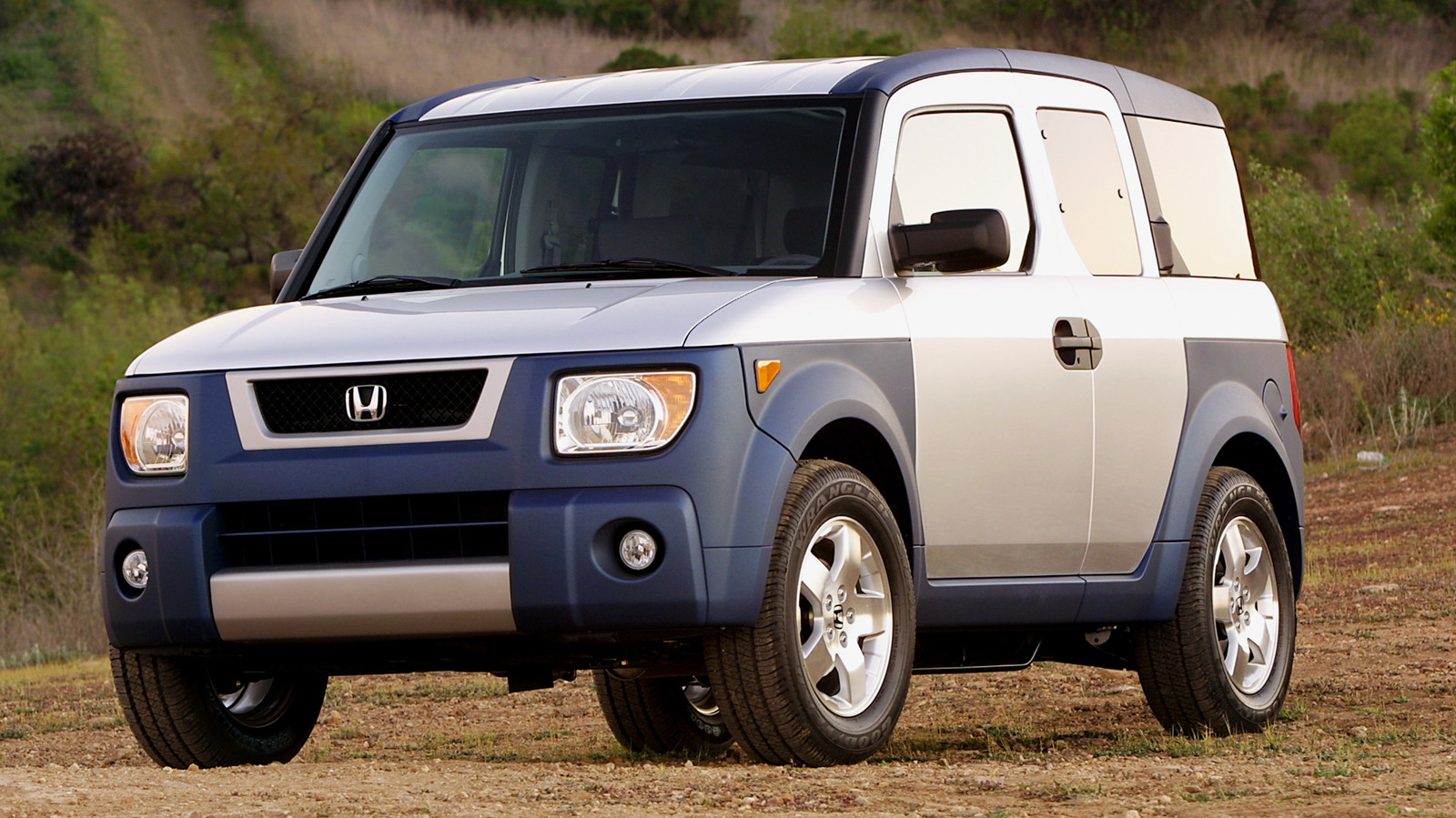


Honda is betting that 100,000 people a year will want a boxy hybrid crossover with a name that hasn’t been on a dealer lot since 2011. The automaker is reviving the Element, with production slated to begin in 2029 at its Ohio plant, built not just for North America but for global consumption. That’s a wildly ambitious target for a nameplate most buyers under 30 have never seen in a showroom.
The original Element launched in 2002 as a genuinely clever piece of packaging — a pillarless body with clamshell rear doors, fold-flat and flip-up rear seats, a washable floor, and a footprint that punched way above its weight in interior volume. It was also deeply weird-looking in an era that rewarded curves. Sales peaked early and faded fast, and Honda pulled the plug after 2011.
The market has rotated hard in the Element’s direction since then. Ford’s Bronco Sport sells on its squared-off shoulders. Toyota gave the RAV4 sharper creases. Even Honda’s own Pilot and Passport have gone boxy, and angular is no longer a liability — it’s the whole pitch.
Honda hasn’t revealed any details about the new Element’s design, features, or interior packaging. There’s no confirmation the clamshell doors, washable floors, or clever seat configurations will return. What we do know is the powertrain will be a hybrid, likely something derived from the Civic Hybrid’s 2.0-liter four-cylinder paired with two electric motors and a CVT.
The hybrid battery is the wildcard. The original Element’s flat, open cargo floor was central to its identity. A battery pack living underneath could compromise the very thing that made the first car special, and how Honda engineers around that problem will determine whether this is a revival or just a name on a generic crossover.
Pricing could be the real make-or-break. According to Sam Fiorani, vice president of AutoForecast Solutions, the new Element should slot between the HR-V and CR-V, suggesting a starting price around $26,000 to $28,000. Honda just learned the hard way with the Prelude that sticking a beloved name on a $40,000-plus vehicle doesn’t automatically move metal.
The Element has always been an everyman’s car — practical, affordable, unpretentious. Price it like a nostalgia play and it dies the same death the Prelude is courting.
Dealers, for their part, sound hungry. “If we ever get one on trade, which is rare anymore, those things sell instantly at huge values,” one retailer told Automotive News. Used Elements have become cult objects, commanding prices that would have been absurd when they were new. That kind of residual loyalty is gold for a marketing department, but it also raises expectations.
Three years is a long wait, and the crossover market will shift between now and 2029. Honda is placing a bet that the current appetite for boxy, utilitarian design isn’t a trend but a permanent correction. If they keep the price honest and the packaging clever, 100,000 units might be conservative.
If they gut the quirks that made the Element an Element, they’ll just have another small crossover with a famous name on it. Honda has enough of those already.
Share this Story