
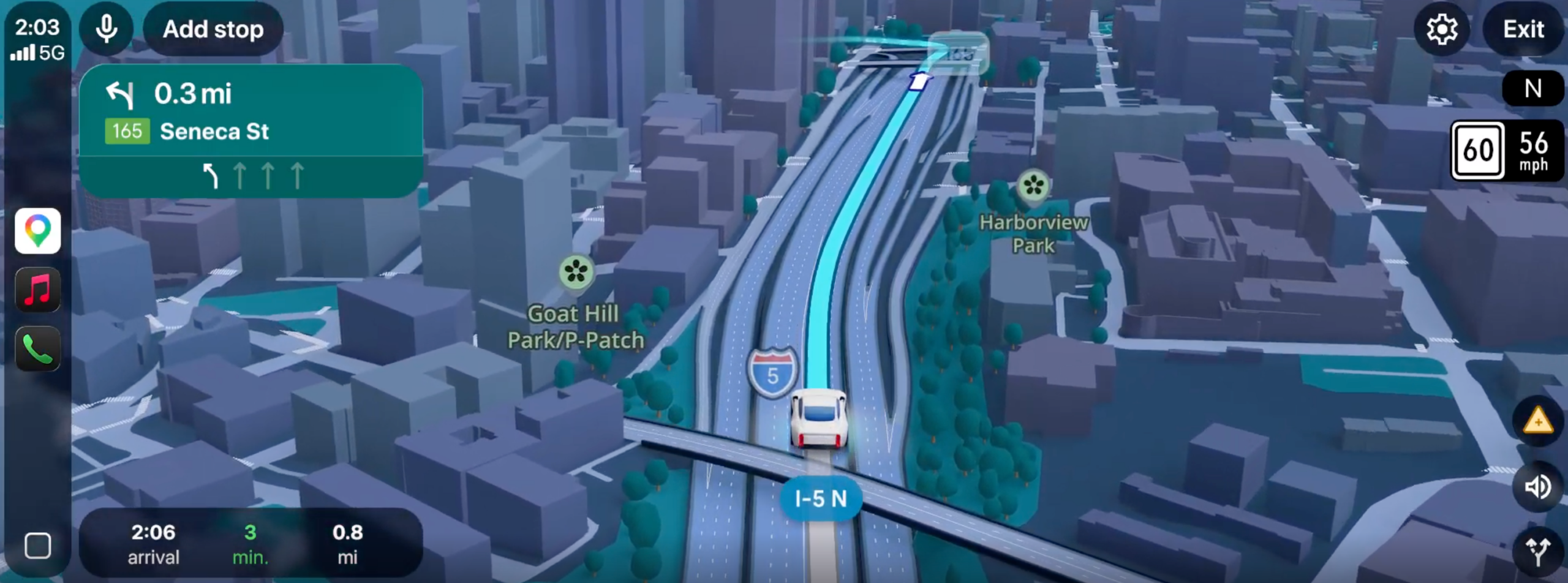


Google Maps on Thursday launched its most aggressive overhaul in a decade, replacing the familiar two-dimensional driving view with a fully rendered 3D environment and bolting on a Gemini AI chatbot that can answer free-form questions mid-trip. The company calls it Immersive Navigation, and it rolls out immediately across the U.S.
The flat, utilitarian map that has guided hundreds of millions of drivers since 2005 is gone. In its place, buildings have volume, overpasses cast shadows, and terrain rises and falls as you drive. Gemini models pull from Street View imagery and aerial photography to reconstruct the world around your car in real time, deciding what to render prominently and what to suppress so the screen doesn’t become a cluttered mess.
That’s the pitch, anyway. And on paper, the underlying engineering is genuinely impressive.
Google says every second, Maps processes more than five million traffic updates worldwide. Its community of drivers files more than 10 million incident reports daily. That firehose of data now feeds into the 3D view, surfacing real-time construction zones, crashes, and congestion overlaid on a landscape that actually looks like the road ahead.
The practical payoff targets the moments that trip up even experienced drivers: the quick-succession merge, the highway exit that appears 200 yards after the last one, the unmarked left turn in an unfamiliar city. Immersive Navigation introduces “smart zooms” that pull the camera back automatically to show what’s coming next, plus transparent building overlays so a skyscraper doesn’t obscure your upcoming turn.
Voice guidance has been rewritten to sound less robotic. Instead of barking “take exit 14B,” it now says, “Go past this exit and take the next one for Illinois 43 South.”
Alternate route suggestions get smarter, too. When Maps proposes a detour, it will now tell you why — less traffic but 12 more minutes, or a faster route with a $4.50 toll. That kind of trade-off transparency has been conspicuously absent from every major navigation app for years.
Then there’s Ask Maps, the feature that reveals where Google really wants to take this. Tap the button, type or speak a question — “Where can I charge my phone without a long line?” or “Any good vegan spots halfway between me and my friend in Midtown East?” — and Gemini responds conversationally. It pulls from 300 million indexed places and reviews from over 500 million contributors, personalizes results based on your history, books restaurant reservations, and drops pins directly into your route.
Ask Maps launches in the U.S. and India on Android and iOS, with desktop support coming soon. Immersive Navigation starts in the U.S. and will expand to CarPlay, Android Auto, and vehicles with Google built-in over the coming months.
The timing is no accident. Google has been on a Gemini integration blitz, injecting AI into Gmail and Chrome in recent weeks. Maps is the crown jewel — the product most intimately tied to real-world behavior and commercial intent.
Every restaurant recommendation is a potential ad placement. Every parking suggestion near a business is a data point. A chatbot that knows where you are, where you’re going, and what you like to eat is not just a navigation tool — it’s the most sophisticated local commerce engine ever built.
None of which diminishes the genuine utility here. Drivers who have white-knuckled through a tangled interchange in an unfamiliar city will welcome the 3D rendering and look-ahead zooms. The voice guidance improvements alone could prevent the kind of last-second lane dive that causes fender benders every day.
But Google isn’t doing this out of goodwill. The better Maps understands your world, the more precisely it can sell access to you. The 3D makeover is real, and so is the business model underneath it.

Share this Story