
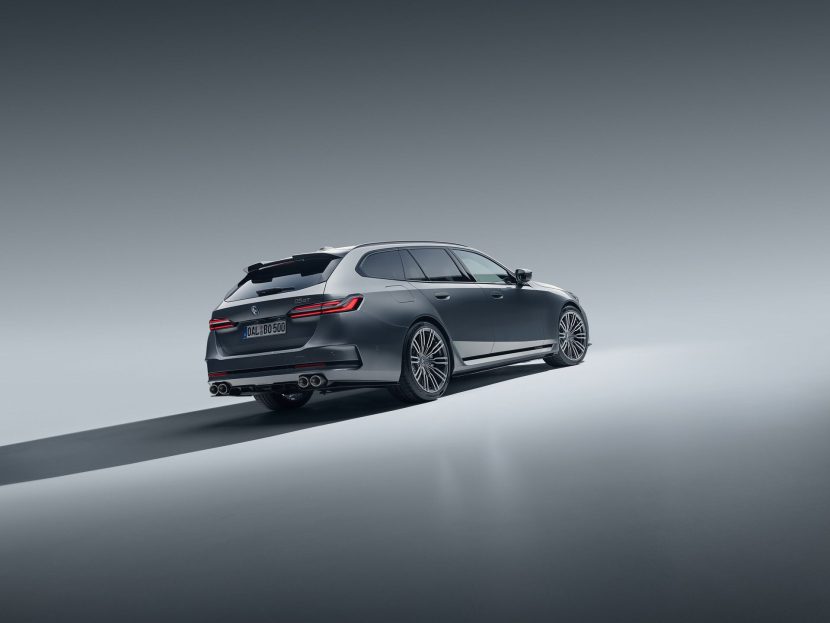


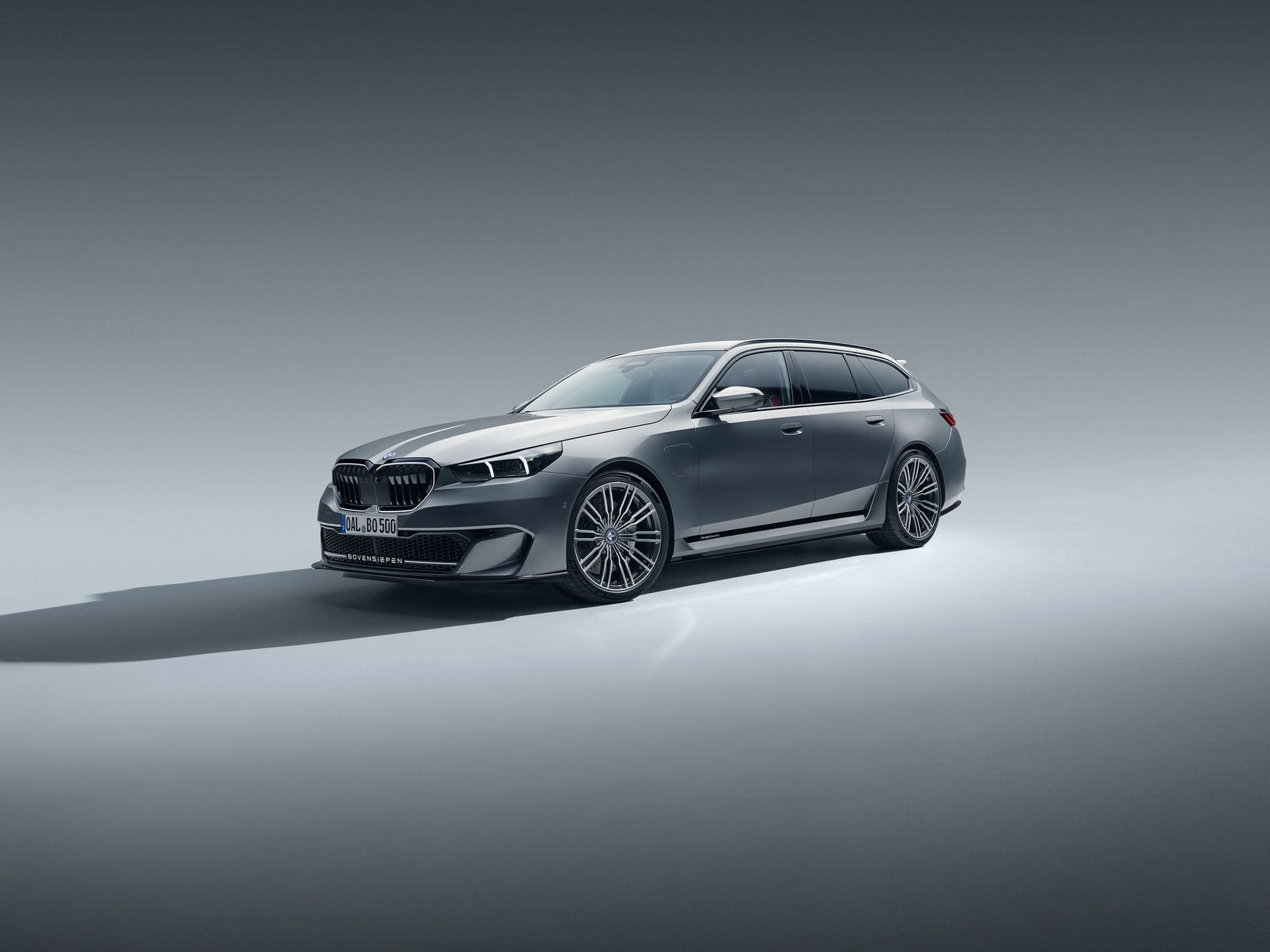
Burkhard Bovensiepen’s shop in Buchloe, Bavaria, barely had time to let the paint dry on its Zagato before pulling the sheet off car number two. The 05 GT is an 800-horsepower plug-in hybrid Gran Turismo built on the BMW M5 Touring, redesigned bumper to bumper by Frank Stephenson, and priced at €198,900 in Germany. First deliveries are slated for Q4 2026, with production capped at 200 units per year.
That price sits roughly €50,000 north of a standard M5. For the premium, Bovensiepen recalibrates the S68 4.4-liter twin-turbo V8 PHEV powertrain to produce 589 kW — 800 hp — and 1,100 Nm of torque. Top speed climbs to 305 km/h. The claimed 0-100 km/h time drops under 3.6 seconds, all while the car still tips the scales at 2,555 kg.
The power bump comes from revised intake funneling, a freer-flowing Akrapovič titanium exhaust that sheds 7.8 kg over stock, and engine software validated at both Papenburg and Nardò. The 800-hp figure is total system output — combustion engine plus electric motor — consistent with how BMW quotes PHEV numbers. Nobody is claiming hidden horsepower here.
Stephenson’s involvement is the headline grabber. The man behind the original BMW X5, the modern MINI Cooper, and the McLaren MP4-12C didn’t phone this one in from a studio. Bovensiepen says his team worked directly on the physical car at the Buchloe facility, reshaping the front end, rear, and sills with a continuous wraparound design line that ties the whole car together.
There is one tell, though: the rear doors are untouched M5 panels. BMW never widened the door skins on the G90, so the beefed-up front and rear bodywork doesn’t flow seamlessly through the B- and C-pillars. Bovensiepen has masked it cleverly, but on a car approaching two hundred grand, you notice the seams where coachbuilding meets platform reality.
The chassis gets Eibach springs, modified support bearings, and a strut tower brace. Twenty-spoke forged 21-inch wheels ride on bespoke Pirelli rubber stamped “BOV” on the sidewall. Brake calipers wear the Bovensiepen logo and can be color-matched to anything on the car.
Inside, every 05 GT gets a numbered production plate, a handcrafted Lavalina leather steering wheel, milled aluminum shift paddles, and leather trim around the cupholders and iDrive controller. Seatback panels can be painted any color at no charge. The base car is genuinely well-appointed.
The press photos show the full Lavalina interior — barrel-dyed cowhide suede sourced from farms in southern Germany, Austria, Switzerland, and northern Italy — and that package costs another €20,000. Alcantara trunk linings, embossed headrests, and custom embroidery are all on the menu.
Two hundred cars a year is the kind of volume where personalization isn’t a marketing gimmick. A small Bavarian workshop can hand-finish that many vehicles without cutting corners, which is the whole pitch Bovensiepen is making. There’s a market between a factory M5 and the seven-figure hypercars for people who want something genuinely handbuilt.
The real question is whether the market agrees. Coachbuilding is experiencing a quiet renaissance, with outfits like Niels van Roij, Touring Superleggera, and now Bovensiepen all betting that wealthy buyers want distinction over badge prestige. The 05 GT’s advantage is its starting point: the M5 Touring is already a deeply competent machine, and 800 hp in a long-roof body with all-wheel drive is a compelling formula.
At €198,900, Bovensiepen is asking customers to pay a 35 percent premium over the donor car for bodywork, leather, and an exhaust. Whether 200 people a year consider that a bargain or a stretch will tell us everything about where this segment is headed.


Share this Story