
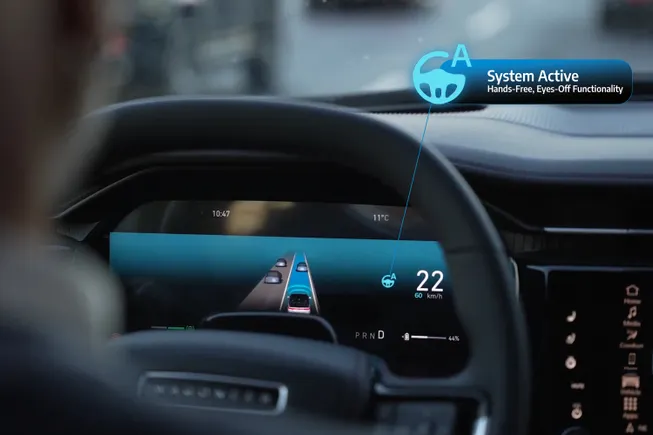


Stellantis just handed a significant piece of its autonomous driving roadmap to a company most consumers have never heard of. The automaker announced a strategic technology partnership with London-based Wayve to integrate the startup’s AI Driver software into its STLA AutoDrive platform, targeting a 2028 launch in North America.
That timeline matters. Three years out, with “early development” already underway, means Stellantis is playing catch-up in a segment where GM’s Cruise has stumbled, Tesla’s Full Self-Driving remains stuck at Level 2, and Waymo operates actual robotaxis in multiple cities. The target here is Level 2+ — supervised, hands-free driving on highways and in urban environments. Useful, but a long way from true autonomy.
Wayve closed a $1.2 billion Series D round in February with a who’s-who investor list: Stellantis, Mercedes-Benz, Nissan, Microsoft, Nvidia, and Uber. That kind of money buys credibility. It also reveals something uncomfortable — multiple competing automakers are now funding the same supplier for technology they once swore they’d build themselves.
Nissan tapped Wayve in April 2025 to help develop the next generation of its ProPilot system. Uber wants Wayve for self-driving vehicles on its ride-hailing platform, and Mercedes is in the mix too. Wayve’s pitch is universal compatibility — one AI software stack, many vehicle platforms. For a startup, that’s an enviable position. For the automakers writing the checks, it raises an obvious question: who actually owns the competitive advantage here?
Stellantis Chief Engineering and Technology Officer Ned Curic framed the deal as a natural extension of the company’s in-house STLA AutoDrive system, unveiled in February 2025. “Combining our STLA AutoDrive platform with Wayve’s groundbreaking AI-first approach creates a genuinely intuitive and enjoyable hands-free driving experience,” he said.
Wayve CEO Alex Kendall was more direct about ambition. “We’re accelerating our mission to bring autonomy to any vehicle, anywhere,” he said.
The language around the technology leans hard on the idea of “human-like driving behavior” that learns from real-world scenarios and improves continuously. Every AV company says something similar. The differentiator Wayve claims is its end-to-end approach — a single neural network processing raw sensor data into driving decisions, rather than the modular stacks most competitors use.
It’s an elegant concept. Whether it survives contact with Detroit winter roads and Atlanta rush hour is another matter entirely.
For Stellantis, the deal fits into a broader strategic reset. The company recently announced a $70 billion investment as part of a new five-year plan, alongside a global modular vehicle platform called STLA One designed to slash costs. But bolting on a third-party AI system, however sophisticated, is fundamentally different from the vertically integrated approach Tesla pursues or the purpose-built hardware Waymo deploys.
The partnership is structured to scale across additional Stellantis platforms and markets over time, with the promise of supporting higher levels of autonomy as the technology matures. That’s the standard language of an industry hedging its bets — commit enough to stay relevant, but not so much that a pivot becomes impossible.
Wayve is now embedded in the technology strategies of at least four major automakers and a dominant ride-hailing platform. If the software works as advertised, Wayve becomes one of the most important companies in the auto industry that doesn’t build a single car. If it doesn’t, Stellantis and its peers will have burned years and billions on someone else’s science project.
The 2028 date will arrive faster than anyone in Auburn Hills thinks.
Share this Story