
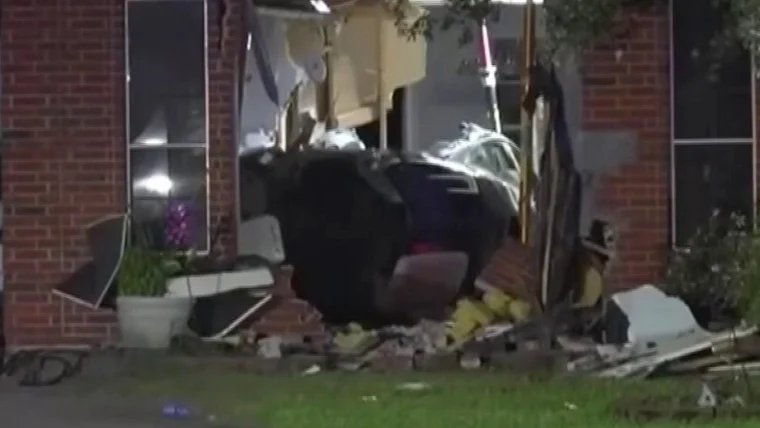


The 2025 Tesla Model 3 was doing over 70 in a 30 zone when it tore through a home in Katy, Texas, killing 76-year-old Martha Avila inside. The driver, 44-year-old Michael Butler, told authorities he had passed out at the wheel. The National Transportation Safety Board’s preliminary findings, released Wednesday, say otherwise.
Data pulled from the vehicle confirmed that Butler had engaged Full Self-Driving Supervised mode on a quiet residential street, then manually overrode the system by pressing the accelerator pedal to 100%. The weather was clear, the road was dry, and it was broad daylight. This was not a software failure. It was a foot on a pedal.
Security camera footage obtained by the NTSB showed the car accelerating through an intersection before leaving the road entirely. That footage directly contradicts Butler’s claim that he lost consciousness. Passing out does not typically involve flooring the accelerator on a residential street.
Then there is the phone. Police recovered Google searches on Butler’s device including “Tesla FSD not aggressive enough 2026” and “Tesla FSD too timid.” Those searches don’t prove intent, but they sketch a profile of a driver who was frustrated with the system’s conservative behavior and may have been trying to push past it.
Butler has been charged with manslaughter. Avila’s family has filed a lawsuit against both Butler and Tesla, alleging negligence.
The NTSB’s findings landed exactly where Tesla VP of AI Software Ashok Elluswamy had publicly pointed weeks earlier. In a post on X shortly after the crash, Elluswamy wrote that “the driver manually overrode self-driving by pressing the accelerator all the way to 100%.” At the time, that statement looked like corporate damage control. Now it looks like a factual summary confirmed by a federal agency.
This crash sits at a fault line that the industry has been dancing around for years. Every time a Tesla is involved in a fatal incident, the first question is whether the software failed. It is a reasonable question, but in this case, the answer is unambiguous: the human overrode the machine, and someone died because of it.
FSD Supervised mode is exactly what its name says. The driver is supposed to remain engaged and responsible. The system will brake, steer, and navigate, but it does not lock the driver out of the controls.
When a driver pushes the accelerator to the floor, the car responds. It is designed to. The alternative, a system that refuses driver input entirely, raises its own set of legal and engineering problems that no manufacturer has resolved.
The lawsuit against Tesla will test whether the company bears responsibility even when a driver deliberately overrides its software. That is a question for courts, not crash investigators. The NTSB data makes the plaintiff’s case harder to build on a theory of software defect.
What persists is a public perception problem that no data log can fix. Every fatal Tesla crash generates headlines that pair the brand name with the words “Autopilot” or “Full Self-Driving,” and those headlines travel faster than any preliminary report. Butler’s Google searches suggest he wanted the car to drive more aggressively. He got what he asked for, and Martha Avila paid for it.
The NTSB’s final report is expected later this year. The criminal case against Butler is pending in Harris County. Tesla has not commented beyond Elluswamy’s earlier post.
Share this Story