
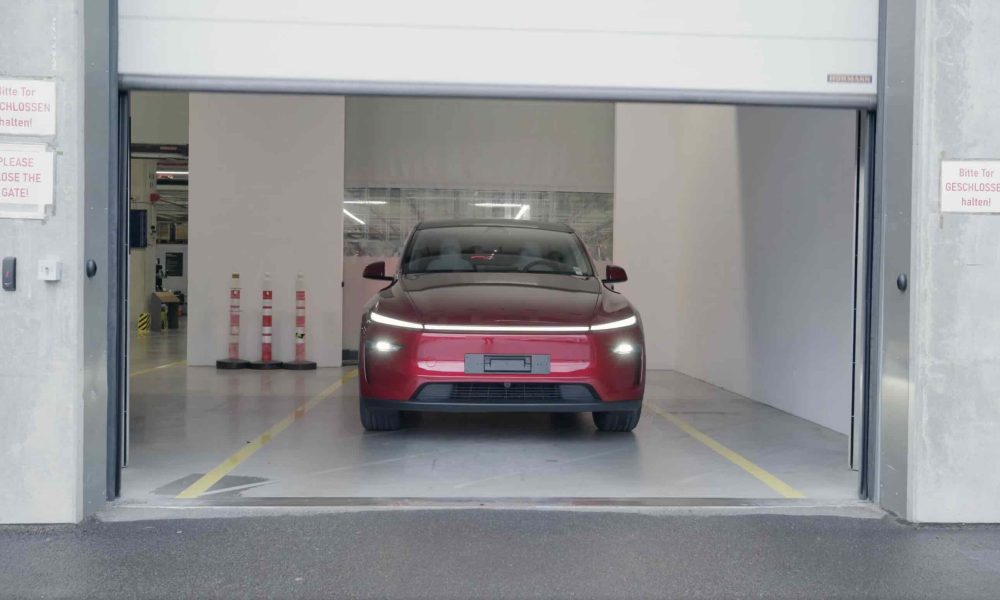


Every Model Y rolling off the line at Giga Berlin drives itself to the parking lot. No human behind the wheel. No regulatory permission required. Tesla has quietly accumulated 93,000 miles of autonomous driving inside its German factory campus, in a country where consumers still can’t activate Full Self-Driving on a single public road.
The milestone surfaced alongside news that Giga Berlin has now produced 750,000 Model Y vehicles. A short factory tour video showed a general assembly team member named Jan explaining the process: freshly built cars engage FSD, navigate marked internal pathways, and park themselves in the outbound staging area. Every trip is on private property, with no mixed traffic, no pedestrians darting between lanes, and no regulatory framework to satisfy.
It’s a clever end-run around Europe’s cautious stance on autonomous driving. Germany’s Federal Motor Transport Authority hasn’t approved unsupervised FSD for consumer use, and broader EU regulations remain years from catching up to Tesla’s software ambitions. But private property is private property.
The practical benefits are real. Workers who once spent hours shuttling finished vehicles from the end of the line to the lot are freed up for higher-value tasks. At a plant pushing high volumes, even shaving a few minutes per car compounds into serious labor and logistics savings.
Tesla gets its cars staged faster, and outbound lot management becomes more predictable. But the efficiency argument is almost secondary to what’s really happening here.
Tesla is harvesting zero-cost validation data in a perfectly controlled environment. Each autonomous run tests acceleration, steering precision, and obstacle avoidance under repeatable conditions. It’s not the chaos of a Berlin intersection, but it is real-world physics applied to brand-new hardware thousands of times over.
The 93,000-mile figure also serves as a quiet demonstration of system maturity. Moving thousands of freshly manufactured vehicles without a single publicized incident inside a busy factory, where forklifts, workers, and logistics equipment create their own hazards, says something about the robustness of Tesla’s vision-based neural network. It’s not highway driving in rain, but it’s not nothing either.
European regulators have been deliberate, some would say glacial, in their approach to autonomous vehicle approval. Germany permits Level 3 automation under narrow conditions on certain autobahn stretches for select manufacturers, but nothing close to the unsupervised urban autonomy Tesla sells in the United States. The gap between what Tesla’s software can do on a factory campus and what German drivers are allowed to experience on public roads grows wider with every Model Y that parks itself.
Tesla has done this before, turning constraints into content. The company’s ability to generate usable autonomy data from its own manufacturing operations means it doesn’t need regulatory green lights to keep refining the system. Every factory mile feeds the neural network, and every network improvement theoretically benefits the global fleet.
Whether 93,000 miles on flat, predictable factory lanes translates meaningfully to the complexity of European city driving is a fair question. Controlled environments are controlled for a reason. The cars aren’t dodging cyclists on Friedrichstrasse or navigating rain-slicked roundabouts in Munich.
Still, the optics are unmistakable. Tesla builds cars in Germany that can drive themselves. German customers just aren’t allowed to use that capability once they leave the lot.
The factory gates mark the boundary between what the technology can do and what the regulations permit. Right now, those two things aren’t even in the same conversation.
As Giga Berlin’s output continues climbing, the autonomous mileage will too. Tesla has turned its own production floor into a rolling proof of concept, generating data and headlines while regulators deliberate. It’s a factory workaround that doubles as a policy statement.


Share this Story